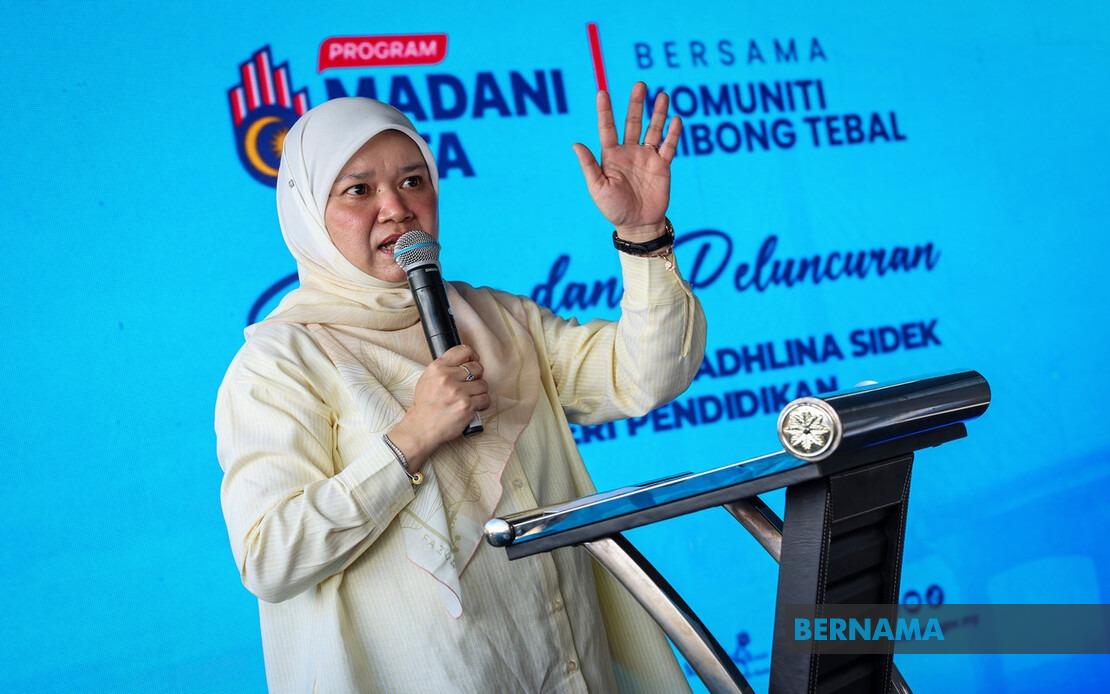
Education Minister Fadhlina Sidek has highlighted how the National Information Dissemination Centre (NADI) Mahir initiative is providing meaningful relief to Malaysian families struggling with the cost of school uniforms. The programme, which permits parents to pay for uniforms in instalments rather than as a lump sum, represents a practical response to the financial pressures many households face at the beginning of the academic year. Speaking during the MADANI Kita programme in Nibong Tebal on August 8, Sidek underscored the dual benefits of the scheme, which simultaneously addresses household budgeting constraints whilst creating sustainable income streams for small entrepreneurs.
The initiative's architecture reveals a thoughtful approach to economic empowerment. Rather than simply subsidising uniforms through government channels, NADI has trained 120 alumni through its Mahir Jahit sewing programme, who now operate as independent entrepreneurs producing school uniforms. These individuals underwent formal skills development through NADI's Pintar Services before establishing their own businesses, transforming them from job seekers into income-generating economic actors. This model reflects a broader Malaysian policy shift toward skills-based entrepreneurship, particularly among those lacking traditional tertiary qualifications.
For Fadhlina, who represents Nibong Tebal, the programme embodies the kind of community-focused intervention that demonstrates government responsiveness to constituents' needs. She stressed that the uniform instalment scheme complements NADI's broader suite of community programmes, each targeting different aspects of educational access and youth development. The convergence of these initiatives—spanning academic tutoring, digital skills, and entrepreneurship—suggests a holistic approach to reducing educational inequality across different demographic groups and regions.
The scale of NADI's educational outreach has expanded considerably. The NADI Tuisyen Rakyat tutoring programme has attracted over 42,000 students nationwide, with 73 participants from Nibong Tebal alone. Importantly, this programme is producing measurable academic results; 65 outstanding students connected to the initiative achieved strong results in the 2025 Sijil Pelajaran Malaysia examination. For Malaysian families, particularly those in lower-income brackets, access to additional tutoring has historically represented a significant financial barrier, making government-supported alternatives particularly valuable.
Beyond traditional academics, NADI has invested in developing youth capability through e-sports platforms. The NADI E-Sukan initiative serves a dual purpose: identifying young talent in competitive gaming whilst fostering soft skills including teamwork, strategic thinking, and confidence-building. Nibong Tebal's achievements in this arena—winning the national NADI E-Sukan MADANI Mobile Legends championship and achieving runner-up status at state level—suggest that the initiative is successfully engaging youth who might otherwise lack institutional recognition of their abilities.
The diversification of NADI's programming reflects recognition that educational engagement takes multiple forms. Beyond e-sports, the organisation has sponsored cooking competitions, where Nibong Tebal competitors achieved second place at state level. These varied platforms acknowledge that different young people develop confidence and capability through different outlets, whether competitive gaming, culinary arts, or academic tutoring. Such breadth increases the probability that youth from diverse backgrounds will find an entry point to meaningful engagement.
Particularly significant is NADI's recent turn toward artificial intelligence literacy. The 1 NADI 1 Prompt Engineer initiative, which has attracted 11 participants in Nibong Tebal, signals awareness that Malaysia must equip citizens with emerging digital competencies to remain competitive in future labour markets. As AI integration accelerates globally, programmes introducing citizens to prompt engineering—the practical skill of interacting effectively with AI systems—may prove crucial for workforce adaptability, particularly among youth in smaller cities and towns.
The cumulative impact of NADI's initiatives cannot be measured by any single programme's metrics alone. Rather, the ecosystem effect—whereby students benefit from tutoring support, parents experience reduced financial pressure through uniform instalments, youth discover talent through competitive platforms, and entrepreneurs develop sustainable incomes—creates compounding social value. This integrated approach contrasts with siloed government interventions that address discrete problems in isolation.
For Malaysian policymakers, NADI's model offers lessons about sustainable community development. By channelling programme benefits toward local entrepreneurs rather than purely subsidising consumption, the initiative creates multiplier effects within communities. The 120 sewing entrepreneurs serving the uniform market generate income that circulates within their local economies, supporting families and potentially funding further skill development. This contrasts sharply with one-time subsidies that provide temporary relief without structural economic change.
The programme's expansion also reflects demographic realities facing Malaysian education. As household sizes increase and school-age populations grow, the aggregate cost burden on families intensifies. A scheme enabling uniform payments over several months transforms a potentially impossible expense into a manageable one, potentially improving school attendance rates by removing this specific barrier to enrolment. Research from other contexts suggests that reducing such friction points can meaningfully improve educational outcomes, particularly among disadvantaged cohorts.
Looking forward, the challenge lies in scaling these initiatives to underserved regions whilst maintaining quality oversight. NADI's current footprint in Nibong Tebal—with measurable outcomes across tutoring, e-sports, and entrepreneurship—demonstrates proof of concept. However, ensuring similar programme density across Malaysia's more remote districts will require sustained resource commitment and local capacity-building. The involvement of the Ministry of Communications and the Malaysian Communications and Multimedia Commission suggests that digital infrastructure may facilitate broader reach, potentially enabling online tutoring or virtual competition platforms.
The institutional partnership evident in Nibong Tebal's MADANI Kita programme—bringing together education, communications, and multimedia authorities—hints at recognition that modern community development requires cross-sectoral coordination. As Malaysia navigates post-pandemic education recovery, addressing both academic deficits and youth engagement challenges simultaneously, such integrated approaches may become increasingly important for achieving equitable educational outcomes.

