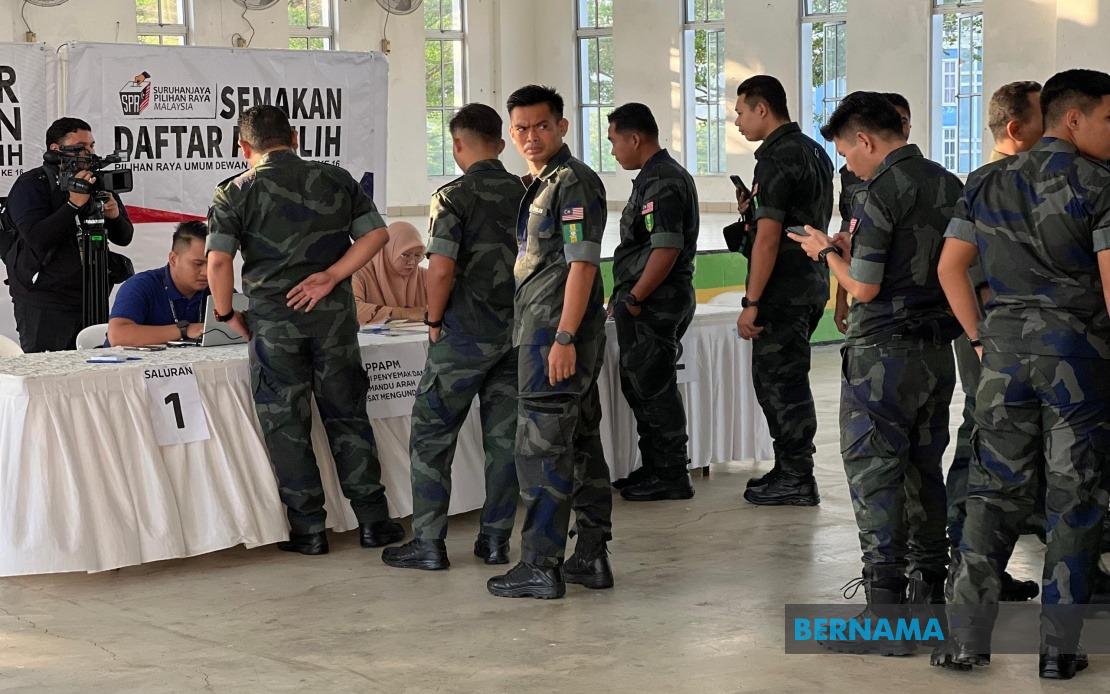
Voting got underway across Johor on July 7 as the state's security apparatus participated in a staggered electoral process ahead of the main election day. The Election Commission arranged 64 early voting centres to accommodate 24,751 personnel from the Malaysian Armed Forces, Royal Malaysia Police, and General Operations Force, along with their spouses, enabling these essential workers to discharge their civic duties before Saturday's broader polling exercise.
The logistical operation reflected careful planning by electoral authorities to ensure that frontline security personnel could participate without disrupting their operational readiness. The Malaysian Armed Forces contingent numbered 12,041 voters—comprising soldiers and their family members—who exercised their franchise across 11 designated polling locations. This arrangement allowed the military to maintain deployment schedules while enabling broad participation in the democratic process. Separately, the Royal Malaysia Police and General Operations Force mobilised their own personnel, with 12,710 members and spouses allocated across 53 polling centres throughout the state.
The early voting window, which commenced at 8 am, provided flexibility within the electoral calendar. Rather than closing at a single time, the 64 centres shut their doors in stages according to an Election Commission timetable that spanned the period from noon through 6 pm. This phased approach prevented congestion and allowed the electoral machinery to process voters efficiently while accommodating varying shift patterns and duty rosters across different security agencies.
Weather conditions across much of Johor favoured a smooth voting day. Field reports from several districts including Batu Pahat, Muar, Pontian, and Tangkak indicated predominantly sunny skies, which simplified logistics for election officials and voters navigating to polling stations. The absence of adverse weather meant that transport arrangements for security personnel and their families proceeded without significant hindrance.
The early voting exercise represented only a preliminary phase of a much larger electoral contest. Saturday's main election would transform the voting landscape dramatically, with approximately 2.7 million ordinary voters scheduled to cast ballots across 56 state seats. This considerably larger exercise would determine the composition of the Johor state assembly and, consequently, the direction of state governance for the coming term. The concentration of voters in Saturday's poll, coupled with the logistical demands of managing such a substantial electorate, underscored why electoral authorities staged the security personnel voting days in advance.
The 16th Johor state election represented a significant political moment for Malaysia's second-largest state by land area and a crucial component of the country's political landscape. The state has historically wielded considerable influence within the broader Malaysian political ecosystem, with outcomes in Johor often reverberating through national political calculations. The participation of security personnel in these early voting arrangements demonstrated the institutional commitment to ensuring universal suffrage while maintaining operational capacity across defence and law enforcement agencies.
Malaysia's electoral system routinely accommodates security force voting through advance polling mechanisms. This practice recognises the practical reality that personnel engaged in critical security and public safety functions may face deployment schedules or operational commitments that conflict with standard polling day arrangements. By enabling early participation, the Election Commission ensures that these voters—whose professions demand flexibility and availability—can fulfil their constitutional rights without compromising national security or public order.
The magnitude of Saturday's main election provided essential context for understanding the early voting operation. With 2.7 million voters participating across 56 constituencies, the election would represent a substantial democratic exercise demanding significant resources from the Election Commission. Managing queues, ensuring security at polling stations, preventing irregularities, and processing ballot counts all required meticulous coordination. The advance casting of votes by security personnel effectively distributed the voting load and reduced pressure on polling day infrastructure.
For Malaysian observers and regional analysts tracking the evolution of the country's federal system, Johor's electoral process carried particular significance. The state remains an economic powerhouse and a bellwether for broader political trends. The participation rates and voting patterns from both the early security force voting and Saturday's mass poll would provide valuable indicators of public sentiment and engagement levels. Such information often influences national political strategists as they calibrate policy positions and coalition calculations ahead of future federal contests.
The staggered approach to voting in Johor also reflected best practices in electoral administration that have developed across Southeast Asia and globally. By separating security personnel voting from the general poll, authorities minimised potential complications arising from large concentrations of uniformed personnel at polling stations during ordinary voting. This separation preserved the perception of electoral neutrality—a critical element of democratic legitimacy—while accommodating the genuine operational requirements of security agencies responsible for maintaining public order throughout the election period.

