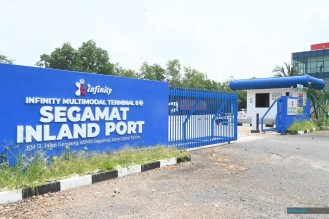
Segamat Inland Port (SIP) is pursuing an ambitious goal of handling more than 6,000 twenty-foot equivalent units (TEUs) of containers by the close of 2026, capitalising on its restart following dormancy spanning more than a decade. The facility, which resumed operations on 25 June under the stewardship of Infinity Logistics & Transport, has already handled roughly 1,000 TEUs during its initial month of operation through July, according to SIP manager Samuel Ho. This pace, if sustained, positions the facility well to exceed its year-end target and establish itself as a meaningful player in Malaysia's inland logistics ecosystem.
The reactivation of Segamat Inland Port carries strategic significance for the industrial heartland spanning northern Johor, southern Pahang, southern Negeri Sembilan and Melaka. These regions, which have long struggled with logistics inefficiencies due to distance from major coastal ports, now benefit from direct access to a dedicated inland transportation hub. Rather than relying exclusively on trucking networks to reach Port Klang, Port of Tanjung Pelepas, or Johor Port in Pasir Gudang, manufacturers and traders in these areas can now route cargo through rail infrastructure, fundamentally altering their supply chain calculus. This accessibility improvement particularly strengthens the competitive position of smaller industrial estates and manufacturing clusters that previously bore disproportionate transport costs.
The resurrection of SIP aligns with broader governmental strategy to buttress Malaysia's rail transport infrastructure as articulated through the Road to Rail initiative, a collaborative framework involving Keretapi Tanah Melayu Bhd. and various stakeholders across the logistics sector. Rather than pursuing growth solely through roadway expansion, policymakers increasingly recognise that rail-based cargo movement offers superior safety profiles, reduced congestion impacts, and enhanced environmental outcomes. Ho emphasised that freight movement via rail eliminates exposure to accident risks inherent in trucking operations whilst circumventing road congestion delays that plague major transport corridors during peak periods. The environmental mathematics prove equally compelling: one freight train journey substitutes for approximately 80 container trucks, substantially diminishing diesel consumption across regional supply chains.
Technical constraints plagued the facility's previous incarnation, ultimately explaining its decades-long underutilisation. When SIP originally commenced operations in 1997, single-track railway configurations forced operators to subordinate cargo scheduling to passenger train priorities, resulting in approximately one freight movement per week at maximum capacity. This constraint rendered rail-based logistics impractical for time-sensitive shipments, driving shippers toward trucking alternatives regardless of superior rail economics. However, the completion of double-tracking infrastructure extending to Johor has fundamentally transformed operational possibilities. The facility now accommodates up to four weekly cargo dispatch and receiving cycles, multiplying previous throughput capacity whilst introducing scheduling flexibility that mirrors commercial trucking responsiveness.
The doubling of cargo-handling frequency represents more than mere numerical improvement; it reconstitutes the competitive calculus between rail and road logistics. Manufacturers requiring weekly shipments now face viable alternatives to trucking-dependent arrangements, enabling them to capture substantial cost savings through consolidated rail movements whilst improving supply chain predictability. Ho articulated this transformation explicitly, positioning SIP as a catalyst for economic diversification across northern Johor districts including Batu Pahat and Kluang. The facility functions simultaneously as infrastructure investment and as a market signal to industrial investors that rail-accessible locations warrant serious consideration for warehouse, manufacturing, and distribution facility development. Such facilities traditionally gravitate toward coastal port proximity; inland rail access fundamentally expands the geographic options available to investors.
The immediate employment impact demonstrates measurable returns on the reactivation investment. SIP's first-phase operations, conducted across 20.23 hectares adjacent to Segamat Railway Station, have generated over 200 jobs for local residents. Upon completion of the envisioned three-phase development programme, employment numbers are anticipated to rise substantially. Beyond direct port operations, indirect employment opportunities emerge through logistics coordination, security provision, warehouse management, and related ancillary services. Ho's estimation that operations could eliminate approximately 18,000 monthly truck movements underscores the scale of economic activity repositioning from roads toward rail infrastructure, a transition that simultaneously reduces congestion pressures on critical highways whilst improving road safety metrics.
The knowledge-transfer dimension of SIP's operations extends its impact beyond immediate commercial logistics. Collaboration with Universiti Tun Hussein Onn Malaysia (UTHM) facilitates academic exposure to rail-based inland port operations through fieldwork opportunities and structured research initiatives. This partnership cultivates technical expertise within Malaysia's logistics workforce precisely as regional supply chains demand increasingly sophisticated inland transportation solutions. The relationship bridges academic institutions and commercial operators, ensuring that emerging professionals develop practical understanding of modern logistics infrastructure rather than relying solely on theoretical models. Such knowledge circulation strengthens sectoral capacity across Malaysian transportation and logistics.
Transport Minister Anthony Loke Siew Fook's official launch of SIP on 25 June positioned the facility within national infrastructure and economic development strategy. Loke characterised SIP as a catalyst for northern Johor's economic expansion whilst acknowledging its role in consolidating Malaysia's broader logistics network. His articulation emphasised employment generation potential alongside supply chain efficiency improvements, framing inland port development as comprehensive economic strategy rather than narrowly focused infrastructure projects. The minister's engagement signals sustained governmental commitment to rail transport prioritisation, suggesting that SIP's success will likely generate policy support and potentially catalyse similar inland port initiatives in other underserved regions.
The traffic-reduction projections merit scrutiny regarding their broader transportation policy implications. Reducing 18,000 monthly lorry movements translates to meaningful congestion relief on highways connecting southern Malaysia's industrial regions to coastal ports. Truck-free roads experience lower wear rates, extending pavement lifespan and reducing maintenance expenditure. Accident frequency typically correlates with traffic volume; the shift of 18,000 monthly movements to rail infrastructure produces measurable safety improvements across affected corridors. These aggregate benefits to road infrastructure, safety, and congestion extend beyond SIP's direct beneficiaries to encompass entire regional transportation systems. The facility essentially functions as capacity-enhancing infrastructure without requiring new highway construction, a particularly valuable outcome given Malaysia's ongoing infrastructure spending constraints.
Looking forward, SIP's 6,000 TEU year-end target remains achievable yet demanding, requiring consistent ramp-up in market adoption across its service region. Success depends on sustained shipper confidence in rail logistics reliability, competitive pricing relative to trucking alternatives, and consistent service quality from Infinity Logistics & Transport. The three-phase development programme suggests management confidence in scaling operations substantially beyond initial capacity parameters. If execution proceeds smoothly, SIP could establish itself as a model for inland port development applicable to other Malaysian regions lacking coastal port proximity. The facility represents a maturing recognition that Malaysia's logistics infrastructure requires diversification beyond port-centric models toward distributed inland hubs serving industrial clusters positioned remotely from coastal gateway cities. This architectural shift in supply chain infrastructure positioning carries implications extending well beyond Segamat itself.

