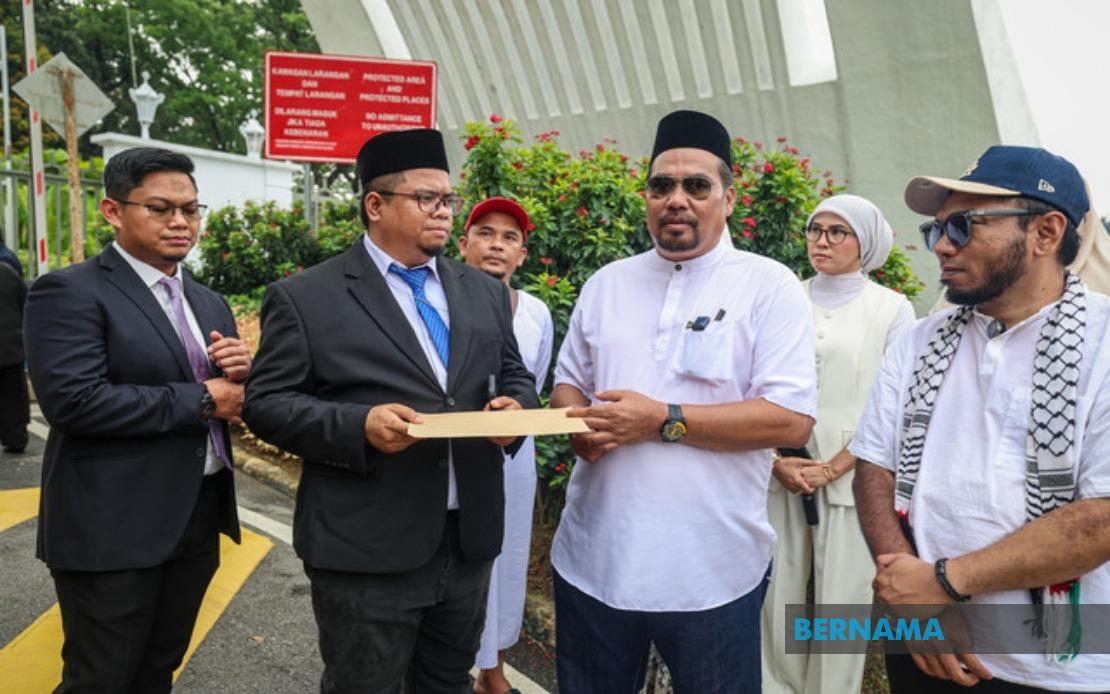
Social media activist group Sekretariat Gerak Gempur Media Sosial Rakyat Malaysia (SEKPUR) has escalated pressure on the government to pursue criminal charges and administrative action against officials implicated in mismanagement at Lembaga Tabung Haji, Malaysia's Islamic pilgrimage financing institution. The group delivered a formal memorandum at Parliament's main entrance on August 11, underscoring growing public demand for accountability following the publication of a damning Royal Commission of Inquiry report that exposed systemic governance failures spanning seven years.
SEKPUR secretary Mohd Yani Alias handed the memorandum to Zairudin Hashim, press secretary to the Minister in the Prime Minister's Department (Religious Affairs), at 12:35 pm, requesting its urgent transmission to Minister Senator Dr Zulkifli Hasan. The timing of the submission coincided with a special Dewan Rakyat sitting convened specifically to allow the minister to brief Parliament on the RCI findings and the institution's rehabilitation strategy. This choreography reflected broader legislative attention to what has become one of Malaysia's most significant institutional crises in recent memory, touching the financial welfare of millions of Muslim depositors nationwide.
The memorandum invoked the Yang di-Pertuan Agong's explicit directive that all individuals culpable for Tabung Haji's difficulties must face prosecution through available legal mechanisms. Mohd Yani emphasized that SEKPUR's position transcends partisan considerations, arguing that institutional integrity should supersede political affiliation or seniority. His statement carried particular weight given Malaysia's historical reluctance to prosecute high-ranking officials and the political sensitivities surrounding Tabung Haji, which serves as a crucial financial instrument for the Malay-Muslim majority and carries profound cultural and religious significance.
The 211-page RCI report, released publicly on July 29, documented extensive operational weaknesses and management lapses during the 2014-2020 period. These findings represent the culmination of an independent investigation into how the institution—responsible for managing billions in pilgrim savings—suffered mounting losses and liquidity challenges. The report's release marked a rare moment of transparency regarding a state-linked entity that had previously operated with limited public scrutiny, prompting civil society organisations like SEKPUR to mobilise around accountability demands.
Beyond criminal prosecution, SEKPUR's memorandum articulated concerns extending to Tabung Haji's structural viability and depositor treatment. The group specifically flagged the institution's capacity to distribute competitive hibah payments—the periodic distributions providing returns on savings accounts—a matter of acute concern for the approximately 9 million account holders who depend on these payouts to supplement their hajj savings. This issue resonates deeply in Malaysian society where hajj performance represents a religious obligation and lifelong aspiration for observant Muslims, often requiring years of disciplined saving through Tabung Haji facilities.
Rising hajj costs emerged as another focal point in SEKPUR's advocacy. The group contended that escalating expenses for performing the pilgrimage compound financial pressures on ordinary Malaysians, potentially pricing smaller wage-earners out of this fundamental Islamic obligation. By linking Tabung Haji's mismanagement to broader economic burdens on the Muslim community, SEKPUR positioned the institutional crisis not merely as a governance problem but as a socioeconomic issue affecting millions of ordinary families across the peninsula and Sabah and Sarawak.
Transparency in hajj quota administration formed another pillar of SEKPUR's memorandum. The allocation of limited hajj places available to Malaysian pilgrims annually has historically been opaque, with perceptions of nepotism or patronage undermining public confidence. SEKPUR's emphasis on quota transparency signals civil society's determination to prevent future malfeasance and institutionalise accountability mechanisms that would render the system more resilient to manipulation or favouritism.
The RCI's 25 recommendations for institutional reform have achieved seventy-five percent implementation rate as of July 30, according to official reporting. This partial compliance suggests that while Tabung Haji management has begun responding to the inquiry's prescriptions, fundamental questions regarding prosecutorial action and remedial compensation for depositors remain unresolved. SEKPUR's parliamentary intervention indicates impatience with incremental reform measures in the absence of demonstrable legal consequences for those deemed responsible.
For Malaysian policymakers, SEKPUR's mobilisation reflects broader erosion of public tolerance for institutional failures that affect the economically vulnerable. The group's explicit rejection of political considerations in accountability matters challenges the patronage networks that have historically insulated officials from legal jeopardy. In the Malaysian context, where religious institutions command special reverence and state-linked entities often enjoy implicit protection, SEKPUR's uncompromising stance represents a meaningful shift in civil society assertiveness.
The parliamentary sitting on the matter signals government acknowledgment of the issue's political salience and the necessity of public communication regarding remedial efforts. However, whether the legislative forum will translate into concrete prosecutorial action remains uncertain. The memorandum's delivery serves as both a formal petition and an implicit warning that Malaysian society increasingly expects institutional failures to trigger personal accountability for officials, regardless of their rank or political connections.
As Tabung Haji navigates restructuring and restoration of financial stability, the institution's credibility depends heavily on whether the government demonstrates willingness to pursue legal remedies against alleged wrongdoers. SEKPUR's intervention at Parliament's threshold crystallises this accountability imperative, establishing a civil society baseline expectation that will shape public assessment of government performance in managing the broader institutional recovery process.

