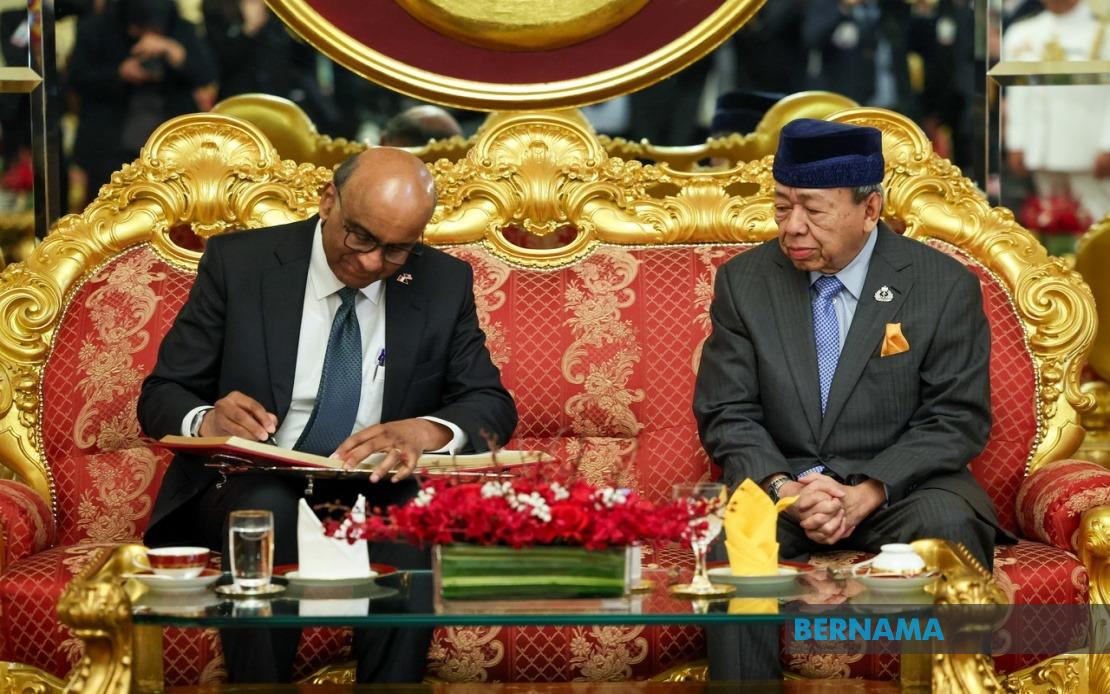
Singapore President Tharman Shanmugaratnam received a formal audience with the Sultan of Selangor, Sultan Sharafuddin Idris Shah, at Istana Alam Shah on July 14, marking a significant moment in bilateral diplomatic engagement between Malaysia and Singapore. The president arrived at the palace compound shortly before 11 am and was formally received by the Raja Muda of Selangor, Tengku Amir Shah, reflecting the ceremonial importance attached to the engagement. The encounter, which stretched to approximately ninety minutes, concluded at 12.40 pm as the Singapore delegation departed the royal residence.
The audience formed part of Tharman's wider three-day state visit spanning July 13 to 15, undertaken at the formal invitation of Yang di-Pertuan Agong Sultan Ibrahim. Malaysia's government delegation included Entrepreneur Development and Cooperatives Minister Steven Sim, who was designated as the minister-in-attendance specifically to oversee and coordinate the visit's proceedings. This ministerial presence underscored the institutional significance that the Malaysian government attributed to the state visit.
The timing and reciprocal nature of this diplomatic exchange merit particular attention within the context of Malaysia-Singapore relations. According to Malaysia's Foreign Ministry, the current visit represents a direct reciprocation of the King's state visit to Singapore conducted on May 6 and 7, 2024. Such mutual state visits between heads of state serve as foundational elements of diplomatic protocol and signal the priority both nations place on maintaining robust bilateral engagement at the highest levels of government.
The economic dimensions underlying this diplomatic exchange are substantial and merit consideration by Malaysian policymakers and business interests. Singapore stands as Malaysia's second-largest trading partner globally, a position that reflects decades of interconnected economic activity and integration across multiple sectors. Within the broader Association of Southeast Asian Nations framework, Singapore represents Malaysia's largest trading partner, underscoring the centrality of bilateral commerce to both economies and the broader regional trade architecture.
The state visit occurs at a moment when Malaysia and Singapore navigate an increasingly complex regional security and economic environment. Both nations share maritime boundaries, interconnected financial markets, and overlapping security interests in one of the world's most strategically significant shipping lanes. The maintenance of high-level diplomatic contact provides essential channels for addressing bilateral concerns, whether related to trade disputes, maritime demarcation, or broader regional security questions.
Selangor's role as the venue for this particular audience carries administrative significance, given that the state generates substantial portions of Malaysia's gross domestic product and hosts the nation's financial hub in Kuala Lumpur. The choice to conduct the audience at Istana Alam Shah rather than other royal residences reflects both the established protocol of state visits and the continued relevance of Selangor within Malaysia's political and economic landscape.
From a regional perspective, the visit occurs within a period of renewed diplomatic attention to ASEAN cohesion and bilateral relations among member states. Singapore, as a strategically positioned city-state with significant economic and geopolitical influence, maintains active engagement with all ASEAN members. Malaysia's reception of President Tharman demonstrates its commitment to preserving these multilateral frameworks while simultaneously strengthening bilateral relationships.
The formal nature of the audience, including the participation of the Raja Muda and senior ministerial representation, adheres to established diplomatic protocol but also signals substantive engagement rather than purely ceremonial interaction. The ninety-minute duration suggests substantive discussions occurred beyond the typical parameters of courtesy visits, though specific details of the discussions were not disclosed to media outlets.
Looking forward, the sustained pattern of high-level diplomatic exchanges between Malaysia and Singapore provides a framework for addressing ongoing bilateral issues whilst capitalizing on shared economic interests. The state visit mechanism, whilst formal and structured, remains an effective tool for reinforcing personal relationships among political leaders and ensuring continuity in bilateral engagement across different administrations and political transitions.
The engagement also reflects both nations' recognition that despite historical tensions and occasional disputes, their geographical proximity, economic interdependence, and shared regional interests necessitate the maintenance of functional and cordial diplomatic relations. For Malaysian observers and policymakers, such visits offer opportunities to recalibrate bilateral relationships and explore avenues for enhanced cooperation in areas ranging from trade and investment to security and cultural exchange.

