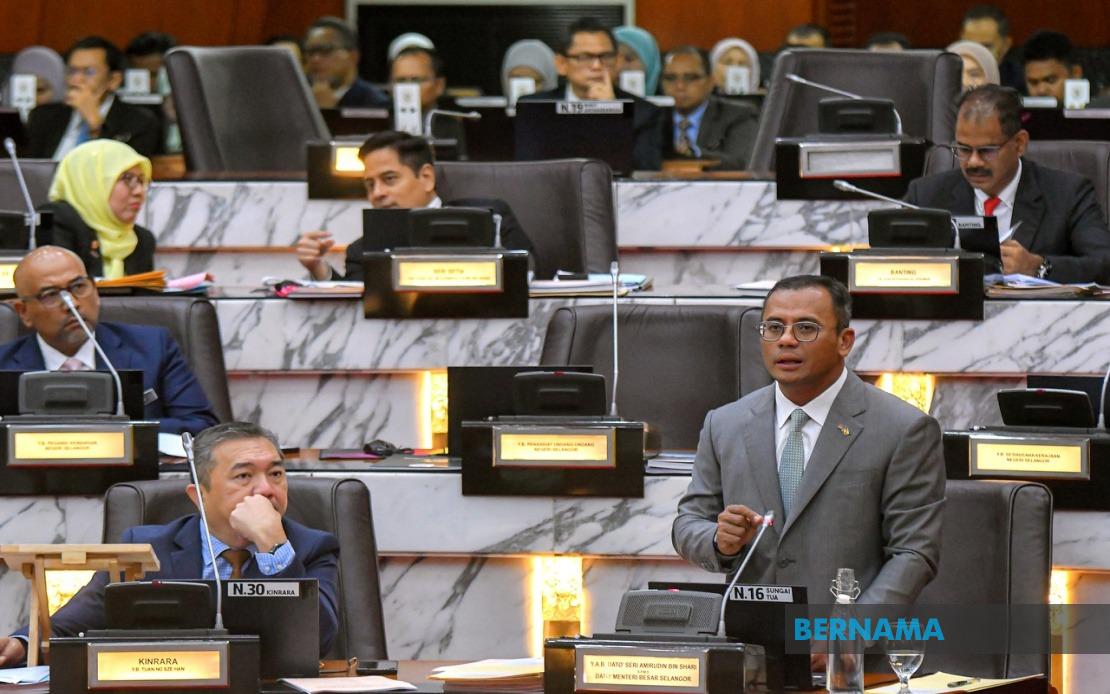
The Selangor government is moving to significantly expand financial support for university-bound students, with Menteri Besar Datuk Seri Amirudin Shari announcing plans to nearly double the number of HPIPT recipients from the current 3,000 to 5,000 in the 2027 Budget. The expansion reflects mounting pressure from families seeking assistance to pursue tertiary education in Malaysia's most economically dynamic state.
The decision comes in response to sustained demand that has far outstripped current capacity. Officials have recorded more than 5,000 applications for the scheme in both 2025 and the current year, indicating that the state's student population continues to grow faster than available support. Recognising this gap, Amirudin indicated that the state administration is evaluating whether fiscal constraints allow for recipients to reach a range between 5,000 and 6,000, suggesting officials may push further depending on revenue projections.
This announcement marks a recalibration of the HPIPT's reach within the state system. The programme had previously offered assistance to 5,000 recipients before being scaled back to its current 3,000 level, a reduction that likely reflected budgetary pressures or changing policy priorities. The move to restore and exceed that previous threshold signals confidence in Selangor's financial position and a renewed commitment to removing financial barriers for students from middle and lower-income families across the state.
The HPIPT itself provides RM1,000 in direct financial aid to Selangor students enrolled at recognised public and private universities, as well as those pursuing accredited Level 4 Skills Certificates, diplomas, and bachelor's degree programmes. The modest sum, while not covering full tuition costs, can meaningfully offset living expenses, accommodation fees, or textbook purchases that often prove decisive for students deciding whether to pursue higher education.
Beyond simply increasing recipient numbers, Amirudin flagged that the state government is simultaneously reviewing the application timeline to address a structural bottleneck. Currently, students must apply after receiving formal admission confirmation from their institution, a sequencing that leaves compressed windows for applications to be processed and approved. The Menteri Besar indicated the administration is examining ways to give applicants more realistic timeframes in which to submit documentation and complete vetting procedures.
Equally important is a proposal to bifurcate the application cycle, introducing twice-yearly intake periods rather than the current single annual window. Such staggered applications would accommodate the diverse timing of student admissions across Malaysia's higher education sector, where different institutions and programmes operate on differing academic calendars. Students enrolling mid-year or in non-standard intake periods would no longer miss the opportunity to apply for assistance.
These procedural reforms address a frustration common in Malaysian state-level scholarship and bursary schemes. Many students discover they are ineligible simply because their admission timing fell outside a brief application window, a technicality that disproportionately affects those attending private institutions or pursuing less conventional programmes. Allowing multiple application rounds removes such arbitrary barriers while requiring only modest administrative adjustment.
The expansion has clear implications for Selangor's positioning as an educational hub within Southeast Asia. The state already hosts dozens of private universities and colleges, alongside major public institutions, making it a magnet for students from across Malaysia and the region. Enhanced financial support can strengthen Selangor's attractiveness as an educational destination and reduce reliance on private borrowing or family remittances, particularly benefiting first-generation university attendees.
Politically, the initiative reflects responsiveness to constituent demands raised in the State Legislative Assembly. The announcement came in direct response to questioning by assemblywoman Datuk Noorazley Yahya of Bukit Melawati, demonstrating how state-level scrutiny can translate into tangible policy shifts. Such engagement may prove especially significant in marginal constituencies where education-related concerns weigh heavily on voters.
The broader context involves Malaysia's persistent skills gap and employers' complaints about graduate readiness. By reducing financial barriers to tertiary education, Selangor can theoretically broaden the pool of degree-holders entering the workforce, though outcomes will ultimately depend on the quality of programmes these students pursue. The incentive alone cannot address questions of curriculum relevance or teaching standards that universities must tackle independently.
Implementing the expanded scheme will require careful budgeting and potential reallocation of existing education vote allocations. Amirudin's cautious phrasing—noting the assessment is ongoing and contingent on revenue position—suggests the expansion, while likely to proceed, remains subject to fiscal reality. A downturn in Selangor's tax collections or unexpected expenditure pressures could complicate implementation.
Regionally, Selangor's move joins broader Malaysian efforts to expand tertiary education access as enrollment targets increase. Other states and the federal government have launched or expanded similar schemes, creating a competitive dynamic where states vie to offer more generous support. Selangor, as Malaysia's most populous state outside the Federal Territories, occupies a unique position to set benchmarks that others may follow or feel pressured to match.

