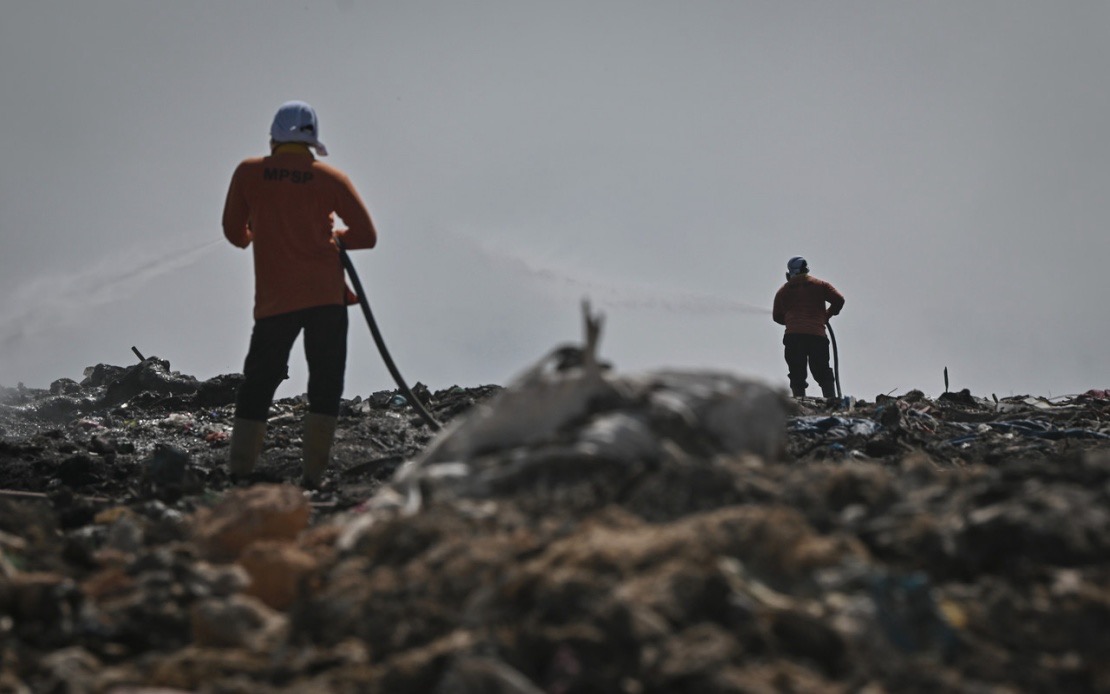
The Selangor state government has unveiled an ambitious plan to repurpose the long-abandoned Teluk Kapas landfill site in Pasir Panjang, Klang, transforming it from an environmental liability into a productive green asset within the broader Selangor Maritime Gateway development corridor. The initiative, formalised through a memorandum of understanding signed between KDEB Waste Management and Landasan Lumayan Sdn Bhd, represents a shift toward extracting value from defunct waste disposal facilities rather than simply abandoning them to environmental decay and public health concerns.
The 80-acre site, which shuttered operations in 2007 after more than a decade of accepting municipal waste, contains an estimated one million tonnes of solid waste compacted to depths of 15 metres. Datuk Izham Hashim, chairman of the Selangor State Infrastructure and Agriculture Committee, acknowledged that conventional remediation approaches would prove prohibitively expensive, with conventional solid waste removal alone estimated to cost approximately RM200 million. This financial barrier has effectively mothballed the site despite its strategic location within a high-value development zone, creating both an environmental and opportunity cost for the state.
The partnership between KDEBWM, led by managing director Datuk Ramli Mohd Tahir, and LLSB, headed by Syaiful Azmen Nordin, hinges on deploying alternative rehabilitation methodologies grounded in circular economy principles. Rather than excavating and disposing of accumulated waste at enormous expense, the collaboration will employ biological, mechanical, and material recovery techniques to extract value from the landfill's contents. This approach reflects growing recognition across Southeast Asia that waste management philosophy must evolve beyond mere disposal toward resource optimisation, particularly as landfill capacity constraints tighten and environmental regulations intensify.
A critical environmental concern driving the rehabilitation effort is leachate pollution—the toxic liquid generated as rainwater percolates through decomposing waste—which continues to contaminate nearby waterways and groundwater. The Klang Royal City Council, the landfill's owner, has long struggled to manage this legacy issue without comprehensive remediation. The new project explicitly targets leachate treatment and water quality restoration as primary objectives, addressing both immediate environmental threats and long-term environmental health in the Klang region, where industrial and residential development increasingly constrains available water resources.
The rehabilitation roadmap incorporates several engineering challenges beyond waste and leachate management. The accumulated mass of compacted waste creates long-term settlement issues and slope stability concerns that could compromise any permanent structures built atop the site. The partnership therefore plans to stabilise slopes, address settlement patterns, and establish proper drainage and containment systems before transitioning the land to productive uses. This phased approach reflects best practices in landfill reclamation seen internationally, where structural integrity must precede commercial development.
Recycling and resource recovery form the commercial backbone of the project. Feasibility studies indicate that employing advanced sorting and processing technologies could achieve recovery rates of 70 to 80 percent for recyclable materials embedded within the historical waste deposits. Metals, inert construction debris, and other recoverable materials represent genuine economic value that can offset remediation costs while reducing the actual volume of waste requiring long-term management. For Malaysia, where recycling rates lag behind regional and global benchmarks, this model demonstrates how legacy waste sites could become secondary material sources supporting the circular economy transition.
Financial sustainability underpins the entire initiative. Unlike conventional remediation projects dependent on continuous government subsidy, the Teluk Kapas rehabilitation is structured to achieve commercial viability through material recovery revenues, leachate treatment cost reductions, and eventual land value appreciation. This self-sustaining financial model is crucial for scalability across Selangor, which contains multiple former landfills requiring rehabilitation. Izham indicated that successful completion of this pilot project would provide the template and proof-of-concept for applying similar methods to other closed disposal sites throughout the state.
The redevelopment sits within the Selangor Maritime Gateway framework, a broader infrastructure initiative designed to position Klang as a modern logistics and commerce hub. Transforming the Teluk Kapas site from a degraded waste dump into a functioning resource recovery centre and potentially mixed-use development aligns with the SMG's ambitions to create high-value urban assets. This integration suggests that the site's future may extend beyond environmental remediation to encompass commercial facilities, green industry operations, or recreational spaces—outcomes that would require successful environmental restoration but create broader community benefits.
For Malaysia's waste management and environmental policy landscape, this project carries broader implications. Selangor's approach challenges the traditional linear disposal model—extract resources, manufacture products, dispose of waste—and instead demonstrates commitment to circular economy principles at the state governance level. As urbanisation accelerates and waste streams expand, the capacity to reclaim and repurpose closed landfills could substantially defer the need for new disposal sites, a pressing concern in densely settled regions where available land is scarce and community opposition to new landfills remains fierce.
The initiative also reflects evolving international standards for landfill remediation and the recognition that environmental justice demands addressing legacy pollution in historically waste-burdened communities. Klang, a working-class industrial municipality, has historically absorbed disproportionate environmental burdens from regional waste disposal. Investing in genuine rehabilitation—not merely containment—of the Teluk Kapas site signals a commitment to environmental equity and long-term community welfare. Datuk Ng Suee Lim, chairman of KDEBWM and State Local Government and Tourism Committee, witnessed the MoU signing, underscoring official endorsement and integration with local government operations.

