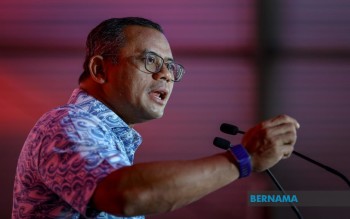
Selangor has reinforced its position as Malaysia's dominant economic engine, with its gross domestic product climbing RM28 billion to reach RM460.1 billion in 2025, according to data released by the Department of Statistics Malaysia. The achievement underscores the state's outsized role in driving national prosperity, with Menteri Besar Datuk Seri Amirudin Shari highlighting that the growth alone exceeded the combined economic expansion of every other state in the country, a testament to Selangor's economic gravitational pull within the federation.
The expansion has lifted Selangor's share of Malaysia's GDP from 26.2 per cent to 26.5 per cent, a shift that reflects not merely incremental progress but a meaningful deepening of the state's integration within the broader economy. To contextualise the scale, Selangor's economy now operates at a scale surpassing Kuala Lumpur's by 1.7 times and Johor's by 2.7 times, placing the state in a category of its own when measuring provincial economic contributions. This concentration of economic activity in a single state raises important questions about regional inequality and the sustainability of development patterns across the Malaysian federation.
The 6.3 per cent growth rate that Selangor achieved in 2025 also exceeded Malaysia's overall expansion rate of 5.2 per cent, demonstrating that the state's economy is not merely large but also performing at a pace that outstrips the national trajectory. This divergence suggests that Selangor's structural advantages—its proximity to Kuala Lumpur, established infrastructure, accumulated human capital, and business ecosystems—continue to compound, allowing the state to attract and retain economic activity at rates that other regions struggle to match.
Three sectors drove this expansion, with the services industry contributing RM15.9 billion of new economic value, followed by manufacturing at RM5.3 billion and construction at RM3.7 billion. The heavy weighting toward services reflects Selangor's evolution into a post-industrial economy, where financial services, professional services, retail, and hospitality now form the backbone of economic activity. Manufacturing's continued significance, meanwhile, reflects the state's enduring importance as a hub for industrial production, particularly in electronics and petrochemicals.
Selangor's dominance across these sectors is striking. The state now accounts for 35.9 per cent of Malaysia's entire construction activity, up from historical norms, suggesting that major infrastructure projects and real estate development are increasingly concentrated within the state's boundaries. Similarly, Selangor's share of the national manufacturing sector has climbed to 32.8 per cent, while its contribution to services now stands at 27.1 per cent. These figures illustrate how economic activity has become geographically concentrated, with Selangor emerging as the primary locus of development across multiple industries simultaneously.
The Menteri Besar attributed much of this success to the First Selangor Plan, a five-year socioeconomic development strategy covering 2021 to 2025 designed to guide the state's economic restructuring. Over the plan's duration, Selangor's economy expanded by 33.94 per cent in cumulative terms, an addition of RM116.6 billion in economic output that lifted the state from RM343.5 billion to its current RM460.1 billion trajectory. This growth rate significantly exceeds Malaysia's overall economic expansion during the period, indicating that state-level policy interventions and strategic investments have yielded measurable results that distinguish Selangor's performance from the national average.
The economic expansion has cleared a symbolic threshold that carries significance for regional positioning. Selangor became the first Malaysian state to surpass the RM400 billion GDP mark in 2023, and maintaining this momentum through 2025 demonstrates consistency rather than a one-off achievement. For investors and analysts tracking Malaysia's economic geography, Selangor's sustained performance signals that the state remains the safest bet for capital deployment and business expansion, potentially perpetuating the concentration trends that already define the national economy.
Looking forward, Amirudin has set an ambitious target of making Selangor the first Malaysian state to achieve a RM500 billion economy, a goal that would require sustained growth and continued structural transformation. The target is neither unrealistic nor guaranteed; it depends on maintaining sectoral momentum while managing emerging challenges such as skills shortages, infrastructure bottlenecks, and rising operational costs that increasingly constrain growth in high-performing jurisdictions. Achieving this milestone would widen Selangor's economic lead over other states, potentially amplifying regional disparities unless complementary growth strategies are implemented elsewhere in Malaysia.
The state leadership has acknowledged that economic expansion alone does not guarantee improvements in living standards, pledging to focus on translating GDP growth into tangible improvements in the quality of life for ordinary residents. This recognition is crucial, as rapid economic growth in concentrated urban areas often produces uneven benefits, with gains captured by capital owners and skilled workers while lower-income households face rising costs of living, housing unaffordability, and congestion externalities. The challenge facing Selangor's administration is ensuring that the next phase of economic development delivers broadly distributed prosperity rather than exacerbating inequality.
For Malaysia's broader economic policy framework, Selangor's dominant performance raises structural questions about regional development strategy. With a single state now contributing over one-quarter of national GDP and operating at growth rates that outpace the average, Malaysia's economic health has become increasingly dependent on Selangor's continued success. This concentration creates both opportunities and risks: opportunities to leverage Selangor's strength to drive national competitiveness, but risks if the state experiences economic shocks or loses competitive advantages. Policymakers must weigh whether existing development patterns are sustainable or whether deliberate efforts to diversify economic growth across other regions become necessary for long-term stability.

