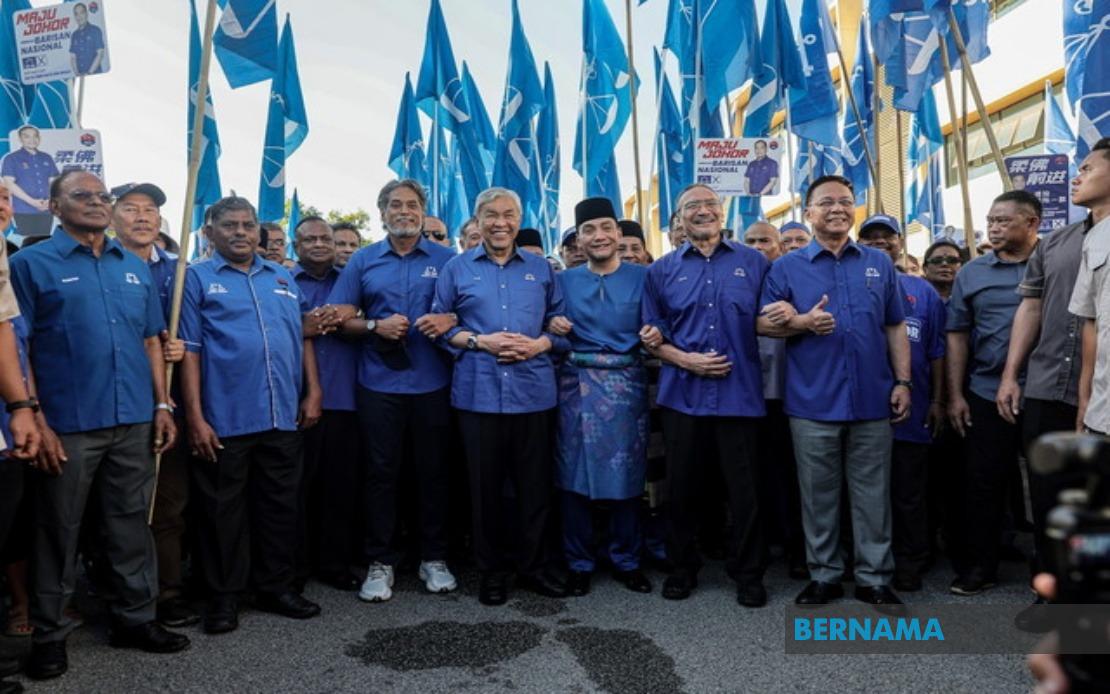
The political machinery of UMNO swung into action on June 27 as Johor Barisan Nasional chairman Datuk Onn Hafiz Ghazi formally entered the race for the state election by submitting his nomination papers at the Muafakat Hall in Simpang Renggam. The move underscored the party's determination to retain control of the southern state following a period of political turbulence that has tested the stability of Malaysia's most developed economy outside the federal territories.
Onn Hafiz, the incumbent Machap assemblyman seeking another term, arrived at the nomination centre at 9.10 am accompanied by a delegation of heavyweight UMNO figures whose presence signalled the party's unified backing. The choice to have UMNO president Datuk Seri Dr Ahmad Zahid Hamidi appear alongside the state coalition leader reflected both the centrality of the Johor contest to national party dynamics and the party's effort to project a cohesive leadership structure despite recent factional tensions within its ranks.
The support extended beyond Ahmad Zahid. Sembrong MP Datuk Seri Hishammuddin Tun Hussein, a veteran figure with deep roots in Johor politics and significant influence within UMNO's decision-making circles, also made the journey to Simpang Renggam to witness the nomination. His presence carried particular weight given his role in maintaining party discipline and his previous ministerial experience at the federal level. Such high-profile attendance demonstrated that the BN campaign would not be a localised affair but rather a coordinated effort drawing on the party's national apparatus and most recognisable figures.
Khairy Jamaluddin, the former minister and influential UMNO politician known for his engagement with younger voters and contemporary political discourse, completed the trio of senior leaders present. His attendance reflected UMNO's intention to bridge traditional and modern constituencies within the Johor electorate. The inclusion of personalities with different generational appeal and political styles suggested a calculated approach to broadening the coalition's electoral base beyond its core demographic strongholds.
Former Johor Menteri Besar Datuk Seri Hasni Mohammad also lent his weight to the occasion, lending historical continuity to the campaign narrative. Hasni's participation provided a symbolic connection to previous BN governance in the state, an implicit reminder of the coalition's track record in delivering development and administrative stability. This layering of support, spanning current officeholders and elder statesmen, created a visual representation of party unity that party strategists hoped would resonate with voters seeking stability and experienced governance.
The nomination centre itself became a focal point of political activism as supporters congregated in the surrounding areas. Dressed in the colour schemes of their respective parties, carrying banners and waving flags, these supporters transformed the everyday administrative process into a visible demonstration of grassroots mobilisation. The scene captured the energy that Johor elections generate, reflecting the state's significance as a bellwether for national political trends and as a crucial revenue generator for the federal government through its commercial and industrial activities.
The Johor state election represents far more than a routine renewal of the state assembly. The coalition's performance here carries implications for the broader political landscape ahead of the next federal election, influencing perceptions of UMNO's electoral viability and the credibility of the BN as a governing force. A strong showing would validate the coalition's positioning and provide momentum for federal-level politics, while any setback could embolden opposition parties and complicate UMNO's internal dynamics.
For Malaysian observers following regional political developments, the Johor contest exemplifies how state-level elections function as crucial testing grounds within Malaysia's federal system. Unlike some federal democracies where state elections operate somewhat independently, Malaysia's state contests are intimately connected to national party structures and electoral arithmetic. Victories and defeats in state assemblies reverberate through the complex interplay of coalition management and party positioning that characterises the country's competitive political environment.
The prominence given to federal-level UMNO figures in supporting Onn Hafiz's nomination reflects calculations about the evolving political economy of Malaysian elections. Voter expectations have shifted in recent years, with constituencies demanding tangible evidence of administrative capacity and evidence of resource allocation. The presence of ministers and senior leaders served as implicit assurance that a Johor BN government would enjoy access to federal resources and influence over policy implementation affecting the state's crucial economic sectors.
As the 16th Johor state election unfolds, the composition of the support delegation accompanying Onn Hafiz offers insight into current party leadership priorities and internal alliance-building. The careful orchestration of who appeared at Simpang Renggam, and the sequencing of their arrival and remarks, follows conventions of party theatre carefully calibrated to communicate messages about hierarchy, unity, and commitment to various stakeholder groups within the broader BN coalition and its electoral constituency.

