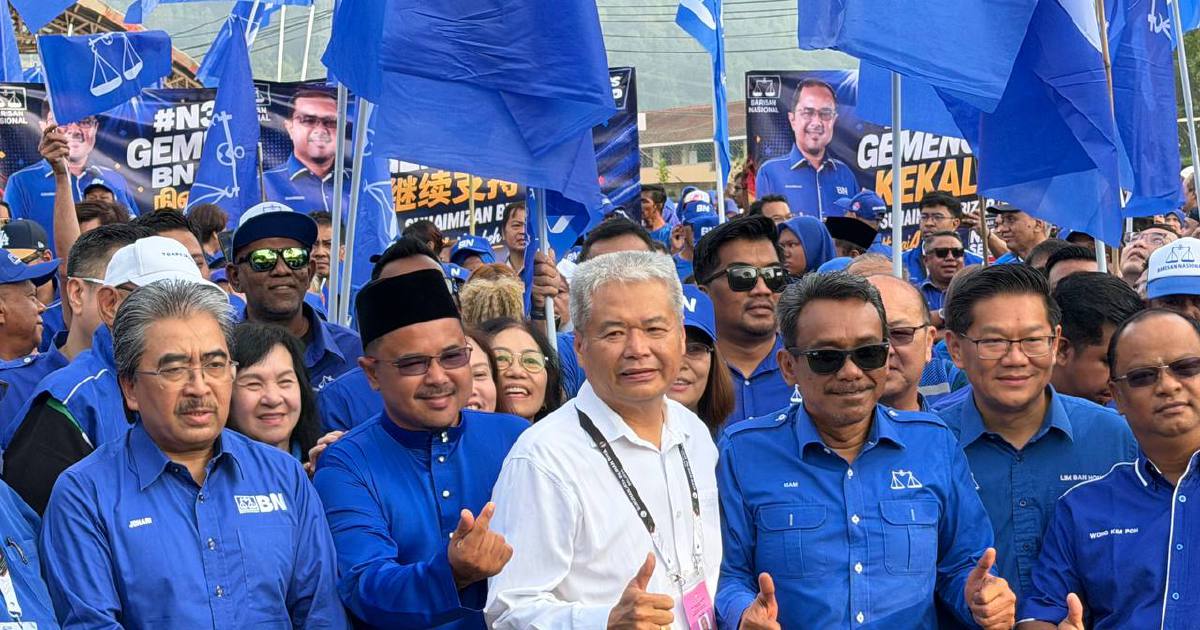
Umno's top leadership moved to energise its campaign machinery in Negri Sembilan on Tuesday when vice-president Datuk Seri Johari Abdul Ghani and party treasurer Datuk Seri Tengku Adnan Tengku Mansor descended upon the Dewan Perdana Tampin to rally behind Barisan Nasional contenders vying for state assembly seats. Their synchronized appearance underscored the coalition's determination to make significant inroads in a state where political fortunes have shifted considerably over recent election cycles.
The presence of such high-ranking party officials at the nomination centre signals the strategic importance the Umno establishment places on the Negri Sembilan contest. Both Johari and Tengku Adnan hold considerable influence within Umno's internal dynamics—Johari as the number two figure and Tengku Adnan overseeing party finances—making their direct involvement in campaigning a statement about the seriousness with which leadership views this electoral exercise. Their joint appearance was designed to project unity and strength at a critical juncture when parties are finalizing candidacies and beginning to address voters directly.
Negri Sembilan has witnessed substantial political volatility in recent years, with the state swinging between different political configurations. The Barisan Nasional coalition's showing in the state reflects broader national trends regarding voter sentiment toward the established parties. By deploying senior leadership figures early in the nomination process, Umno is attempting to demonstrate that it remains a consequential force capable of mobilizing organizational resources and commanding attention from the national level.
The Tampin constituency holds particular significance within Negri Sembilan's political landscape. As a nomination centre, it would have processed candidates from multiple constituencies, allowing senior officials to project strength across a wider geographical footprint than any single assembly seat. This geographical breadth of engagement represents a calculated strategy to remind party members, supporters, and observers that Umno remains actively committed to contesting across diverse demographic and geographic segments of the state.
Tengku Adnan's role as party treasurer carries additional symbolic weight. Control over financial resources represents one of the most concrete expressions of organizational power in electoral politics. His presence suggests that resources are being allocated to support candidates in this state-level contest, a tangible backing that extends beyond mere rhetorical encouragement. For candidates and party members observing these movements, such signals matter considerably in gauging the intensity of organizational commitment.
The timing of this leadership deployment, coinciding with the nomination process, reflects standard electoral strategy. The nomination phase represents a critical window when the party's final roster of contenders becomes crystallized. Having senior figures present during this period allows them to provide not only symbolic support but also direct guidance to candidates and local organizational structures. It creates visible demonstration effects that filter through party networks and ultimately reach constituency-level voters through various communication channels.
For Malaysian voters and political observers, particularly those in Negri Sembilan, this kind of leadership activity serves as a barometer of which parties view particular contests as meaningful battlegrounds. The willingness of Umno's vice-president and treasurer to physically travel to a nomination centre suggests internal confidence, or at minimum, a determination to project such confidence to multiple audiences simultaneously. This multilayered signalling mechanism remains an important feature of Malaysian electoral politics, where choreographed appearances by senior figures carry considerable meaning.
The coalition framework within which these Umno candidates operate reflects the broader structure of Malaysian electoral competition. Barisan Nasional's continued existence as a coalition mechanism, despite internal strains, remains consequential for electoral mathematics at state level. Umno's role as the coalition's dominant Malay-Muslim party makes its performance in Negri Sembilan partially determinative of overall coalition prospects in the state. This interdependence explains why national-level party figures coordinate with state-level contests so directly.
For the wider Southeast Asian region, Malaysian electoral dynamics continue to demonstrate patterns familiar throughout the region—the interplay between established ruling coalitions, opposition challengers, and the constantly shifting calculus of voter preferences. Negri Sembilan's particular configuration as a state where electoral outcomes have recently swung provides a microcosm of how national political figures engage with regional contests to reinforce organizational coherence and project strength during periods of competitive uncertainty.
The practical implications of this leadership presence extend beyond immediate campaign atmospherics. Local candidates benefit from enhanced visibility, volunteers gain clarity about party priority levels, and the nomination process itself occurs within an environment of energized party activity rather than administrative routine. These factors, accumulated across multiple constituencies, contribute meaningfully to overall campaign momentum. Whether such momentum translates into electoral success depends on multiple other variables—local grievances, candidate quality, opposition performance, and broader national sentiment—but the infrastructure for campaign intensity has demonstrably been established through this leadership engagement.

