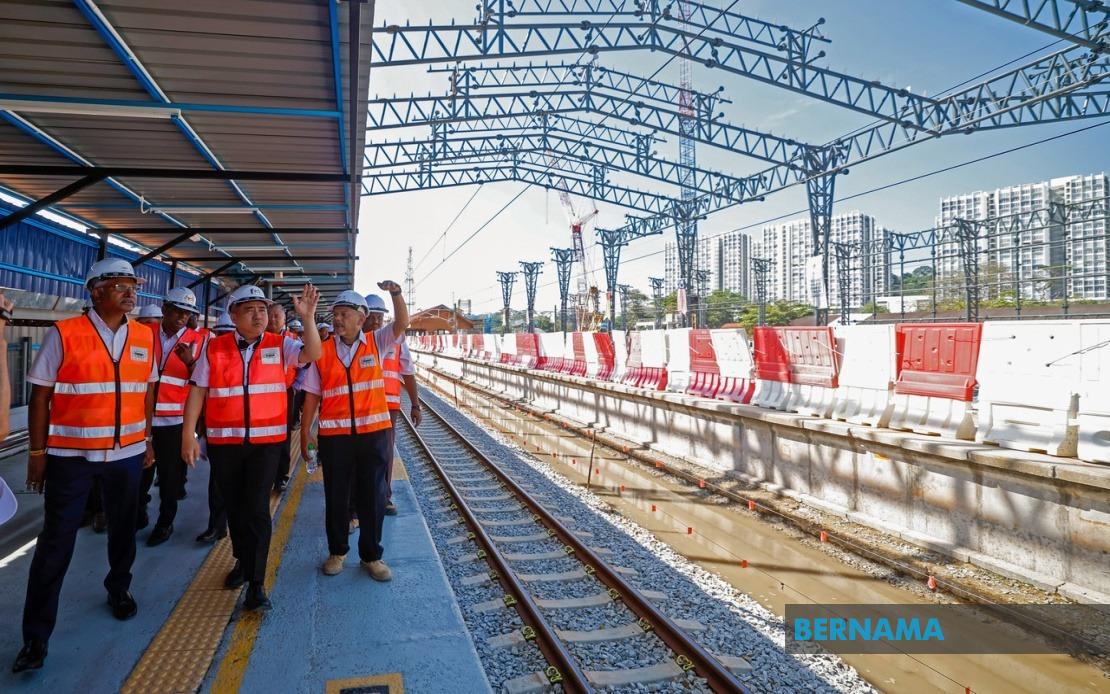
The much-anticipated Seremban Sentral railway station is progressing steadily towards completion, with Transport Minister Anthony Loke announcing that the RM100 million integrated transport hub has reached 35 per cent completion and is expected to open its doors in March 2027. The announcement, made during an inspection of the site in Seremban, signals that one of the country's most complex urban infrastructure projects is entering a more visible construction phase following the successful completion of foundational work that had previously constrained progress.
The first two years of the project were dominated by preparatory work that demanded precision and meticulous coordination. Piling operations, which form the essential foundation for a structure of this scale, proved particularly time-consuming. Beyond the piling itself, contractors faced the intricate challenge of relocating underground utilities—electrical cables, water pipes, and telecommunications infrastructure—that crisscross beneath Seremban's busy city centre. These foundational obstacles, while essential to complete before any visible progress could be made, explained why initial momentum appeared sluggish to observers. With these hurdles now cleared, Loke indicated that the next phases should proceed with markedly greater velocity, encompassing roof installation, glass façade assembly, and comprehensive finishing work that will finally transform the site into a recognizable modern transport terminal.
The project represents a fundamental reimagining of Seremban's transportation infrastructure by marrying historical preservation with contemporary urban design principles. At its heart lies the integration of the original Seremban KTMB Station, a colonial-era building now over a century old, with an entirely new modern facility. This adaptive approach acknowledges the station's heritage value while acknowledging that the aging structure alone cannot serve the city's contemporary transportation demands. The new station's architectural vocabulary draws inspiration from Minangkabau design elements, creating a Malaysian aesthetic identity rather than adopting a generic international style. This thoughtful design approach signals how transport infrastructure can function as cultural expression, not merely as functional utility.
Capacity planning reflects ambitious yet measured expectations about Seremban's growth trajectory. Initially, the facility will accommodate 30,000 passengers daily—a substantial figure that nonetheless pales beside the ultimate design capacity of 120,000 daily travellers. This staged expansion philosophy proves particularly significant for Malaysian urban planners wrestling with the tension between immediate fiscal realities and long-term demographic projections. The station's platform design exemplifies this pragmatism: six platforms have been conceptually approved, but construction will initially deliver only three, with the remaining three reserved for future development pending demonstrated demand increases. This modular approach potentially protects public finances from premature over-investment while ensuring that the facility remains scalable as Seremban's economic significance evolves.
Loke emphasized that the infrastructure investment fundamentally supports the ministry's broader vision for regional rail connectivity. Upon the station's completion and the concurrent finishing of double-track railway upgrades, frequency increases for Komuter commuter services, Express Train Service (ETS), and other rail operators will substantially expand. For Malaysian commuters in the Negeri Sembilan region, this translates into more regular service intervals, reduced waiting times, and enhanced viability of rail travel as a competitor to automobile use. The strategic intent extends beyond mere convenience: by attracting commuters through improved service quality, the ministry aims to stimulate residential population growth in Seremban and surrounding areas, generating economic expansion that extends far beyond the transport sector itself.
The station's physical design incorporates sophisticated thinking about urban mobility patterns. Two distinct entrances—one fronting Jalan Tunku Antah and another at the station's rear—coupled with dedicated drop-off zones at both locations, deliberately distribute vehicular traffic flows. This traffic management strategy acknowledges that even excellent public transport facilities generate substantial car movements during peak hours as passengers arrive and depart. By splitting vehicle ingress and egress across multiple points rather than concentrating them at a single main entrance, planners hope to mitigate congestion on Seremban's city-centre streets. This represents the kind of granular urban design consideration that often escapes public attention but meaningfully influences whether transport-oriented developments actually succeed in their goal of reducing automotive dependency.
The completed heritage station renovation project, finished in June, demonstrates parallel commitment to preservation. Beyond cosmetic upgrades, work encompassed comprehensive electrical system modernization and comprehensive rewiring to contemporary safety standards. These technical improvements ensure that the heritage structure, while retaining its historical character, functions safely and reliably within contemporary operational demands. The conservation work illustrates an important principle: heritage preservation need not mean museum-fication or functional obsolescence. Rather, intelligent intervention can sustain historical buildings as active community assets rather than relegated relics.
Flood mitigation emerges as an unexpectedly crucial component of the broader infrastructure investment. Seremban's geographical and meteorological characteristics expose the station area to periodic flash flooding that previously disrupted operations. The new sewerage system, engineered to direct stormwater directly into Sungai Temiang rather than allowing it to flow through station areas, represents preventative infrastructure investment addressing climate vulnerabilities. For Malaysian cities increasingly affected by intense rainfall events, such stormwater management integrated into major construction projects demonstrates responsible climate adaptation planning that extends beyond railway passenger facilities to broader urban resilience.
The Seremban Sentral project exists within a wider constellation of rail upgrade initiatives across the Klang Valley region. The Klang Valley Double Track Phase 2 project, currently 55.8 per cent complete, aims to increase railway capacity and enable more frequent service along Malaysia's busiest commuter corridor. The apparent reduction in Komuter service frequency during afternoon hours, rather than representing service degradation, actually facilitates accelerated construction by temporarily closing one track entirely for maintenance and upgrade work. This trade-off between short-term convenience and long-term capability reflects the operational calculus that transport authorities must navigate when simultaneously maintaining services while executing major infrastructure overhauls.
For Malaysian business communities and residential planners, the Seremban Sentral project carries significance extending well beyond rail transportation. The Transit-Oriented Development (TOD) Seremban Sentral project, planned behind the new station, represents an integrated urban development approach increasingly embraced across Southeast Asia. By concentrating residential, commercial, and entertainment facilities within walking distance of high-capacity rail infrastructure, such developments theoretically optimize land utilization, generate sufficient passenger volumes to ensure transit system viability, and create vibrant mixed-use urban districts. The success or failure of this particular TOD project will likely influence similar initiatives elsewhere in Malaysia by providing a real-world test case of whether integrated planning theory translates into economic reality.
The March 2027 completion timeline, while still several years distant, represents a concrete milestone in Seremban's urban trajectory. For businesses considering regional headquarters locations, for prospective residents evaluating residential options, and for investors contemplating development opportunities, the certainty of enhanced transport connectivity by that date provides planning parameters. The station will occupy prominent position as a literal and symbolic new landmark in Seremban's urban landscape, potentially catalyzing the broader commercial and residential revitalization that Loke's ministry envisions for the city.

