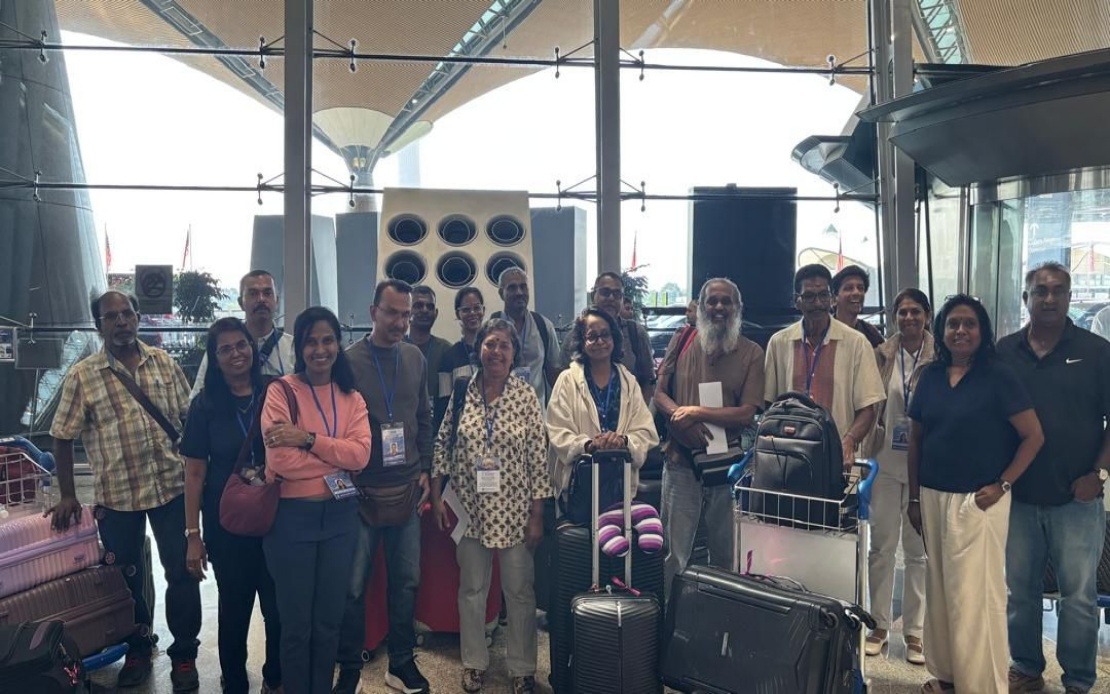
Seventeen Malaysians engaged in a religious pilgrimage to Mount Kailash in Tibet have gone silent for more than 24 hours after catastrophic flash floods devastated the Nepal-Tibet border area, prompting growing alarm among relatives back home and triggering coordinated government action to trace their whereabouts. The group, organised by Nepal-based travel operator Fishtail Tours & Travels, arrived in Nepal on August 23 and was scheduled to complete their spiritual journey by September 5, but communications ceased abruptly following the natural disaster on August 26.
Among those in the unreachable contingent are four family members of R. Logadashini, a Malaysian who described the anguish of losing contact with her father S. Raman, her mother M. Neelavany, her uncle S. Murukan, and her aunt G. Padmahwathi. The last confirmed communication with the pilgrims occurred at approximately 8.18 am Nepal time on August 26, when the group reported being positioned roughly two kilometres from the Nepal-Tibet Immigration Checkpoint. Logadashini's family received one final WhatsApp message at 8.40 am Malaysian time before all channels of contact evaporated, leaving relatives grasping for any scrap of information about their loved ones' condition.
The situation extends beyond the immediate family anxieties. The Foreign Ministry, through Wisma Putra, acknowledged that 55 Malaysians have been reported to the Malaysian Embassy in Kathmandu as unreachable in the aftermath of the flooding, though no official death toll or injury reports have been verified at this stage. Attempts to reach the travel agency and the embassy itself have yielded minimal information, compounding the frustration and concern reverberating through affected households across Malaysia. Families have found themselves in a painful limbo, unable to confirm whether their relatives remain trapped, injured, or perhaps already in the process of being rescued.
Prime Minister Datuk Seri Anwar Ibrahim intervened decisively, issuing direct orders for relevant government bodies to prioritise locating and establishing contact with all Malaysians impacted by the floods. The Malaysian Embassy in Kathmandu and the diplomatic mission in New Delhi have been activated to coordinate with Nepalese authorities, local search and rescue organisations, and the various travel agencies operating in the region. This multilayered response underscores the gravity with which Malaysia's government views the crisis and reflects the scale of the emergency facing nationals stranded in a region now ravaged by nature's sudden violence.
The triggering disaster unfolded when torrential rainfall combined with a glacial collapse produced flash floods that swept through Nepal's Rasuwa and Nuwakot districts on August 26. The deluge not only killed and injured people but severed communication networks and destroyed critical road infrastructure connecting the affected zones to Kathmandu, the capital, thereby strangling rescue operations and isolating survivors. This particular corridor along the Nepal-Tibet frontier has historically served as a crucial passage for countless pilgrims annually making their way to the sacred Mount Kailash, as well as trekkers bound for the Everest climbing regions, making it a well-travelled but inherently vulnerable route through mountainous terrain.
Contrasting sharply with the distress surrounding the Fishtail Tours group is the confirmed safety of a larger pilgrimage led by Datuk N. Mohanadas, Malaysia's legendary mountaineer renowned for his Everest ascents. His delegation comprises 56 people in total, encompassing 39 Malaysians alongside four Singaporeans and three Canadians, and this entire group has been verified as secure and unharmed by the flooding. Mohanadas reported that his contingent remained fully conscious of the tragedy unfolding at the border—the torrential rain, the flash floods, and the casualties—yet fortunately their route through Tibet avoided the affected zones entirely, permitting them to continue their pilgrimage without interruption or peril.
The existence of these two distinct outcomes—one group incommunicado and endangered, the other progressing safely through Tibet—highlights how geographical positioning and timing proved crucial determinants in this natural disaster. Had the Fishtail group been even slightly ahead of schedule or taken a marginally different route, the outcome might have differed substantially. Conversely, a minor delay might have placed them more directly in the path of destruction. Such contingencies underscore how pilgrims traversing the treacherous Himalayan routes face inherent vulnerabilities that extend beyond the spiritual or physical challenges they deliberately undertake.
For Malaysian families awaiting news, the hours of silence have transformed a religious journey into a nightmare of uncertainty. The decision to participate in Mount Kailash pilgrimages is typically made with profound spiritual intent, and families accept the inherent risks of high-altitude trekking and remote Himalayan travel as part of that commitment. However, the sudden severing of communication channels has shifted the narrative from managed risk to catastrophic contingency, leaving loved ones hundreds of miles away to contemplate scenarios they had perhaps never genuinely expected to confront. The emotional toll of such separation, compounded by the knowledge of dangerous conditions in the region, weighs heavily on Malaysian households.
The broader implications for Malaysian pilgrimage tourism and adventure travel organisations are substantial. While religious and mountaineering expeditions to sacred Himalayan sites will likely continue, this incident will inevitably prompt scrutiny of safety protocols, communication redundancies, and contingency planning among travel operators serving Malaysian clients. Travel agencies will face heightened expectations from both families and regulatory bodies to demonstrate robust emergency response systems, multiple communication channels, and pre-established coordination mechanisms with local authorities. The Foreign Ministry may also consider enhanced guidelines or advisory positions regarding pilgrimages to high-risk frontier regions.
As diplomatic missions and rescue teams intensify their search efforts, the fundamental question remains whether the unreachable group encountered the floods directly or managed to find shelter in the interim. The geography of the region—with its narrow passes, river valleys, and limited alternative routes—suggests that the group's precise location at the moment the floods struck would have been absolutely determinative. If they had not yet crossed into the most dangerous confluence points, they may have sought refuge at higher elevations or within settlements. Conversely, if they were caught directly within the flood's path, prospects diminish considerably, making every hour of elapsed time both precious and agonising for those monitoring developments from afar.

