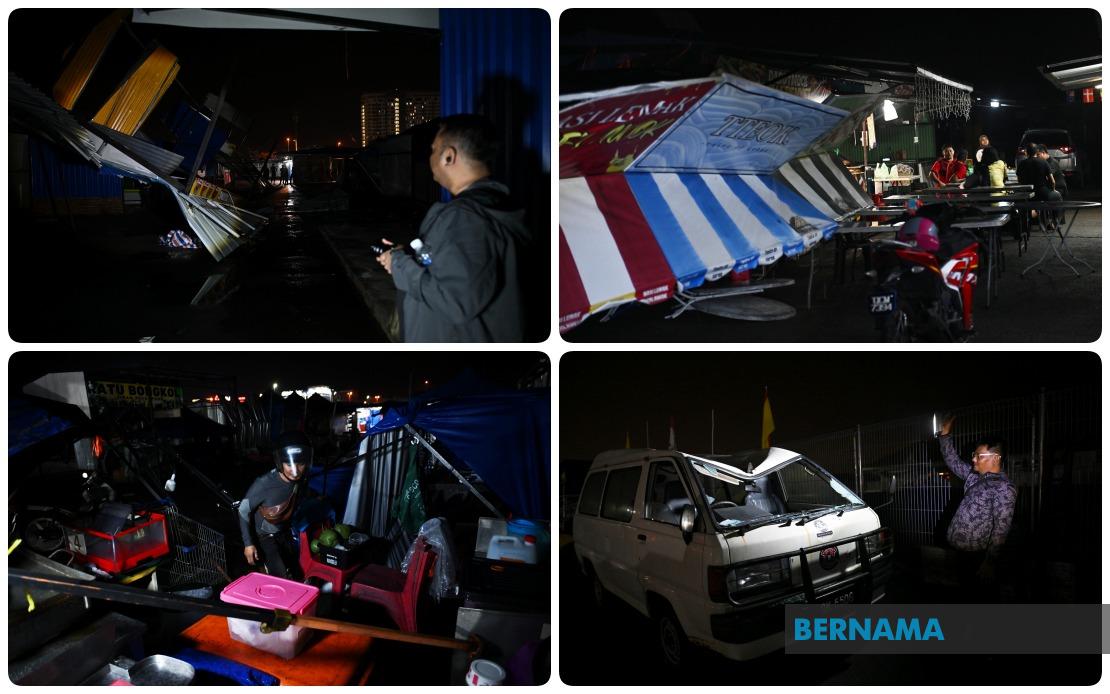
A violent thunderstorm that swept through Kuching district over the weekend has dealt a significant blow to the N6 Metrocity 2 Youth Night Market, prompting management to shut down operations following extensive structural damage. The intense rainfall and powerful winds struck during peak business hours, creating a hazardous situation that sent vendors and customers fleeing for safety as canopy structures were torn from their moorings and sent flying across the market grounds.
The incident unfolded with alarming speed as the weather deteriorated rapidly. Mohamad Faisal, a vendor who has operated at the market for a decade, described the harrowing experience of watching the disaster unfold. He was approaching his selling station when the severity of the conditions became apparent, forcing him to abandon his plans and rush away alongside other traders as entire canopy sections became airborne projectiles. The chaotic scene saw protective structures flying unpredictably around the market, creating genuine danger for anyone still present on the grounds.
For vendors like Faisal who have invested years building their businesses at this location, the financial toll has been considerable. Traders estimate individual losses hovering around RM2,000 from damage to merchandise and equipment, though some operations may have suffered significantly higher losses depending on the scale of their setups and stock levels. Beyond the immediate monetary impact, many vendors now face the uncertainty of when they can resume trading and whether their damaged equipment can be repaired or must be replaced entirely.
The scale of destruction quickly became apparent once conditions stabilised. Hamzah Hassan, deputy chairman of the N6 Metrocity 2 Youth Night Market management committee, characterised this incident as the most severe disaster to strike the facility in its operational history. From the approximately 300 vendor lots operating at the night market, more than 40 have suffered severe damage, representing a substantial portion of the trading community operating at this popular evening destination.
Damage assessment reveals the storm's indiscriminate destruction extended well beyond individual vendor stalls. The market's communal infrastructure bore significant damage, including the main performance stage, the management office, and the electrical supply system that powers the entire operation. These elements form the backbone of the night market's functionality, and their compromise threatens to disrupt operations for an extended period beyond simply replacing canopies and individual equipment.
The financial implications for individual traders are substantial and multifaceted. Hamzah indicated that canopy replacement costs alone could range from RM2,000 to RM5,000 per trader depending on the size and structural complexity of their protective coverings. When combined with damage to cooking equipment, refrigeration units, water storage containers, and other essential business apparatus, the cumulative burden becomes truly onerous for vendors operating on typically tight profit margins in the informal trading sector.
The timing of the disaster compounds its severity. Night markets serve as crucial economic engines for informal traders across Malaysia, and seasonal patterns of customer behaviour are difficult to recoup once disrupted. A closure spanning even a few weeks represents lost income across dozens of households that depend on nightly sales to meet family obligations and repay business investments. The weekend timing ensured maximum financial impact, as Saturday and Sunday nights typically attract the heaviest customer traffic.
Meteorological data supports the intensity of the weather event. Malaysia Meteorological Department issued thunderstorm warnings for the region spanning 5 pm to 9 pm on the day in question, covering multiple areas across Sarawak including Kuching, Serian, Siburan, Samarahan, Simunjan, Kapit and Song. The warning system demonstrated the forecasting capacity existed to anticipate severe conditions, though operational night markets may not have implemented precautionary measures or not had sufficient lead time to secure loose infrastructure adequately.
Market management has signalled openness to external assistance as it confronts the recovery challenge. Hamzah Hassan explicitly welcomed contributions from government ministries, elected representatives, and cooperative organisations to help distribute the financial burden affecting traders. This appeal reflects recognition that individual vendors lack capacity to absorb such losses independently, and that supporting rapid recovery serves broader community interests by maintaining employment and economic activity in this informal trading sector.
The incident highlights vulnerabilities within outdoor trading infrastructure across Malaysia. Many night markets and street-trading locations operate with relatively modest protective structures designed primarily against typical weather conditions rather than extreme events. The climate patterns across Southeast Asia are increasingly producing more intense weather episodes, suggesting that traders and market management require updated infrastructure standards and contingency protocols to protect livelihoods and customer safety.
For Kuching's broader trading community and municipal authorities, this event presents both immediate crisis management challenges and longer-term strategic questions about resilience. Rebuilding the market presents an opportunity to implement improved infrastructure standards, enhanced drainage and wind-resistance features, and potentially early-warning communication systems that can alert vendors when conditions become dangerous. Investment in such improvements, though costly initially, could prevent recurrence of similar devastation.
The recovery process will require coordination across multiple stakeholders. Vendor associations will need to document losses systematically, assist members with insurance claims where applicable, and coordinate with management on phased reopening. Municipal authorities must assess whether underlying ground conditions or drainage patterns contributed to the storm's impact, while state-level agencies may need to evaluate whether meteorological warnings reached traders with sufficient clarity and lead time to enable protective actions.

