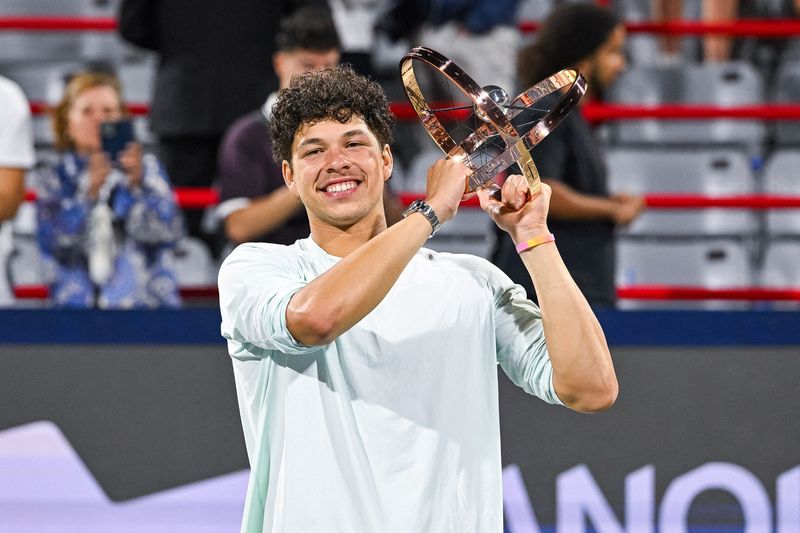
Ben Shelton arrives at the US Open determined to translate recent momentum into major championship success, buoyed by his commanding defence of the Canadian Open crown where he swept through without losing a single set. The 23-year-old American, currently ranked ninth in the world, enters the tournament at Flushing Meadows having endured what he characterises as an unpredictable season marked by contrasting performances across the sport's elite stage.
Shelton's 2024 campaign has resembled a turbulent ride, punctuated by four title victories yet shadowed by underwhelming results at tennis's most prestigious competitions. His Australian Open run stalled at the quarter-final stage, while subsequent showings proved significantly more disappointing—a second-round exit at Roland Garros and a first-round elimination from Wimbledon left observers questioning whether the young talent could deliver when it mattered most. The psychological toll of such reversals at major tournaments weighs heavily on any aspirant seeking to establish himself among tennis's elite hierarchy.
However, his Montreal triumph signals a genuine inflection point. Speaking after defeating Brandon Nakashima in the Canadian Open final, Shelton reflected on a recalibrated approach marked by clinical precision and heightened mental clarity. He emphasised his improved return-of-serve game and the tactical sophistication with which he executed both defensive and aggressive strategies, indicating a player who has identified specific weaknesses and systematised their correction. Such self-awareness and demonstrated improvement offer legitimate grounds for optimism heading into Flushing Meadows.
The implications extend beyond individual achievement. American men's tennis has endured a championship drought lasting more than two decades, with Andy Roddick's 2003 US Open triumph over Juan Carlos Ferrero remaining the nation's last singles crown at this tournament. That prolonged absence has created a void and a collective yearning across American sports culture. Shelton has gradually emerged as a figure capable of filling that vacuum, and the weight of national expectation now accompanies his journey through the draw.
Former champion Roddick, speaking on his podcast before Jannik Sinner withdrew from the tournament, suggested Shelton possessed genuine contender status should the expected favourites falter. With question marks surrounding Sinner's participation and the consistency of Carlos Alcaraz, Roddick identified a rare window of opportunity. Such assessments from established champions carry particular weight, as they reflect not mere optimism but genuine tactical evaluation from someone who has previously navigated these exact pressures.
Shelton's progression on hardcourt surfaces throughout this season deserves particular mention. He has described a trajectory of incremental improvement with each passing tournament, building rhythm and confidence in an environment where many younger players struggle with consistency. This measured upward curve contrasts sharply with his stumbling performances at clay and grass majors, suggesting he has identified surfaces where his game flourishes and adjusted expectations accordingly—a mark of maturing competitive intelligence.
The American's previous US Open appearance proved instructive. Reaching the semi-finals in 2023 demonstrated he could navigate the demanding conditions and high-pressure environments that define this championship. That experience provides a roadmap and confidence that the stage itself need not intimidate him. Returning to New York with additional titles and refined technical execution, he enters with considerably elevated credentials.
Shelton's philosophical approach to the tennis calendar reveals mature perspective often absent in younger players. He acknowledges the paradoxical nature of professional tennis: the extended season presents abundant competitive opportunity yet simultaneously dilutes focus and energy across numerous tournaments. This awareness suggests he approaches the US Open not as a desperate final chance but as one meaningful opportunity within a broader arc of development. Such equilibrium can paradoxically enhance performance by reducing the paralyzing pressure of singular expectation.
The timing of his Canadian Open success appears particularly fortuitous. Arriving at Flushing Meadows with recent concrete evidence of championship-level performance, Shelton can point to actual results validating his belief that another level of excellence awaits unlocking. This tangible confidence, grounded in demonstrated execution rather than mere aspirational thinking, may prove the decisive difference in sustained tournament runs where mental fortitude determines outcomes as significantly as technical proficiency.
For Southeast Asian tennis observers and Malaysian sports enthusiasts, Shelton's emergence represents a fascinating narrative within global sport's broader power dynamics. His potential breakthrough would reshape the tennis hierarchy that has increasingly centralised around European and other international players, reminding audiences that American tennis retains capacity for renewal and relevance. The US Open will provide the definitive early answer regarding whether his recent ascent represents a genuine transformation or merely another oscillation within his inconsistent season.

