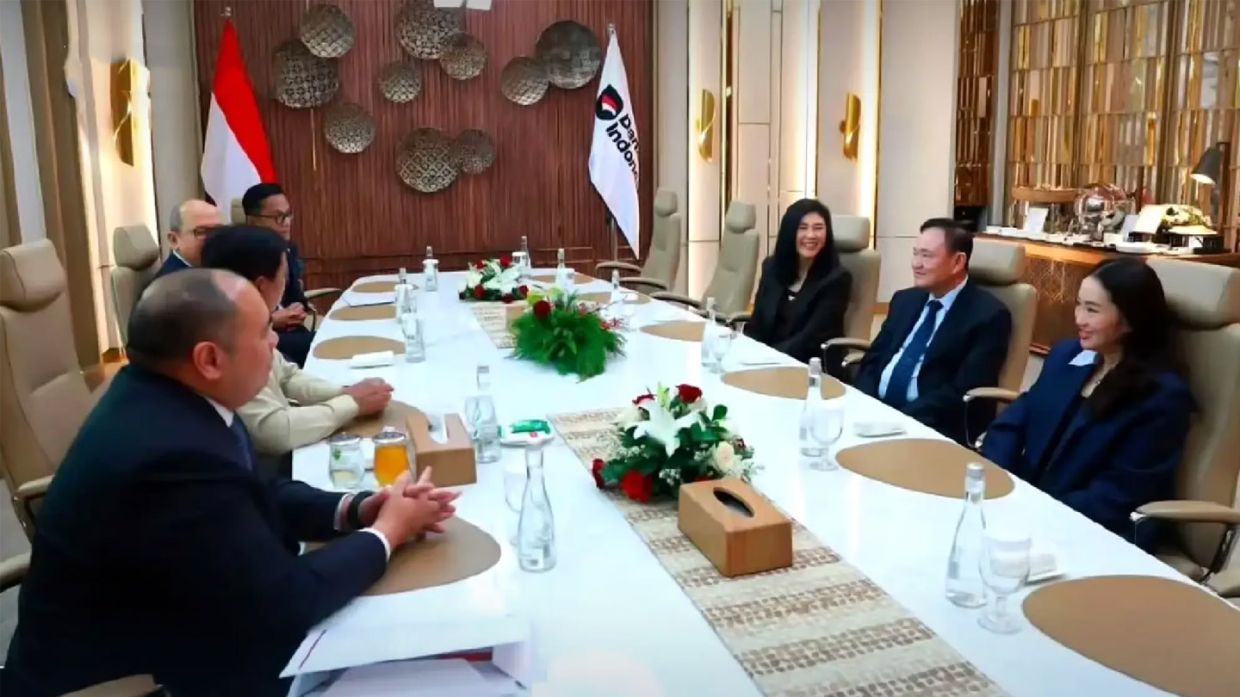
Three members of Thailand's influential Shinawatra family—all former holders of the country's highest office—convened with Indonesian President Prabowo Subianto in Jakarta this week for wide-ranging discussions on investment strategy and economic development. The gathering on July 9 brought together Thaksin Shinawatra, who served as prime minister from 2001 to 2006; his youngest sister Yingluck Shinawatra, who held the office from 2011 to 2014; and his eldest daughter Paetongtarn Shinawatra, who more recently led the government from 2024 to 2025. The meeting, documented through official photographs released by Indonesia's Cabinet Secretariat, took place at the Danantara building in the capital, bringing into focus the deep business and political connections spanning the wider Southeast Asian region.
The discussions centred on identifying viable investment opportunities, strategies for asset management, and approaches to fostering sustainable economic growth across the medium to long term. According to Indonesian Cabinet Secretary Teddy Indra Wijaya, the atmosphere remained warm and informal throughout the engagement, underscoring the established rapport among the participants. The presence of multiple generations of the Shinawatra family—spanning Thaksin's era of transformative governance in the early 2000s through to his daughter's current tenure—signals the family's enduring relevance in both Thai and regional economic circles. For observers of Southeast Asian business and politics, the gathering illustrates how leading political figures maintain influence and access to investment platforms well beyond their formal terms in office.
Thaksin's role as a member of Danantara's advisory board served as a primary catalyst for the meeting, positioning him as a valued consultant on matters of strategic significance to Indonesia's long-term development agenda. His recommendations and insights were exchanged directly with Prabowo and the agency's senior leadership team, including group chief executive officer Rosan Roeslani, chief operating officer Dony Oskaria, and chief investment officer Pandu Sjahrir. The involvement of these executives underscores that the meeting transcended ceremonial courtesy and delved into substantive business matters. For Malaysia and other ASEAN nations watching regional investment flows, the calibre of participants signals the seriousness with which Indonesia is pursuing coordinated capital deployment across strategic sectors.
Danantara Indonesia operates as the state's principal mechanism for managing, optimizing, and developing national assets that underpin the country's structural economic transformation. The institution wields considerable influence over how Indonesia identifies, acquires, and nurtures assets deemed critical to the nation's competitive positioning in an increasingly multipolar global economy. By engaging the Shinawatra family—whose business acumen spans telecommunications, infrastructure, real estate, and financial services—Indonesia's leadership is tapping into decades of accumulated expertise in building large-scale enterprises across Southeast Asia. This represents a pragmatic approach to economic statecraft, whereby governments leverage relationships with successful private sector figures to inform policy and investment decisions.
The scope of economic engagement between Thailand and Indonesia has broadened considerably in recent years, extending beyond traditional bilateral trade arrangements into joint investment vehicles and shared strategic priorities. The Shinawatra family's commercial empire, which once dominated Thailand's telecom sector and expanded into multiple industries, provides a template for understanding how regional capital can be mobilized and deployed. Prabowo's outreach to the family—both through formal institutional settings and through a separate, more intimate gathering at his private residence—suggests Indonesia's leadership recognizes the value of maintaining open channels with influential figures capable of mobilizing capital and expertise.
For Malaysian stakeholders, the implications are multifaceted. Regional investment flows increasingly move through networks of connected business and political leaders who maintain influence across borders. The Shinawatra family's engagement with Indonesia's investment apparatus suggests that Thai capital and expertise will continue flowing into Indonesian projects, potentially affecting the competitive landscape for foreign direct investment throughout ASEAN. Malaysia's ability to attract comparable investment may depend partly on fostering similarly high-level relationships with influential regional figures and ensuring that its investment platforms remain attractive to experienced operators.
Thaksin's advisory position at Danantara reflects a broader pattern wherein seasoned political leaders transition into roles advising state investment institutions. This model has become increasingly common across Asia, where the boundaries between public sector authority and private sector expertise blur considerably. The former Thai prime minister's continued relevance in shaping Indonesia's strategic investment decisions demonstrates that political capital, once earned through successful governance, can be converted into sustained influence over economic policy and capital allocation. For other ASEAN leaders navigating post-office transitions, the Shinawatra example illustrates pathways to maintaining relevance and generating income through advisory roles with foreign governments.
The Indonesian government has publicly framed such international engagements as essential components of its broader strategy to strengthen bilateral relationships and fortify the nation's position amid shifting global conditions. By hosting leading figures from neighbouring Thailand—and by extension, signals of engagement with the region's wider business ecosystem—Jakarta is signalling that it views regional cooperation as integral to its economic transformation agenda. This approach contrasts with more inward-focused development models and instead emphasizes the value of cross-border knowledge transfer and capital flows in accelerating progress toward structural economic objectives.
The timing of the meeting carries additional significance given regional economic uncertainties and ongoing shifts in global trade patterns. As ASEAN nations compete for foreign investment and seek to position themselves advantageously within evolving supply chains, the capacity to convene experienced investors and policymakers becomes increasingly valuable. Indonesia's willingness to engage senior figures from Thailand's political and business establishment—including a sitting prime minister—demonstrates confidence in its investment environment and signals openness to partnerships that span the region. For Malaysia, such developments underscore the importance of cultivating relationships with influential regional figures and ensuring that homegrown business leaders maintain visibility and credibility across Southeast Asia.
The substantive content of discussions between the Shinawatra family and Prabowo's team remains largely opaque, with official statements emphasizing the cordial nature of interactions rather than detailing specific investment proposals or commitments. This discretion is typical in high-level business diplomacy, where public announcements may follow only after preliminary negotiations have matured and deal structures crystallize. Nevertheless, the fact that such meetings occur at all—and that they are documented and acknowledged by state institutions—signals their importance to Indonesia's economic planning processes. For regional observers seeking to understand how capital deployment decisions are made at the highest levels of Indonesian governance, such gatherings provide valuable insight into the networks and relationships that shape investment flows.
Looking ahead, the meeting between the Shinawatra family and President Prabowo may represent the beginning of a deeper economic partnership between Thailand and Indonesia, mediated through institutional vehicles like Danantara and executed through private sector actors. The engagement of Paetongtarn Shinawatra, as the current Thai prime minister, alongside her father and aunt adds another dimension, potentially opening pathways for government-to-government cooperation on economic matters that extend beyond traditional bilateral channels. For Malaysia and other ASEAN members, such developments underscore the evolving nature of regional economic cooperation and the importance of maintaining competitive positioning as investment flows become increasingly sophisticated and are increasingly directed through state-managed vehicles and advisory networks that span multiple countries.

