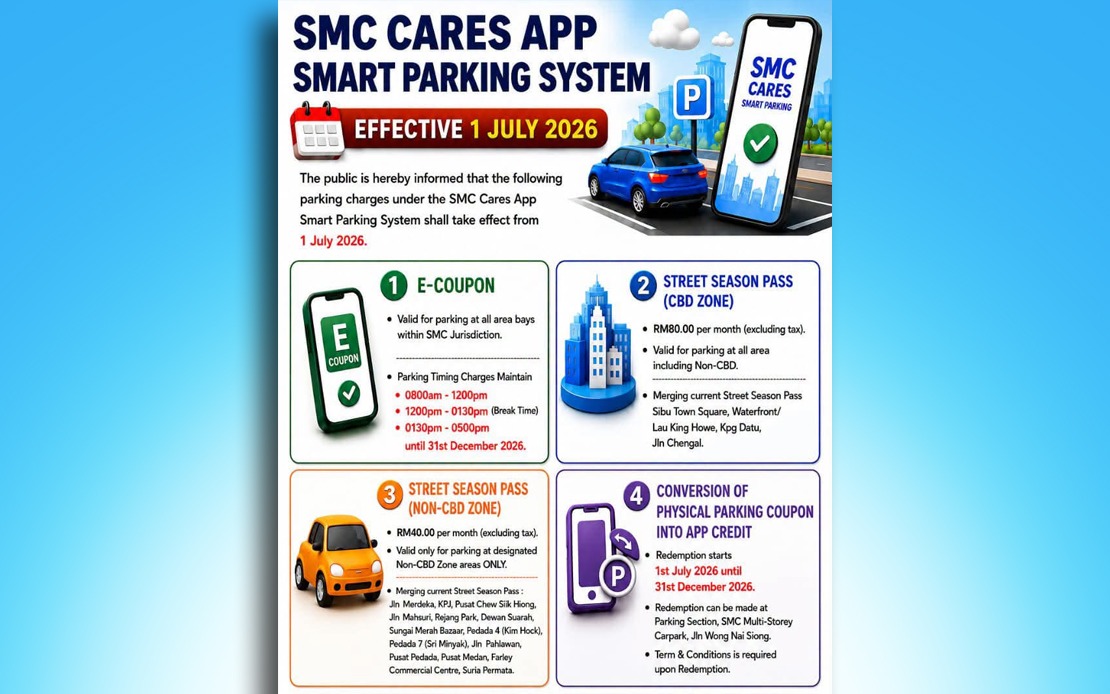
The Sibu Municipal Council has moved to address mounting public frustration with its smart parking enforcement system by introducing a grace period and targeted concessions for older drivers. Speaking at his office, SMC Chairman Clarence Ting Ing Horh announced that motorists will receive between five and 10 minutes before an Over Parking Notice is issued, a change aimed directly at complaints that compounds were being levied too hastily. The adjustment responds to genuine user difficulties: many drivers reported struggling to exit their vehicles, locate the mobile application, and complete payment activation within the original timeframe, only to find themselves penalised despite attempting compliance.
The council has instructed system provider Primal Solution Sdn Bhd to implement the grace period, signalling a pragmatic shift in enforcement philosophy. Rather than treating the smart parking system purely as a revenue-generation mechanism, Ting framed the adjustment as recognition that user experience and fairness must accompany technological modernisation. His statement—"We want to make the system more user-friendly and convenient, not to penalise the public"—suggests the council recognises the system's deployment was premature and lacked adequate preparation for widespread adoption. This acknowledgment carries weight in Malaysia's local government context, where digital service rollouts frequently encounter resistance when public convenience is subordinated to administrative efficiency.
From August, SMC will introduce a dedicated Senior Citizen Parking Pass for motorists aged 60 and above, though full details remain forthcoming. This measure directly tackles one of the most vocal complaint categories: elderly drivers struggling with app-based registration and navigation. Given Malaysia's rapidly ageing population and the particular challenges older citizens face adopting digital-first systems, this initiative recognises a genuine equity gap. Many Sibu residents in this age group may lack smartphone familiarity or technical support at home, making a dedicated pass not merely convenient but essential for meaningful access to public services.
Public criticism of the SMC Cares system intensified following its full implementation earlier this month, with social media becoming the primary channel for grievances. Users reported a cascading series of technical failures: registration processes deemed excessively complicated, particularly for seniors; an unintuitive interface; sluggish performance; involuntary session logouts; payment processing delays; and most problematically, compounds issued before transactions could be completed. These weren't isolated complaints but systematic patterns pointing to inadequate testing and user acceptance trials before launch. The convergence of technical failures and aggressive enforcement created a perception that the system prioritised penalty collection over genuine public compliance.
Ting acknowledged this feedback and invited direct engagement rather than social media speculation, establishing a formal appeal mechanism for motorists believing notices were wrongly issued. The council will review cases involving registration errors or other legitimate circumstances, with every notice backed by photographic evidence maintained within the system. This formalisation of appeals represents an implicit admission that errors had occurred and that the initial enforcement approach lacked safeguards. For Malaysian motorists accustomed to local council operations, having a clear, documented review process represents meaningful accountability improvement.
A critical distinction emerged regarding enforcement authority: contracted parking wardens enforce only paid parking violations, expired time, and overparking offences. Illegal parking, traffic obstruction, and related violations remain under SMC's enforcement division and police authority. Ting dismissed social media allegations that parking wardens were issuing compounds for illegal parking, clarifying the scope and limits of contractor authority. This demarcation matters because it prevents private contractors from wielding enforcement powers beyond their contractual remit, a safeguard particularly important in Malaysia where concerns about privatised enforcement sometimes outweigh service efficiency gains.
The council has instructed contractors to enhance parking warden approachability and customer assistance capabilities, with specific direction that wardens avoid face coverings except for genuine medical reasons. This detail signals recognition that enforcement relationships had become adversarial, with drivers perceiving wardens as obstacles rather than service providers. By requiring wardens to be easily identifiable and instructed to assist rather than penalise, SMC attempts to reframe the interaction from punitive to educational. Additionally, a dedicated SMC Cares support counter at Sibu Public Library provides hands-on guidance for registration and app use, specifically addressing the registration difficulties that frustrated users, particularly seniors.
Addressing pricing concerns, Ting defended Sibu's parking charges as competitive with other Sarawak local authorities, rejecting social media claims that the city imposed the state's highest rates. He clarified the financial structure: all parking revenue flows directly to SMC, while the contractor receives separate service remuneration under contract terms. This transparency is important because public perception of excessive charges often stems from opaque revenue allocation. When motorists understand that fees support council operations rather than enriching private contractors, acceptance typically improves. The distinction also addresses concerns that private contractors might artificially escalate violations to increase revenue.
Since its introduction, the SMC Cares Smart Parking system has attracted over 93,000 registered users, with the council targeting 100,000 registrations by year-end. This growth trajectory, despite significant criticism, suggests that underneath user frustration lies genuine willingness to adopt digital parking solutions. The issue wasn't technology acceptance but implementation execution. The improvements announced—grace periods, senior passes, enhanced support, clearer enforcement boundaries—represent course corrections that could transform user perception from antagonistic to collaborative.
For Malaysian readers beyond Sibu, this council's experience offers instructive lessons about digital service deployment. The rush to implement smart systems without adequate user testing, insufficient support infrastructure, and overly aggressive enforcement creates backlash that undermines legitimate goals. Successful technology adoption requires patience, phased rollouts, clear communication, and mechanisms protecting users from system failures. As more Malaysian municipalities explore smart parking and digital enforcement, Sibu's corrections demonstrate both the challenges inherent in such transitions and the possibility of course correction when councils remain responsive to genuine public concern. The measures announced suggest SMC recognises that sustainable revenue and public cooperation require prioritising fairness over rapid enforcement, a lesson that extends well beyond parking policy.

