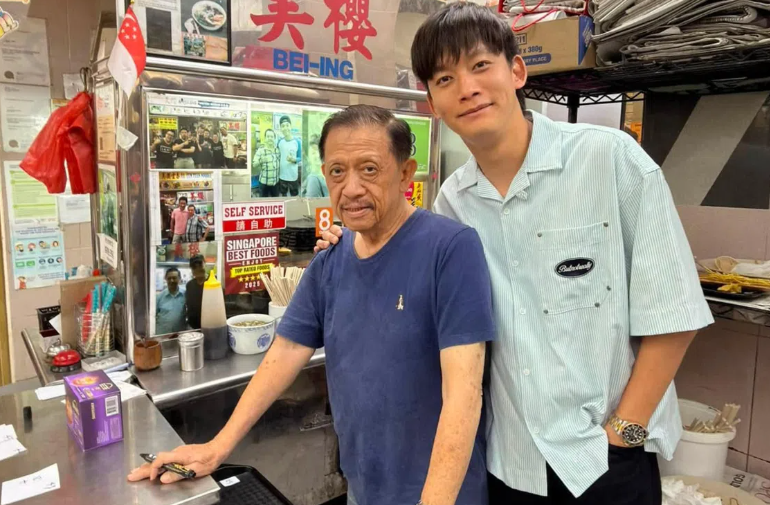
Singaporean actor Noah Yap has forcefully pushed back against online critics who questioned his motives for visiting an elderly hawker injured during an altercation at Roxy Square, dismissing suggestions that he was capitalising on the incident for personal gain. The actor, currently starring in a Channel 5 police drama, responded to allegations from a netizen who claimed Yap had orchestrated the visit to demonstrate concern while harvesting media attention, characterising him as strategically jumping on the opportunity before other public figures could do so. Yap's sharp rejoinder—"Get a life la. I'm not as free as you think"—captured his frustration with what he viewed as baseless speculation about his character.
Central to Yap's defence is his long-standing relationship with Bei-Ing Wanton Noodle, a stall he has patronised consistently for more than two decades since his primary school years. This depth of connection transforms the narrative from that of an opportunistic celebrity seeking relevance to a loyal customer concerned for someone who has been part of his life trajectory. Yap emphasised that the hawker, Yeo, and his family had made genuine efforts to maintain their relationship over the years, always inquiring about his wellbeing whenever he visited. In Yap's recounting, Yeo occupied a meaningful role in his personal development, with the elderly vendor having witnessed his transition from schoolboy to actor.
The incident that sparked the controversy erupted on August 15 when a video of a scuffle between a young man and Yeo went viral across social media platforms. According to accounts provided by Yeo and his family, the elderly hawker was walking past a table after shutting down his stall for the day when he observed a young girl whom he found endearing. Acting on an impulse rooted in his generation's more casual approach to child interactions, Yeo reached over and gently patted the child on the head. This gesture, innocent in his intention, immediately provoked a confrontation from the girl's father, who took umbrage at the physical contact. Circulated CCTV footage appeared to document the subsequent altercation, showing the younger man physically grabbing Yeo and forcibly pushing him to the ground. Singapore's police department subsequently acknowledged receipt of a formal report and confirmed that investigators were actively examining the circumstances surrounding the assault.
Yap made his visit to Yeo the following afternoon, on August 16, discovering the elderly vendor in surprisingly good spirits despite the traumatic experience. However, Yao demonstrated characteristic resilience and reluctance, initially resistant to seeking professional medical evaluation for his injuries. Yap's decision to publicly document and share his visit through social media, he explained, was deliberately calculated to amplify awareness regarding the broader incident rather than to draw attention to himself. By articulating his motivation in this manner, Yap sought to reframe the narrative from one centred on his celebrity status to one focused on the plight of an elderly, vulnerable member of the community who had suffered physical harm.
Within his social media statement, Yap articulated a clear moral position, declaring unequivocally that "violence is never the answer" and appealing for society to embrace greater compassion in interpersonal interactions. The statement functioned simultaneously as commentary on the specific incident and as a broader reflection on social conduct. Yap's emphasis on kindness resonates particularly in Singapore's dense urban environment, where casual courtesies and community bonds have been gradually attenuated by rapid modernisation and individualisation. His intervention, whether viewed sympathetically or cynically, intersected with ongoing societal conversations about intergenerational respect, appropriate physical boundaries in public spaces, and the proportionality of responses to perceived transgressions.
The incident itself highlights evolving tensions around cultural expectations and changing social norms in Singapore. Yeo's gesture, rooted in a generation's informal approach to displaying affection toward children, collided with contemporary parenting philosophies that emphasise strict boundaries around physical contact with minors by strangers. This generational disconnect, amplified through social media's capacity to rapidly disseminate footage and invite commentary, transformed a localised interpersonal clash into a significant public controversy. The disproportionate physical response from the younger man raised parallel questions about appropriate de-escalation strategies and the responsibilities of adults in managing conflict within public spaces.
For Malaysian readers observing this Singapore incident, the episode offers instructive parallels to similar cross-cultural and intergenerational dynamics within Southeast Asia more broadly. Malaysia's own communities encompass comparable generational variations in social conduct expectations, particularly regarding informal physical interactions and the boundaries of community responsibility toward elders. The incident underscores how rapidly traditional informal social compacts can rupture when different groups operate according to incompatible frameworks regarding appropriate conduct. Furthermore, the speed with which the incident spread through digital channels and accumulated layers of interpretation reflects the reality facing public figures and ordinary citizens alike in the social media age, where context can be swiftly stripped away and narratives rapidly calcified.
Yap's defence against accusations of opportunism also illuminates the complicated position occupied by celebrities attempting to engage authentically with community issues or personal relationships. In an ecosystem where every public action invites scrutiny and cynical reinterpretation, demonstrating genuine concern for vulnerable community members becomes fraught with the risk of being mischaracterised as calculated self-promotion. This dynamic potentially discourages celebrity engagement with social issues, as the reputational cost of appearing self-serving may exceed the benefit of raising awareness. Yap's willingness to engage in extended public explanation suggests he prioritises countering what he views as unjust characterisation over accepting the conventional wisdom that responding to critics merely amplifies their reach.

