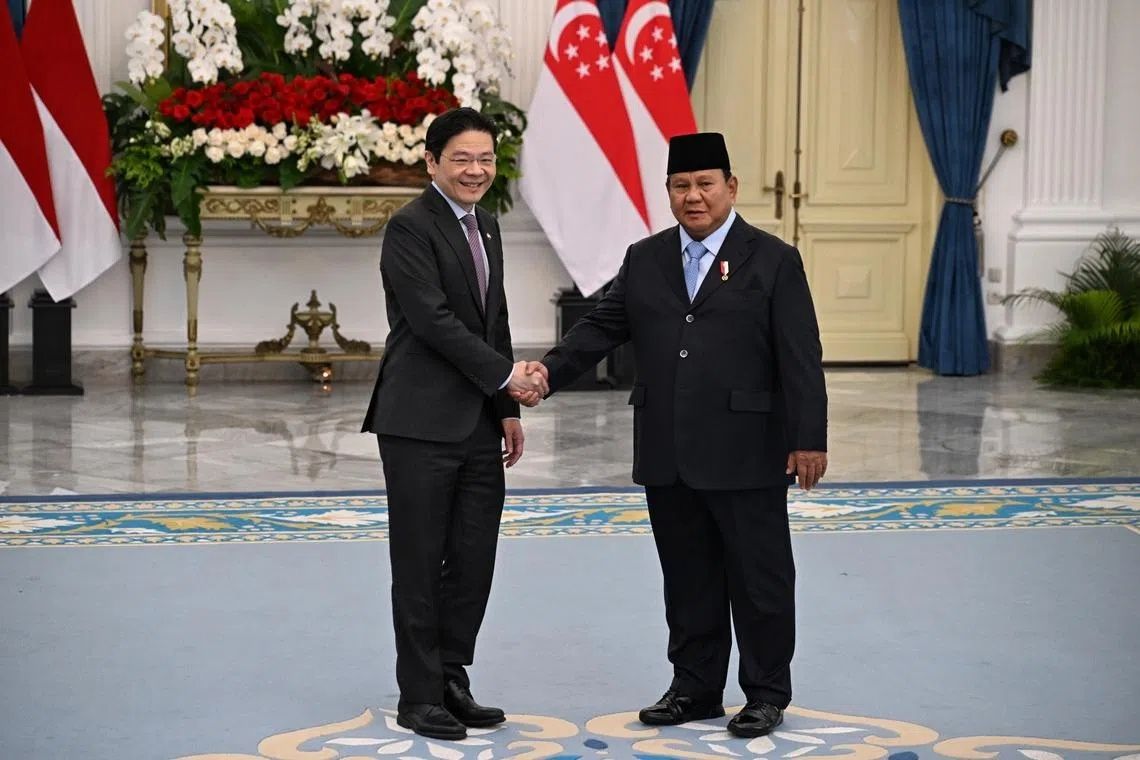
Singapore and Indonesia have reaffirmed their commitment to maintaining the Strait of Malacca as an open, secure and accessible shipping corridor for all nations, positioning maritime security as a cornerstone of their increasingly strategic bilateral relationship. The pledge came following high-level talks on July 6 between Singapore Prime Minister Lawrence Wong and Indonesian President Prabowo Subianto during the annual Leaders' Retreat, where both leaders stressed the critical importance of safeguarding one of the world's most vital trade passages against mounting geopolitical instability.
The Strait of Malacca represents far more than a geographic convenience for the region's two largest maritime nations. As the critical waterway connecting the Indian Ocean to the South China Sea, it carries a substantial portion of global maritime trade and energy shipments, making it irreplaceable to international commerce and regional prosperity. For Singapore and Indonesia, which directly border this strategic corridor, the security and accessibility of the strait carries particular weight. Recent global events have underscored this urgency. PM Wong specifically referenced disruptions in the Middle East, where ongoing tensions have choked traffic through the Strait of Hormuz, creating ripple effects across global supply chains and energy markets. By contrast, maintaining fluidity in the Strait of Malacca protects millions of dollars in daily commerce and underpins economic stability throughout Asia-Pacific.
President Prabowo articulated Indonesia's dual commitment to both freedom of navigation and environmental stewardship. Beyond simply keeping lanes open, he emphasised the importance of protecting the waterway from pollution, accidents, piracy and maritime crime—concerns that resonate with Malaysian readers given their country's shared interest in the strait's security. Indonesia has signalled its intention to continue coordinating with Malaysia and Thailand to ensure compliance with the United Nations Convention on the Law of the Sea, establishing a multilateral framework that respects international maritime law while safeguarding regional interests. This coordination reflects the reality that the strait's security cannot be managed unilaterally but requires sustained cooperation among all littoral states.
PM Wong framed Singapore's position within a broader strategic architecture, using the phrase "strategically aligned" to describe the two nations' convergence on navigational rights and freedom of passage. His statement reveals how Singapore views maritime security not as a technical matter but as integral to regional stability and economic resilience. The explicit recognition of shared strategic interests signals to the region and beyond that Singapore and Indonesia speak with one voice on this issue, potentially discouraging any unilateral actions that might disrupt shipping lanes or challenge established international maritime norms. For Malaysian observers, this alignment between Singapore and Indonesia provides reassurance that ASEAN's largest maritime powers remain committed to upholding open passage through one of Southeast Asia's most critical waterways.
Beyond maritime security, the retreat revealed the sophistication of the Singapore-Indonesia relationship as it evolves toward the two nations' 60-year diplomatic milestone in 2027. The bilateral engagement now extends into renewable energy cooperation, cross-border electricity trade, digital infrastructure development and supply chain resilience—domains that will shape economic competitiveness and national development over the coming decade. This expansion reflects a recognition that traditional cooperation frameworks centred on trade and investment no longer suffice in an era of climate transition, digital disruption and geopolitical fragmentation. Both nations increasingly understand that their fortunes are intertwined not merely through commerce but through shared infrastructure, energy systems and technological ecosystems.
The most significant breakthrough involves cross-border electricity trade, which both nations have identified as foundational to future regional energy security. Indonesia's sovereign investment fund Danantara will lead implementation of electricity cooperation alongside Singapore-based firms Keppel Electric, Sembcorp Industries and Singapore Energy Interconnections. These arrangements move beyond preliminary discussions to establish concrete operational frameworks for eventual electricity exports. PM Wong characterised the initiative as a "win-win" project while positioning it as a building block for a broader ASEAN Power Grid—a visionary infrastructure project that could eventually link electricity networks across Southeast Asia. For Malaysian stakeholders, this development suggests that integrated regional electricity trading could eventually encompass the entire region, offering both opportunities and complexities as national grids become more interdependent.
The electricity cooperation represents more than commercial opportunity; it embodies a strategic response to regional energy vulnerability. As Southeast Asian economies grow and decarbonisation pressures mount, cross-border electricity trade offers a mechanism to diversify energy sources, stabilise prices and facilitate renewable energy integration across national boundaries. Indonesia, with its substantial hydroelectric and geothermal potential, possesses export capacity that could benefit energy-scarce neighbours. Singapore, as a trading and financial hub, can serve as a distribution and coordination centre. This complementarity creates natural economic incentives while serving broader climate goals—a calculus that extends beyond Singapore and Indonesia to encompass the entire region's energy security architecture.
The Leaders' Retreat also addressed supply chain resilience and cybersecurity, reflecting shared concerns about economic vulnerabilities exposed by recent global disruptions. Both leaders acknowledged that manufacturing and trade networks remain susceptible to geopolitical shocks, cybercriminal activity and infrastructure fragility. By prioritising supply chain coordination and digital security, Singapore and Indonesia are positioning themselves as architects of a more resilient regional trading system. This focus carries particular significance for Malaysia, which occupies a central position within Southeast Asian supply chains and therefore has direct interest in initiatives that strengthen chain transparency, redundancy and security.
PM Wong's emphatic expressions of confidence in Indonesia's economic future reflect Singapore's strategic calculation that the two nations' development trajectories remain interdependent. He highlighted Singapore's ongoing investments across Indonesian regions, from the Batam, Bintan and Karimun free trade zone to the Kendal Industrial Park in central Java. The latter facility, approaching its tenth anniversary in 2026, has reached full operational capacity and is preparing a 1,000-hectare expansion. These developments underscore Singapore's conviction that Indonesia's economic growth translates directly into opportunities for Singapore's businesses, investors and financial services sector. For regional analysts, this positions the Singapore-Indonesia relationship not as competitive but as fundamentally complementary, with Singapore providing capital, expertise and market access while Indonesia offers scale, natural resources and demographic dynamism.
The industrial park expansion exemplifies how Singapore-Indonesia cooperation generates concrete outcomes beyond policy statements. Full capacity utilisation followed by planned expansion demonstrates sustained commercial confidence and represents a significant employment generator for central Java. This pattern repeats across multiple investment sites, suggesting that the bilateral relationship functions as an effective mechanism for channelling capital into productive infrastructure. Malaysian observers should note that Singapore's strategic positioning alongside Indonesia may influence regional investment flows, potentially creating competition for manufacturing facilities and technology parks across Southeast Asia.
The retreat's emphasis on both maritime security and economic cooperation reveals a sophisticated bilateral relationship that simultaneously protects shared interests and pursues mutual gain. By anchoring maritime commitments within a broader framework of energy cooperation, supply chain resilience and digital infrastructure development, Singapore and Indonesia are constructing a relationship architecture that withstands both immediate geopolitical challenges and longer-term structural transformations. The timing—approaching their 60-year diplomatic anniversary—suggests both nations wish to demonstrate that their partnership remains vital and evolving rather than static or ceremonial. For Malaysia and other ASEAN members, these developments signal that the regional order increasingly revolves around bilateral partnerships between leading economies that combine security cooperation with economic integration, a pattern likely to influence intra-ASEAN dynamics for the foreseeable future.

