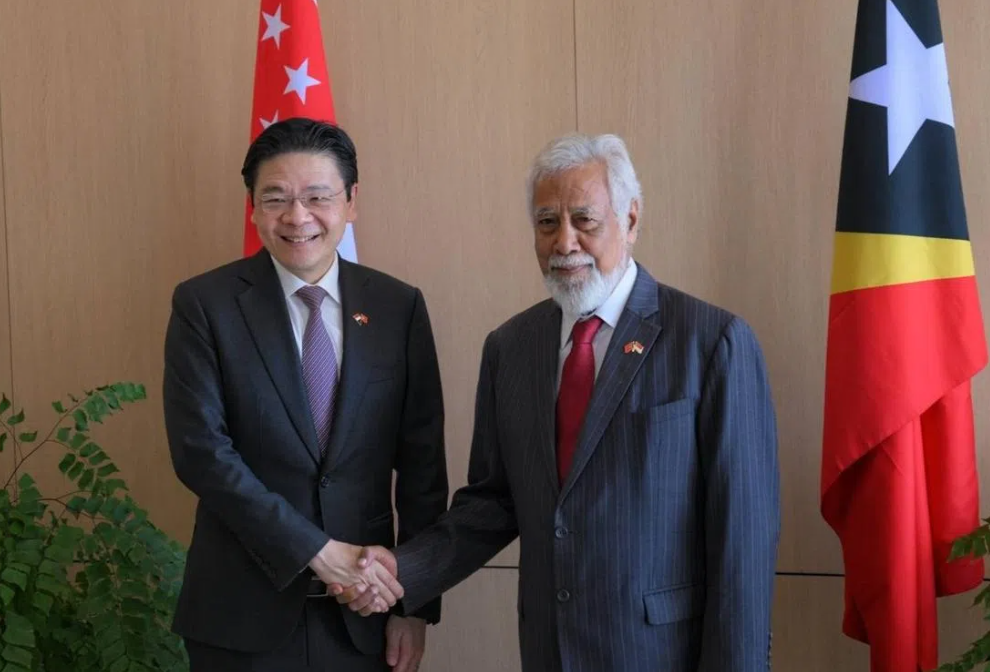
Prime Minister Lawrence Wong's inaugural visit to Timor-Leste marks a significant milestone for bilateral relations between Singapore and the region's newest ASEAN member state. During his two-day stay in Dili, Wong and Timor-Leste Prime Minister Xanana Gusmao jointly endorsed a comprehensive framework agreement on July 3 designed to deepen cooperation across multiple domains. The pact, formalised at the Government Palace with both leaders present, establishes a structured platform for regular consultations on bilateral, regional and strategic matters, transforming what has been an emerging relationship into a more institutionalised partnership.
The significance of Wong's visit extends beyond ceremonial gestures. Before departing Dili, he was conferred the Order of Timor-Leste (Grand Collar) by President Jose Ramos-Horta at the Presidential Palace, honouring Singapore's sustained commitment to Timor-Leste's development and successful integration into the regional bloc. The honour reflects the country's recognition of Singapore's instrumental role in facilitating Timor-Leste's accession to ASEAN in October 2025, achieved through years of targeted capacity-building initiatives. Wong characteristically deflected personal credit, attributing the award to the countless Singaporeans who have worked on the ground in Dili, sharing expertise and building institutional capabilities alongside their Timorese counterparts.
On the economic front, the visit crystallises a relationship already demonstrating tangible momentum. Singapore currently ranks among Timor-Leste's largest foreign investors, with companies actively exploring opportunities spanning wholesale trade, renewable energy, and other sectors. Both governments have committed to creating fresh commercial opportunities whilst supporting economic diversification in Timor-Leste. This strategic focus aligns with broader regional development objectives, particularly relevant as Southeast Asia seeks to strengthen internal economic integration and reduce dependency on external markets.
A particularly notable initiative addresses labour market dynamics. From the second half of 2027, Singapore will formally open selected occupations and sectors to Timorese workers, granting them access to work permits in industries such as construction and marine shipyard operations. Singapore's Ministry of Manpower confirmed preliminary interest from local firms seeking to recruit Timorese workers, particularly in construction, viewing the expansion as an opportunity to access a broader and more diverse labour pool. This move carries significance beyond immediate labour shortages, potentially establishing a template for intra-ASEAN labour mobility that other member states may eventually adopt, whilst providing Timorese workers with valuable income opportunities and skills development.
Healthcare cooperation represents another substantive pillar of the partnership. The National University Hospital and Timor-Leste's Ministry of Health intend to formalise collaboration through an agreement expected in July, establishing a five-year framework focused on health workforce development, training systems, public health capability and overall health systems strengthening. NUH's involvement signals Singapore's willingness to leverage its advanced medical institutions for regional capacity-building. The collaboration will prioritise areas identified as strategic priorities by Timor-Leste's health ministry, including emergency care, pre-hospital care, paediatrics, ophthalmology, obstetrics and gynaecology, and basic supportive care. Such targeted support directly addresses Timor-Leste's most pressing healthcare gaps whilst building enduring institutional linkages.
Education cooperation extends to teacher training and school leadership development, dimensions critical for Timor-Leste's long-term human capital development. Singapore has committed to supporting Timor-Leste's national institute for training education professionals, focusing on developing school leaders capable of nurturing future generations. This initiative reflects broader understanding that sustainable development depends upon strengthening human resource capacity at foundational levels. For Malaysian and Southeast Asian observers, such educational partnerships demonstrate how a small, developed nation can punch above its weight through targeted, knowledge-based cooperation.
Singapore's support for Timor-Leste's ASEAN integration deserves particular attention given Malaysia's role as a founding member and previous ASEAN chair. Singapore launched the Singapore-Timor-Leste ASEAN Readiness Support package in December 2022, providing practical skills and knowledge training for Timorese officials preparing to engage in ASEAN forums. This initiative was enhanced in July 2025, and Wong announced further expansion during his Dili visit. The package's evolution demonstrates sophisticated understanding of capacity constraints facing newly-acceded members attempting to participate meaningfully in complex regional mechanisms.
The roadmap toward Timor-Leste's chairmanship of ASEAN in 2029 provides framework for this expanded support. Singapore will organise tailored workshops familiarising Timorese officials with chairmanship responsibilities whilst facilitating attachments to Singapore's own chairmanship teams when Singapore assumes the rotating role in 2027. This knowledge transfer arrangement enables Timorese bureaucrats to gain practical experience observing how ASEAN presidencies function operationally—a valuable apprenticeship model relevant for other emerging ASEAN members navigating institutional learning curves.
The bilateral framework also establishes regular consultation mechanisms through foreign ministry channels, creating institutional architecture for ongoing dialogue. Such formal structures transform ad-hoc cooperation into systematic engagement, particularly important when one party is geographically small and potentially vulnerable to neglect in a region crowded with competing priorities. Regular consultations facilitate identification of emerging opportunities whilst preventing misunderstandings from calcifying into disputes.
For Malaysia and other ASEAN members, Singapore's approach toward Timor-Leste warrants consideration. The city-state has leveraged its technical expertise, institutional capabilities and historical experience as a newly-independent nation to position itself as a reliable development partner. This strategy generates diplomatic goodwill whilst advancing regional stability and cohesion. Timor-Leste's successful integration into ASEAN strengthens the bloc's geographic footprint and enhances collective capabilities in the eastern portion of Southeast Asia, benefiting all member states including Malaysia.
Both prime ministers articulated a shared conviction that national size need not constrain ambition or destiny. Wong highlighted how Singapore and Timor-Leste, as smaller nations, can shape their futures through courage, diligence and robust partnerships. This framing resonates throughout Southeast Asia, where countries of varying sizes navigate great power competition by deepening mutual cooperation and building coalitions. PM Gusmao reciprocated by characterising Singapore as a trusted friend and partner, acknowledging support extending from Timor-Leste's nascent institution-building through to its ASEAN membership achievement.
The substantive nature of agreements reached during Wong's visit contrasts sharply with purely ceremonial diplomatic exchanges. Whether through healthcare collaboration, educational partnerships, labour mobility, or ASEAN capacity-building, both governments have committed concrete resources and timelines. Such specificity reduces risk of initiatives remaining perpetually aspirational whilst demonstrating serious intent to build lasting institutional relationships. For Malaysian policymakers evaluating regional engagement strategies, Singapore's methodical approach toward integrating and supporting new ASEAN members offers instructive lessons in how patient, targeted cooperation can yield dividends for regional stability and development.

