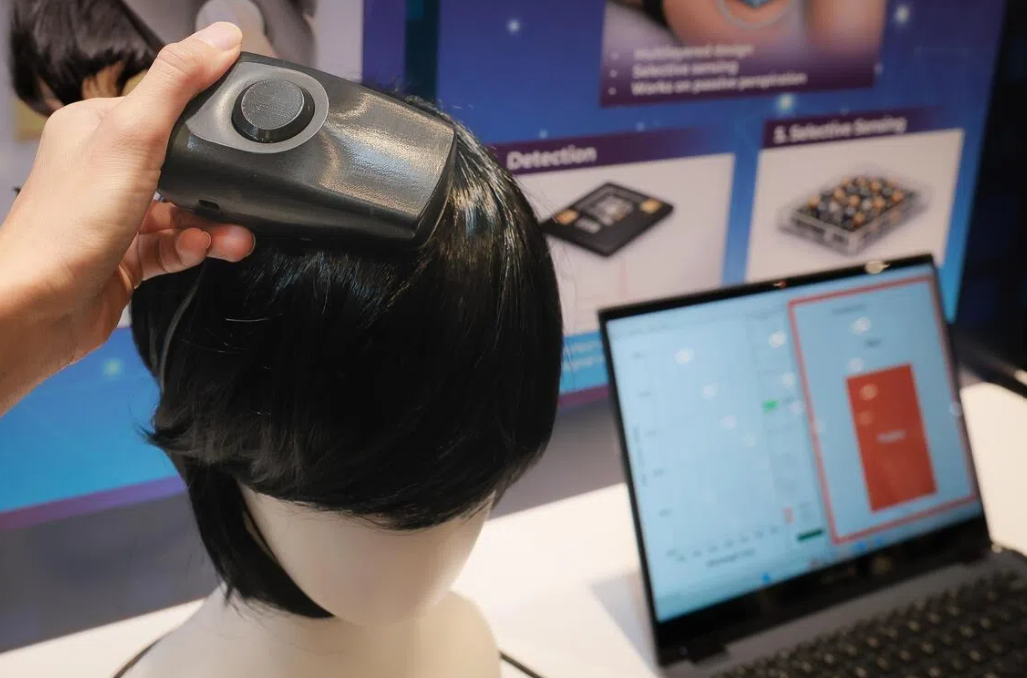
Singapore is pioneering a non-invasive hair-scanning technology that can detect drug use in less than 60 seconds, marking a significant advancement in how regional law enforcement agencies approach narcotics investigations. The device, roughly the size of a laptop mouse, requires no hair samples to be cut or extracted, making it far less intrusive than traditional screening methods. Clipped directly onto a person's hair, the scanner employs spectroscopy to measure wavelengths of light absorbed or emitted by hair fibres, delivering results instantaneously on a connected laptop display.
The technology was unveiled at the CNB Workplan Seminar 2026 held at Singapore Expo on July 22, where it was showcased as part of Singapore's evolving arsenal against drug trafficking and abuse. Developed in-house by the Home Team Science and Technology Agency (HTX), the hair scanner represents a distinctly Singapore innovation—forensic scientist Ong Sheau Wei from HTX's Forensic Centre of Expertise confirmed that Singapore is probably the only nation currently exploring such spectroscopy-based detection methods for identifying drug use. The initiative underscores how regional governments are turning to cutting-edge science to enhance investigative capacity and streamline law enforcement operations.
Beyond the hair scanner, Singapore's narcotics authorities are deploying artificial intelligence to transform how drug investigations are conducted. NarcoNet, jointly developed by the Central Narcotics Bureau and HTX, is an AI-enabled platform designed to drastically reduce the manual labour traditionally involved in assembling evidence and compiling investigative reports. The system can analyse a suspect's mobile phone data and chat communications across multiple languages, identifying incriminating discussions, photographs, or evidence of drug transactions that might otherwise be buried in vast digital footprints. This capability proves particularly valuable in Southeast Asia's increasingly complex digital criminal landscape, where suspects often communicate across borders and through encrypted channels.
A critical function of NarcoNet is its ability to automatically generate statements of facts—documents that previously required investigators to spend hours manually collating evidence and crafting narratives for prosecution. By instantly synthesising gathered information into a formal statement of facts, the platform dramatically accelerates case preparation and reduces opportunities for human error or inconsistency in evidence presentation. NarcoNet was scheduled for full deployment by the end of July, representing a significant operational shift in how the CNB processes drug cases. Such technological advancement has immediate relevance for neighbouring jurisdictions wrestling with similar investigative bottlenecks and growing caseloads.
Singapore has also introduced the Next Generation Reporting Centre, rolled out on July 1 at Tanglin Police Division, which automates the procurement and handling of urine samples—a critical component of drug-testing protocols. The system reduces direct officer contact with biological samples, thereby minimising health and hygiene risks while simultaneously improving operational efficiency. This seemingly technical innovation reflects broader efforts by the city-state to modernise frontline law enforcement practices and protect officer wellbeing during routine operations.
Yet behind these technological advances lies an alarming reality that extends across the entire Southeast Asian region. Senior Minister of State for Home Affairs Sim Ann, delivering the opening address at the seminar, painted a sobering picture of the global drug situation. In 2024 alone, approximately 331 million people aged 15 to 64 across the world had used drugs within the previous 12 months—a staggering 34 per cent increase over the preceding decade. The surge reflects not simply greater drug production but also deepening penetration of narcotics into mainstream society, affecting increasingly younger demographics and crossing traditional socioeconomic boundaries.
The methamphetamine threat looms particularly large in East and Southeast Asia. In June, the United Nations Office on Drugs and Crime reported that 349 tonnes of methamphetamine were seized across the region—a 48 per cent increase compared to the 236 tonnes seized in 2024. This dramatic jump indicates that drug production networks are not only more active but have also become more efficient at supplying regional markets. For Malaysia and other Southeast Asian nations, this escalation presents a direct security and public health challenge, as production facilities often operate across porous borders and supply networks span multiple countries.
Singapore itself continues to aggressively pursue drug syndicates. In 2025, the CNB dismantled 25 drug syndicates and seized drugs valued at over $23 million—substantial enforcement action reflecting the ongoing operational tempo against organised trafficking. However, the composition of those apprehended reveals a troubling demographic shift. Of the 1,188 newly arrested drug abusers in Singapore during 2025, exactly half were below 30 years old, indicating that younger generations are becoming drug users at alarming rates despite decades of education campaigns and enforcement efforts.
Cannabis presents a particular concern within this youthful cohort. Although methamphetamine remains the most commonly abused drug overall, cannabis abuse among young people has become increasingly prevalent, with one in two newly arrested cannabis abusers aged below 30. This pattern mirrors trends observed throughout Southeast Asia, where cannabis availability has increased due to regional production networks and evolving perceptions of the drug among younger users who may view it as less harmful than traditional narcotics. The shifting drug-use landscape demands that enforcement strategies be matched by equally sophisticated prevention and education initiatives.
Sim Ann emphasised that these arrest figures represent far more than abstract statistics. Each individual apprehended represents a young person whose life trajectory has been fundamentally altered—someone's child, a student, a neighbour, or a friend. The human dimension of the drug crisis underscores why Singapore and the broader Southeast Asian region must continuously innovate in both enforcement and prevention. Technological solutions like the hair scanner and NarcoNet address the operational side of the equation, but they cannot substitute for sustained community engagement and family-based prevention strategies.
Dr Chew Tuan Chiong, vice chairman of Singapore's National Council Against Drug Abuse, identified a critical vulnerability in current prevention approaches: many young people possess substantial knowledge about drugs, yet their parents often lack comparable understanding of drug-prevention strategies and factual information. When young people challenge parental assumptions with their own knowledge, unprepared parents risk providing incorrect information that may actually undermine credibility and reduce receptiveness to legitimate warnings. This generation gap in drug literacy suggests that prevention programmes across Southeast Asia must explicitly target parents and guardians, equipping them with accurate, current information so they can engage meaningfully with young people about narcotics risks.
For Malaysia and the broader region, Singapore's technological innovations and evolving drug enforcement strategies offer both lessons and a cautionary tale. The sophistication of drug production and distribution networks demands equally sophisticated detection and investigation tools, which the hair scanner and NarcoNet exemplify. Simultaneously, the persistent rise in young drug abusers—despite intensive enforcement—demonstrates that technology alone cannot solve what remains fundamentally a social and public health challenge requiring multifaceted responses spanning law enforcement, education, family engagement, and community support systems.

