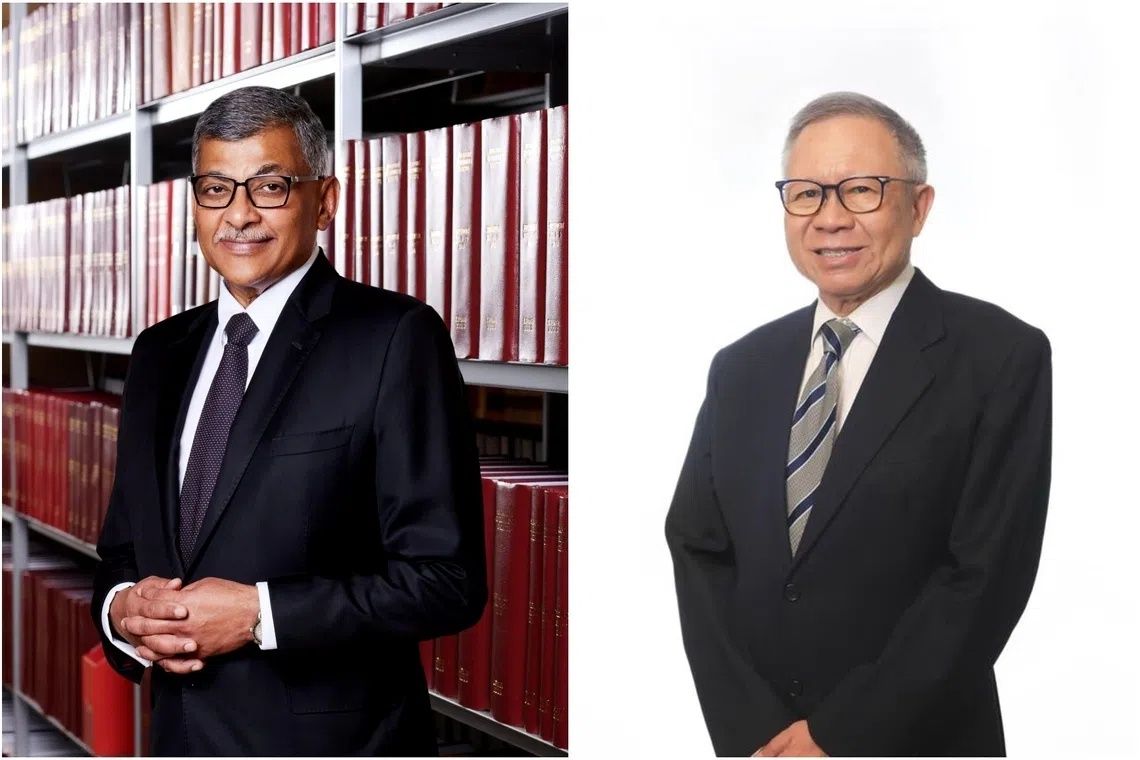
Chief Justice Sundaresh Menon and Eddie Teo, former chairman of Singapore's Council of Presidential Advisers, will receive the Order of Temasek (With Distinction) at this year's National Day Awards, marking the Republic's highest civilian honour. The recognition comes as part of a broader slate of 7,491 individuals being honoured for their service to the nation, reflecting Singapore's systematic approach to acknowledging public contributions.
Menon, 62, has spent the past 14 years steering Singapore's judiciary since his appointment in November 2012, with his tenure concluding on February 26, 2027. His leadership period has been marked by sweeping institutional transformation that positioned Singapore's legal system among Asia's most advanced. The Chief Justice oversaw a comprehensive modernisation agenda that extended far beyond routine administrative improvements, fundamentally reshaping how courts operate and how justice is delivered across the island state.
The judicial reforms undertaken during Menon's stewardship encompassed digital transformation initiatives that streamlined case management and public access to legal information. Equally significant was the establishment of the Appellate Division of the High Court, which created a structured appellate framework that enhanced judicial efficiency. The creation of the Singapore International Commercial Court represented a strategic push to position Singapore as a regional hub for cross-border dispute resolution, directly competing with established centres like Hong Kong and London in attracting high-value commercial litigation.
Beyond institutional architecture, Menon championed philosophical shifts in how courts approach their work. His promotion of therapeutic justice approaches in the Family Justice Courts and Youth Courts reflected growing recognition that traditional adversarial models sometimes undermine social rehabilitation outcomes. The establishment of the Singapore Judicial College as a dedicated institution for judicial education signalled commitment to continuous professional development among the bench, ensuring judges remained current with evolving jurisprudence and best practices.
In his response to the award, Menon framed the honour as recognition of collective effort rather than individual achievement, emphasising that Singapore's legal system represents contributions from judges, court staff, and the broader legal profession. He specifically noted that the timing coincided with the bicentennial of Singapore's legal and judicial institutions, lending historical resonance to the recognition. His comments reflected the hierarchical yet consensus-oriented approach characterising Singapore's governance, where individual achievements are typically positioned within broader institutional narratives.
Teo's career trajectory presents a parallel example of sustained institutional leadership. At 79, having retired from the Public Service Commission in 2018 after nearly five decades of service, Teo subsequently chaired the Council of Presidential Advisers until June 2026. His career arc began in 1970 within the Ministry of Defence's Security and Intelligence Division, rising to directorship by age 31—a trajectory suggesting both technical competence and organisational trust. He subsequently held the position of permanent secretary for defence from 1994 to 2000, overseeing one of the most strategically sensitive portfolios in a city-state dependent on military deterrence.
Teo's subsequent role as permanent secretary in the Prime Minister's Office from 1998 to 2005 positioned him at Singapore's governance centre, where he likely influenced policy across multiple domains. During his 2008-2018 tenure as Public Service Commission chairman, Teo broadened the commission's composition by recruiting members from academia, law, and social work—a deliberate diversification effort reflecting evolving views on meritocratic recruitment. This move acknowledged that excellence in public service extends beyond traditional career pathways, potentially expanding the talent pool available to government.
Teo's recollection of learning from Singapore's founding generation—including Lee Kuan Yew and Goh Keng Swee—underscores how institutional memory operates within Singapore's political system. These pioneer leaders shaped foundational approaches to governance that continue influencing contemporary policy frameworks. Teo's emphasis on this formative period suggests that understanding Singapore's governance model requires recognising the continuity of ideas and principles across generations of leaders.
A particularly instructive aspect of Teo's career involves his role during the Covid-19 pandemic. When the Government drew approximately S$40 billion (US$31.3 billion) from past reserves—the largest such withdrawal in Singapore's history—the Council of Presidential Advisers conducted thorough deliberations before granting approval. This institutional check, which Teo navigated as CPA chairman, demonstrates Singapore's constitutional architecture, wherein accumulated reserves function as a constraint on executive spending. The outcome enabled Singapore to stabilise its economy and preserve employment without accumulating substantial public debt, reflecting policy continuity and fiscal discipline across multiple administrations.
Teo's closing remarks about encouraging others to pursue public service careers merit consideration, particularly in Southeast Asia's contemporary context. Singapore's competitive labour market increasingly draws talented individuals toward private sector opportunities offering superior compensation. Teo's attempt to legitimise public service as fulfilling and substantive work addresses a genuine challenge facing Singapore and comparable developed economies: maintaining public sector recruitment and morale amid private sector competition. His 56-year career serves as testimony that government employment can offer meaningful engagement with consequential policy questions.
The broader National Day Honours cohort also recognised contributions across multiple domains. Alan Chan, 73, received the Distinguished Service Order for his leadership at the Land Transport Authority since 2016, overseeing significant infrastructure projects including the Thomson-East Coast Line and improvements to rail reliability—the latter metric improving dramatically from 393,000 to two million kilometres between failures. Edmund Cheng, 73, also received this honour for aviation sector contributions and involvement in ex-offender rehabilitation and arts promotion.
For Malaysian observers, Singapore's systematic recognition of institutional leadership offers relevant comparative context. Both jurisdictions grapple with questions about meritocratic governance, institutional continuity, and intergenerational knowledge transfer within public services. Singapore's deliberate approach to honouring sustained service—spanning both Menon's judicial modernisation and Teo's cross-portfolio administrative experience—reflects a governance model that prioritises long-term institutional development over short-term political cycles. The specific emphasis on rule of law strengthening and judicial independence resonates particularly in Southeast Asia, where legal system robustness increasingly influences international confidence in governance and investment decisions.

