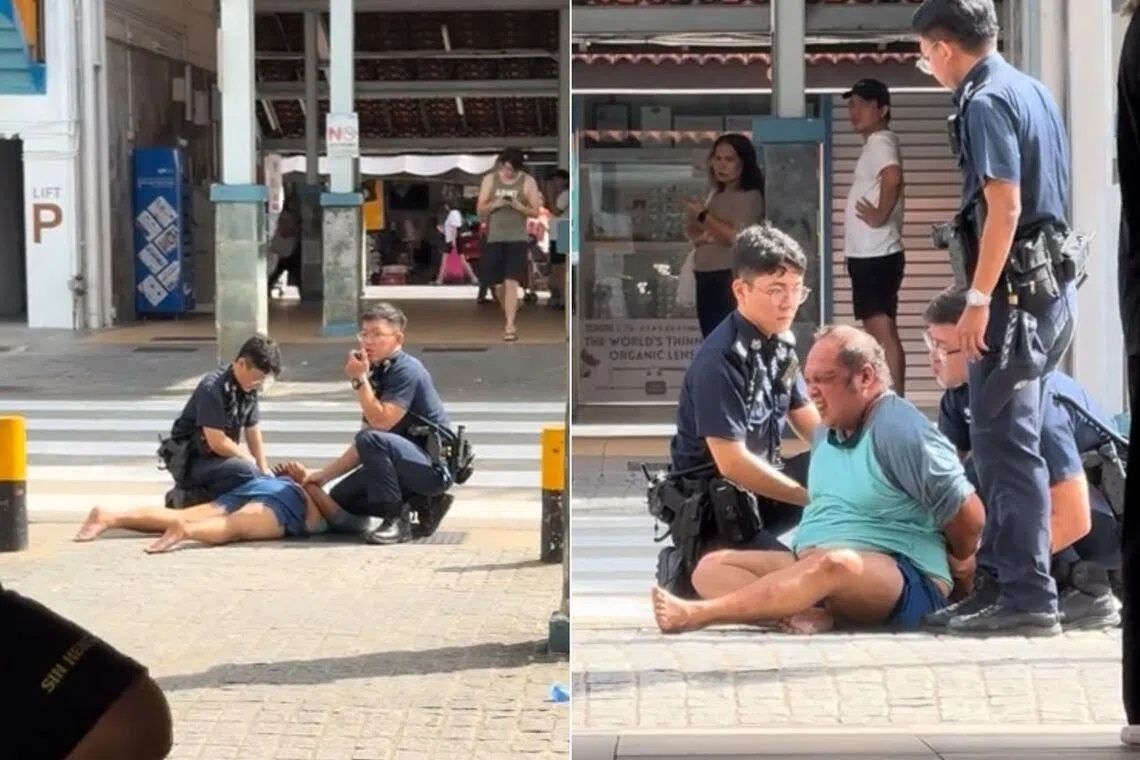
A man is under arrest in Singapore's Toa Payoh area after a Sunday morning incident that saw him engage in indecent behaviour before physically attacking a police officer who responded to the scene. The 36-year-old suspect was detained following the confrontation at Block 184 Toa Payoh Central, where officers had arrived to address complaints of disruptive conduct in a local coffee shop around 9.45am on June 28.
The Singapore Police Force confirmed receiving a call for assistance at the coffee shop location during the mid-morning period. Details about the nature of the disturbance that prompted the initial complaint remain limited, though authorities indicated the man's behaviour had warranted intervention by law enforcement. The situation deteriorated as officers attempted to take the suspect into custody, with the confrontation captured by bystanders and subsequently shared across social media platforms.
According to police statements, the suspect resisted apprehension by striking a uniformed officer across the face with his fist. The assault on the officer represented a deliberate act of violence against a person performing official duties, complicating what might otherwise have been a more straightforward incident response. Video footage posted online by TikTok user Kee Wee Shang depicts multiple officers physically restraining the barefooted man on the ground as they worked to secure his compliance.
Additional video material from the same social media account shows the expanded police presence at the scene, with a third officer visible during the detention process. The footage documents the subsequent moments when the restrained suspect, now handcuffed, was escorted away from the coffee shop by the responding officers. The visual record of the incident provided by the bystander offered a real-time account of how the situation unfolded during the enforcement action.
The charges levelled against the arrested individual reflect both the initial indecent conduct and the subsequent violence directed at police. Authorities have indicated the 36-year-old faces allegations of committing an obscene act in public, alongside a second charge concerning voluntarily causing hurt to deter a public servant from performing official functions. The second charge carries particular gravity, as assaults on police officers conducting their duties represent serious infractions within Singapore's legal framework designed to protect law enforcement personnel from violence.
The 19-year-old police officer who bore the brunt of the punch sustained minor injuries during the altercation. Despite the physical impact, the young officer remained conscious and was transported to hospital for medical evaluation and treatment. The relatively contained nature of the officer's injuries stood in contrast to what could have resulted from such a direct facial assault, though any violence against uniformed personnel generates significant concern within Singapore's policing communities.
The incident underscores the occupational risks faced by frontline police officers responding to public disturbances across Singapore's residential estates. Coffee shops and neighbourhood gathering spaces occasionally become flashpoints for behavioural incidents that require police intervention, with outcomes varying considerably depending on the cooperation of those involved. When such situations escalate to physical confrontation, the potential for officer injury rises substantially, reflecting broader challenges law enforcement agencies navigate daily.
From a regional perspective, Singapore's approach to public order offences and assaults on police represents a stringent enforcement model that maintains relatively high standards of officer safety through legal structures with meaningful penalties. This contrasts with approaches in some neighbouring jurisdictions where officer assault cases may receive lesser prioritisation or legal consequence. The incident also reflects evolving patterns of public incident documentation through social media, which has become routine in urban Southeast Asia.
The ongoing police investigation will likely examine the sequence of events leading to the initial disturbance, the factors motivating the suspect's resistance and assault, and any medical or behavioural considerations relevant to the case. Investigators will also review available video evidence and witness accounts to establish a comprehensive factual record. Such investigations into officer assaults typically receive heightened scrutiny given their implications for workplace safety and the appropriate application of force during arrest procedures.
The case highlights tensions inherent in public order enforcement, where police must balance responsiveness to community complaints with personal safety during interactions with individuals experiencing acute behavioural or mental health crises. For Malaysian readers familiar with similar policing scenarios in domestic contexts, the incident illustrates how different jurisdictions calibrate their legal responses and resource deployment when confrontations occur. The outcome here—successful apprehension despite resistance and assault—reflects training protocols and procedural frameworks that Singapore's police service has developed over decades.

