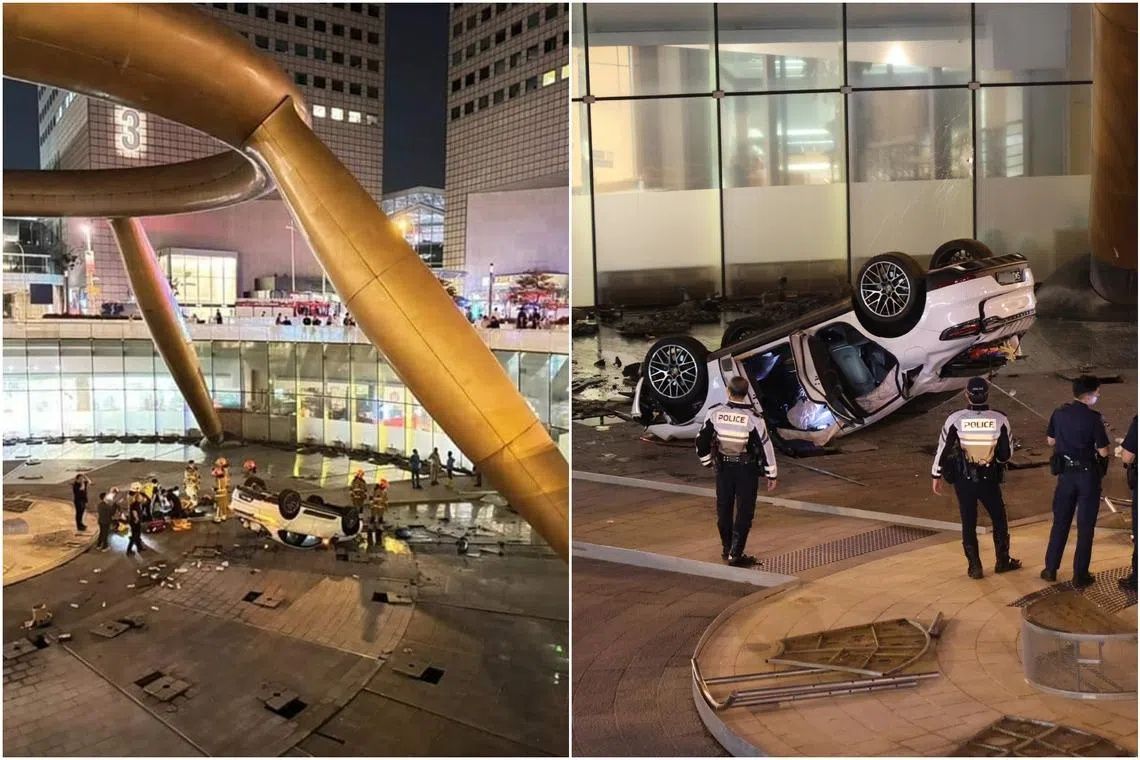
A Singaporean motorist has faced justice for one of the city-state's most dramatic drink-driving incidents, resulting in his vehicle crashing spectacularly into the grounds of the Fountain of Wealth at Suntec City. Then Shing Chong, 58, was sentenced to five weeks in jail on Tuesday after pleading guilty to driving in a dangerous manner. The District Court also imposed a mandatory driving ban of two-and-a-half years from the date of his release, reflecting the severity of his transgression and the judicial commitment to removing dangerous drivers from Singapore's roads.
The sequence of events that led to the July 2024 collision began in the evening when Then left his residence to socialise at Suntec City shopping mall. He parked his vehicle in the basement carpark around 6 pm and proceeded to a bar, where he consumed approximately one litre of beer over a six-hour period between 6:15 pm and midnight. This extended drinking session, combined with medication he had allegedly taken earlier—either an antihistamine or sleeping pill—significantly impaired his cognitive and motor functions, though blood alcohol levels were not formally tested following the accident due to his hospitalisation.
When Then eventually exited the carpark and navigated onto Temasek Boulevard, his impaired state became immediately apparent in his driving behaviour. As he approached a roundabout that required a left turn, he failed to maintain directional focus and instead continued driving straight, crossing three traffic lanes in the process. His vehicle then breached the security barricade surrounding the iconic Fountain of Wealth and plummeted into the basement of the fountain structure. The impact caused substantial structural damage estimated at nearly S$64,600, which the defendant has since fully reimbursed.
What might have been a far more catastrophic incident was narrowly averted when three construction workers who were present at the fountain's basement at the time of the collision managed to escape the danger zone without sustaining injuries. During the sentencing hearing, Deputy Public Prosecutor Gladys Lim emphasised this fortunate outcome, noting that had the workers been positioned directly in the path of the descending vehicle, the consequences would have been devastating. This observation underscored how drink-driving carries consequences extending beyond property damage to pose genuine threats to human life.
The immediate aftermath of the crash saw Then transported to Tan Tock Seng Hospital's emergency department with injuries including a lacerated scalp, while specialized equipment was mobilised to extract his vehicle from the fountain. A lorry crane was deployed to lift the damaged car from the water before it could be towed away, adding further complexity and cost to remedying the situation. The incident had drawn significant public attention as an emblematic case of the dangers posed by impaired driving in an urban environment.
During the court proceedings, Then's legal representatives from Invictus Law Corporation—Josephus Tan, Cory Wong, and Devlin Mohyong—mounted a defence centred on mental health considerations. They presented an Institute of Mental Health report indicating that their client had been diagnosed with major depressive disorder at the time of the incident and argued for a mandatory treatment order rather than custodial sentencing. Under such an arrangement, offenders would undergo psychiatric and medical treatment to address underlying mental health conditions instead of serving jail time, a mechanism intended to address root causes of criminal behaviour.
The prosecution, however, robustly opposed this approach, with the Deputy Public Prosecutor arguing that the case demanded deterrent sentencing principles. The state's position reflected broader concerns about drink-driving as a persistent public safety threat in Singapore, where education campaigns and enforcement efforts have long emphasised the unacceptable risks associated with combining alcohol consumption and vehicle operation. Lim's submissions to the court stressed that irrespective of any psychiatric considerations, the reckless decision to drive after consuming substantial quantities of alcohol warranted punitive consequences.
District Judge Koo Zhi Xuan ultimately sided with the prosecution's deterrence argument, rejecting the call for a mental health report assessment and proceeding directly to sentencing. The judge's decision emphasised that drink-driving constituted highly irresponsible behaviour that could not be excused or mitigated through reference to mental health conditions alone. He noted that Then's offence had resulted in significant property damage and, more crucially, had created genuine potential for serious injury or death to innocent parties, factors that weighed heavily in the sentencing calculation.
The outcome reflects Singapore's increasingly stringent approach to traffic safety violations, particularly those involving alcohol impairment. The five-week custodial sentence, while not lengthy by some standards, carries considerable weight in a jurisdiction where rehabilitation and deterrence are prioritised in sentencing frameworks. The additional driving prohibition serves to protect other road users by removing a demonstrably dangerous motorist from circulation for an extended period, affording time for reflection and, potentially, completion of drink-driving awareness programmes.
For Malaysian observers, the case offers instructive comparisons regarding how neighbouring jurisdictions handle drink-driving enforcement and sentencing. While Malaysia's legal framework addressing impaired driving has evolved over recent years, Singapore's approach demonstrates how consistent application of serious penalties can reinforce public messaging about the incompatibility of alcohol consumption and vehicle operation. The case also illustrates how even apparently fortunate outcomes—where no deaths occurred—can still result in substantial jail sentences when the underlying conduct demonstrates recklessness toward public safety.
The broader implications extend to discussions within Southeast Asia about traffic safety standards and judicial consistency in addressing drink-driving. As urban populations across the region grow and vehicle ownership increases, jurisdictions continue refining approaches to preventing alcohol-related traffic incidents. The Suntec fountain incident, with its dramatic visual impact and significant property damage, serves as a cautionary example of how quickly a decision to drive under the influence can transform from a personal choice into a public spectacle with legal, financial, and safety ramifications that extend far beyond the individual motorist.

