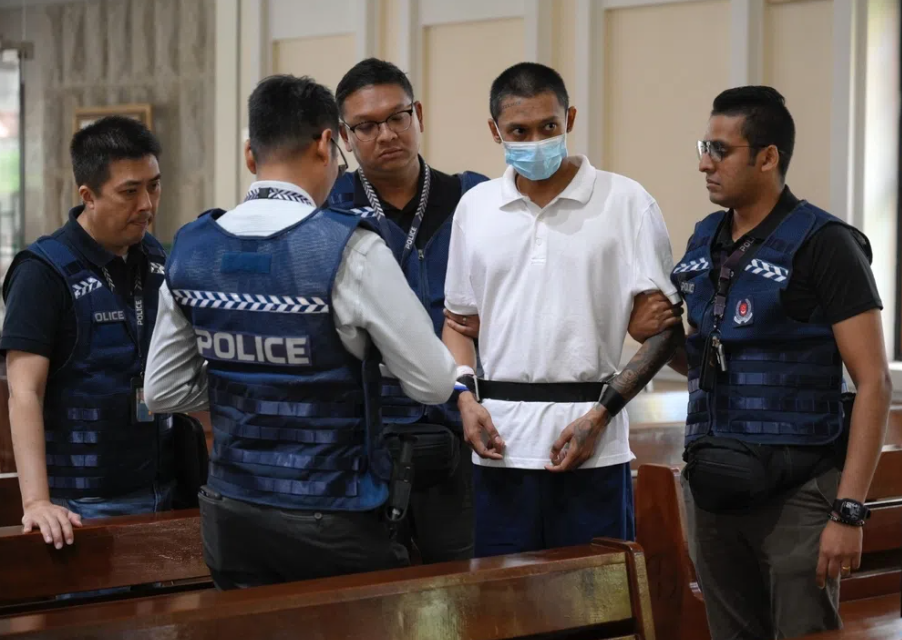
A 38-year-old Singapore man has been handed a jail term exceeding four years and ordered to receive nine strokes of the cane for stabbing Reverend Christopher Lee during a children's mass at St Joseph's Church in November 2024. Basnayake Keith Spencer pleaded guilty on Friday to charges of voluntarily causing grievous hurt with a dangerous weapon and unlawful weapon possession, bringing to a close a case that shocked Singapore's religious community and raised broader questions about public safety during worship.
The attack unfolded on the evening of November 9, 2024, when around 900 parishioners had gathered for mass. Basnayake arrived at the church alone shortly before 5.30pm and initially seated himself in the middle of the church hall. As the service progressed toward communion, he consumed five pills in total—two to maintain focus and three more to calm himself after realizing children would be present at the mass. His actions suggest a level of deliberation that concerned the prosecution and ultimately influenced the sentencing.
During the distribution of communion around 6.15pm, Basnayake positioned himself in a queue behind Father Lee, who was administering the sacrament alongside another priest. When his turn arrived, Basnayake abruptly withdrew a 23-centimetre foldable knife with a 10-centimetre blade and thrust it directly into the priest's mouth. The assault was sudden and violent, leaving Father Lee with severe lacerations including an 8-centimetre wound to his tongue, a 3-centimetre cut on his upper left lip, and a 4-centimetre injury at the corner of his mouth. Blood pooled heavily in and around the priest's mouth as he stepped backward from the shock.
Father Lee's quick thinking prevented further casualties. Despite his injuries, he grabbed the rear pocket of Basnayake's jeans to immobilize him and prevent additional attacks on other congregation members. Members of the gathered faithful, including an off-duty police officer, swiftly intervened, restraining Basnayake and alerting authorities. He was arrested at the scene without further incident. The rapid response from parishioners likely prevented what could have been a far more catastrophic outcome given the large number of children present.
Investigations revealed that Basnayake had armed himself extensively. Beyond the knife used in the assault, police found a 14.5-centimetre penknife, a flip knife, and a fishing gaff—a pole fitted with a sharp hook—when they searched him following his arrest. This arsenal suggested premeditation or at minimum a dangerous state of mind. The discovery of multiple weapons added weight to prosecution arguments that he posed a significant ongoing threat to public safety.
Father Lee was admitted to hospital immediately following the attack and received six days of acute care before discharge on November 15. He was subsequently granted 40 days of hospitalization leave and required months of speech therapy to address the damage inflicted by the blade wound to his tongue and mouth. The long-term effects of such trauma extend beyond physical healing; religious leaders subjected to violent assault within their place of worship often experience profound psychological impacts that affect their capacity to minister effectively to their congregations.
Basnayake's history provided context for the sentencing. In 2019, he had been convicted of a similar offense—voluntarily causing hurt with a dangerous weapon—for which he received a one-year jail sentence. That conviction stemmed from an incident in which he stabbed his then-girlfriend in the buttocks with a kitchen knife while under the influence of methamphetamine. The pattern of violence, drug involvement, and weapon use across multiple years demonstrated what the court characterized as a high risk of reoffending.
The prosecution presented evidence that Basnayake was intoxicated and in a drug-induced psychotic state during the November attack, yet argued this did not completely absolve him of responsibility. Prosecutors contended he retained a degree of awareness when he perpetrated the assault and urged the court to impose a sentence between four years and three months and four years and eleven months, alongside nine strokes of the cane. The defense argued for a more lenient approach, seeking less than four years imprisonment and caning, with Basnayake's lawyer emphasizing that his client expressed remorse, shame, and regret for his actions.
District Judge Shaiffudin Saruwan ultimately sided substantially with the prosecution's recommendation. In sentencing Basnayake to four years and three months' imprisonment and nine strokes of the cane, the judge emphasized that the attack was entirely unprovoked and inflicted severe physical trauma on an innocent, defenseless man. The judge further noted the gravity of the offense being committed at the precise moment Father Lee was administering the Eucharist, a sacred ritual central to Catholic worship. This timing created genuine potential for mass panic within the crowded church and risk of additional injuries had not parishioners intervened so decisively.
Basnayake had been held in remand for more than a year and nine months pending trial, meaning he has already served a substantial portion of his sentence. His bail had been denied in December 2024 after prosecutors successfully argued that his degree of dangerousness and high reoffending risk made release unjustifiable. The case underscores the vulnerability of religious spaces and the individuals who lead worship, a concern that extends across Singapore's diverse faith communities. It also highlights how substance abuse and mental health crises can intersect with violence to create unpredictable threats in ostensibly safe public settings.
The sentencing carries implications for Southeast Asian religious institutions more broadly. Houses of worship across Malaysia, Singapore, and the broader region generally operate with minimal security measures, reflecting theological commitments to openness and hospitality. Yet this attack demonstrates the risks inherent in maintaining such accessibility in contemporary urban environments where drug-related mental health crises and impulses toward violence touch virtually all communities. The case may prompt renewed discussions about balancing spiritual principles of welcome with practical security considerations.

