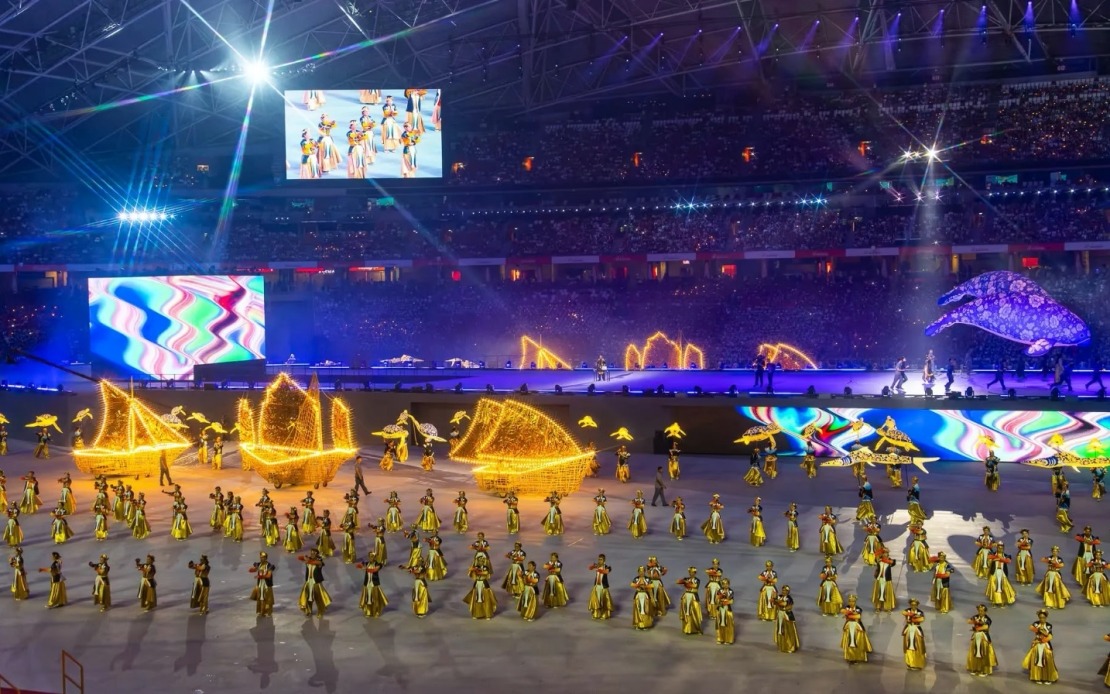
Singapore's 61st National Day celebrations unfolded on Sunday with a ceremonial milestone that underscores the island nation's evolving approach to public commemoration. The National Day Parade, absent from the National Stadium for a decade, has made its return to the venue under the thematic banner "Majulah Singapura, Go Beyond!" marking a symbolic reclamation of the historic space as the centrepiece of the republic's annual patriotic observance. President Tharman Shanmugaratnam and Prime Minister Lawrence Wong presided over the proceedings alongside Cabinet ministers and Members of Parliament, lending formal state gravitas to an event that drew approximately 42,000 members of the general public to the stadium, resplendent in the traditional red and white national colours.
The pageantry introduced several firsts to Singapore's ceremonial traditions, reflecting an institutional willingness to innovate within the framework of established protocols. For the inaugural time in the nation's 61-year history, both the Presidential Gun Salute and the State Flag Flypast were executed not solely within the stadium's confines but extended into the Kallang Basin itself. This geographical expansion fundamentally altered the experiential landscape of the celebration, enabling a substantially larger cross-section of the community to participate in the ceremonial proceedings. Four 25-pounder Howitzer guns, mounted on Mobility 3rd Generation rafts, traversed the water, transforming the basin into an extension of the parade ground and bringing the visceral experience of the salute closer to thousands of additional spectators positioned throughout the broader Kallang precinct.
The gun salute itself demonstrated considerable logistical coordination and symbolic weight. The traditional 21-gun sequence comprised 151 service members drawn from the 23rd Battalion of the Singapore Artillery and the 35th Battalion of Singapore Combat Engineers, underscoring the martial components of the national commemoration and the role of the armed forces in Singapore's security architecture. The ceremonial dimension commenced at approximately 6 pm with what organisers termed the parade and ceremony segment, framed around the concept of "Go Beyond Self." This philosophical underpinning suggests a deliberate thematic progression, inviting citizens to contemplate collective advancement beyond individual constraints.
The parade composition reflected careful orchestration encompassing 32 distinct contingents mobilising more than 2,000 total participants in coordinated formation. The architecture of participation included six Guard of Honour contingents, ten units representing uniformed youth organisations, and sixteen supporting contingents, alongside the Singapore Armed Forces Colours Party serving as the ceremonial focal point. These Guard of Honour contingents, collectively comprising 72 participants, drew representation from across Singapore's security apparatus: the Singapore Army, Republic of Singapore Navy, Republic of Singapore Air Force, the Digital and Intelligence Service—itself a relative institutional newcomer—the Singapore Police Force, and the Singapore Civil Defence Force. This breadth of representation underscores the comprehensive militarisation of state pageantry and the integration of emerging security domains into traditional ceremonial frameworks.
Beyond the formal parade segment, the evening featured a substantial entertainment and performance component designated the "NDP 2026 show segment," which deployed 36 professional artistes and more than 2,600 performers to articulate the overarching thematic message. This production element, substantially larger in personnel than the ceremonial parade itself, centred its narrative architecture around authentic Singaporean stories, technological innovation, and an accompanying musical composition designed to generate emotional resonance. The performance component functioned as the interpretive and humanising counterweight to the martial formality of the ceremonial sections, translating abstract national ideals into tangible cultural expression.
A particularly notable dimension of this year's performance programming involved the deliberate inclusion of performers from marginalised demographic categories within Singapore's social structure. Seven dancers representing diverse backgrounds participated in the show, among them an autistic dancer and a dancer with Down syndrome. This explicit choreographic inclusion, far from being merely decorative multiculturalism, carries substantive messaging regarding inclusivity and the philosophical scope of national citizenship. The symbolic declaration that every Singaporean, irrespective of background or physical capability, possesses the capacity to contribute meaningfully to the nation's collective future represents an important articulation of inclusive citizenship ideals, particularly given Singapore's historical emphasis on meritocratic frameworks that can inadvertently marginalise individuals with disabilities.
For Malaysian observers, Singapore's National Day commemoration offers instructive contrasts and comparative insights into neighbouring state ceremonial practices. Both nations employ national days as occasions for performing sovereignty and mobilising collective identity through orchestrated public spectacle, yet Singapore's approach demonstrates increasing sophistication in scale of production and inclusivity of participation. The decision to reactivate the National Stadium venue after a decade-long hiatus reflects broader urban planning and cultural revitalisation objectives beyond mere ceremonial restoration. The expansion of ceremonial geography into the Kallang Basin suggests a conscious effort to democratise access to official ceremonies, preventing them from remaining confined within controlled stadium environments accessible only to ticketed attendees.
The thematic emphasis on "going beyond"—whether individual self-interest, traditional boundaries, or conventional thinking—resonates with Singapore's perpetual negotiation of its precarious geopolitical position and resource constraints. As a city-state dependent upon regional integration and international partnership for survival, the rhetorical invocation of transcendence and innovation reflects both necessity and aspiration. This messaging, disseminated across 42,000 direct participants plus mediated audiences through broadcast and digital channels, constitutes an important moment in the official production of national identity and the articulation of state priorities to both domestic and international audiences.
The ceremonial innovations introduced at this year's National Day Parade—particularly the waterborne gun salute and the deliberate inclusion of performers with diverse abilities—represent evolutionary adjustments to Singapore's ceremonial traditions. These modifications suggest receptiveness to contemporary values regarding accessibility and representation while maintaining the essential architecture of state pageantry and military symbolism. The scale of production, involving thousands of participants and elaborate coordination across multiple service branches, demonstrates the resource capacity and institutional sophistication available to the Singapore state apparatus. For the Southeast Asian region, Singapore's National Day ceremonies continue to exemplify the integration of tradition and modernity, martial discipline and artistic expression, and state authority with explicit appeals to inclusive citizenship ideals.

