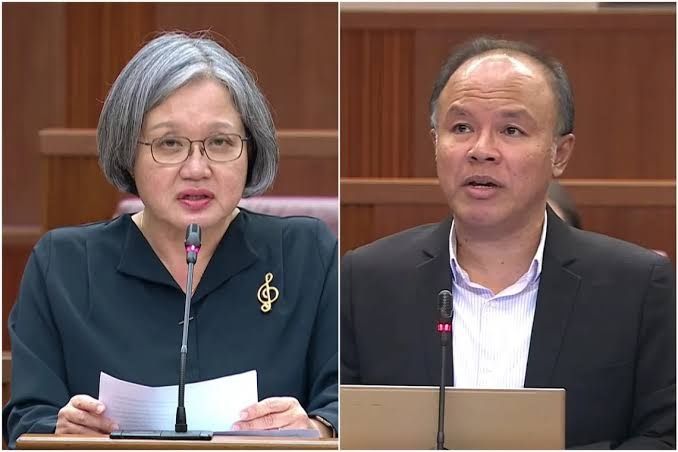
The Singapore Parliament has formally closed a politically sensitive chapter by declining to pursue disciplinary action against Workers' Party leaders Sylvia Lim and Faisal Manap, with Leader of the House Indranee Rajah announcing on July 7 that the legal framework no longer permits penalties to be imposed. The decision hinges on technical provisions within the Parliament (Privileges, Immunities and Powers) Act that create a temporal constraint on Parliament's enforcement powers, a development with implications for how regional legislatures interpret their own privilege and contempt mechanisms.
The underlying controversy stretches back to 2021, when former Sengkong GRC MP Raeesah Khan fabricated an anecdote about police conduct during a parliamentary speech. The subsequent parliamentary investigation, conducted by the Committee of Privileges, discovered that Khan had lied and that three Workers' Party figures—party leader Pritam Singh, then-Aljunied MP Sylvia Lim, and fellow Aljunied MP Faisal Manap—had provided false testimony to investigators. Most critically, the committee found that Pritam had instructed Khan to "take her lie to the grave" during an August 2021 meeting, with Lim and Faisal present but both denying the conversation had occurred.
Parliament's handling of the three leaders diverged significantly based on the severity of their individual conduct. Recognising that Pritam's direction to Khan represented the most egregious breach, Parliament referred him alone to Singapore's public prosecutor for independent criminal investigation and prosecution, affording him the procedural protections of the court system. In contrast, Lim and Faisal were characterised by Indranee as playing "subsidiary" roles and as having been "somewhat helpful to the committee, albeit in a limited way." Rather than immediately pursuing parliamentary sanctions against the two MPs, Parliament opted to defer action pending the outcome of Pritam's criminal trial, positioning this as a measure of fairness to Lim and Faisal.
That deferral strategy ultimately proved consequential. Pritam was convicted by the District Court in February 2025 of lying to Parliament but appealed the conviction. The High Court upheld his conviction in December 2025, confirming the Committee of Privileges' findings that Lim and Faisal had indeed provided false statements. However, the passage of time meant that Parliament's enforcement window had closed. Indranee explained that under Section 22 of the Parliament (Privileges, Immunities and Powers) Act, the legislature can only punish offences committed either in the current parliamentary session or in the final session of the immediately preceding Parliament.
The temporal obstacle stems from Singapore's parliamentary calendar structure. The 14th Parliament, during which Khan's lie and the subsequent false testimony occurred in the first session, was dissolved following the 2025 general election. The 15th Parliament commenced in September 2025 after the election concluded. Since Lim and Faisal's dishonest statements to the Committee of Privileges took place during the first session of the 14th Parliament—not the second session—they fall outside the window of offences that the new Parliament can address. This procedural technicality, though entirely unintentional, effectively insulated the two MPs from parliamentary discipline even though the High Court had validated every factual finding against them.
Indranee acknowledged the frustration inherent in this outcome, noting that "had the timelines been different, I would have proposed a different course of action." She observed that Parliament had acted within its discretion to give Lim and Faisal "the benefit of the doubt for the time being" in 2021 by deferring action, a compassionate choice that inadvertently created legal jeopardy when circumstances changed. The decision to wait for Pritam's criminal proceedings to conclude before determining how to handle the subsidiary participants was intended to ensure fair treatment, yet the intervening election cycle negated Parliament's ability to follow through on that plan.
Parliament is not entirely without remedies. Indranee confirmed that the House retains the theoretical power to pass a motion expressing disapproval or regret at the conduct of Lim and Faisal, a symbolic gesture that carries political weight despite lacking formal disciplinary consequences. However, she argued that Parliament had already communicated its position unambiguously in January when it passed a motion declaring Pritam Singh unsuitable as Leader of the Opposition—a powerful signal of institutional disapproval for lying to Parliament and its committees. This earlier motion, she suggested, rendered an additional expression of regret redundant and potentially anticlimactic.
The closure of this matter comes approximately one week after the Workers' Party itself navigated the controversy during its internal elections and cadre meeting on June 28. Party members voted to retain Pritam as leader despite his conviction, demonstrating that the membership viewed his misconduct as insufficiently grave to warrant removal from his position. This internal affirmation by the party base preceded Parliament's formal acknowledgment that legal constraints prevented further institutional action, suggesting a degree of alignment between the party's judgment and parliamentary reality.
The case raises important questions about parliamentary privilege enforcement in Commonwealth legislatures and the unintended consequences of procedural delays. Malaysia's own Parliament operates under broadly comparable privilege frameworks, and this Singapore precedent illustrates how temporal provisions designed to ensure finality can inadvertently permit escape from accountability when external circumstances—such as electoral cycles—intervene. Indranee's statement emphasised that "the law, in this case the time bar provisions of PPIPA, must be observed," indicating Parliament's commitment to respecting its own legal boundaries even when doing so produces an outcome perceived as unsatisfying.
Lim responded briefly to Indranee's ministerial statement, confirming she did not object and reiterating that she had already addressed the substantive issues during January's motion debate. She highlighted that references to her in Pritam's appeal judgment rested on prosecution evidence presented in court, where she had no opportunity to defend herself because she was not called as a witness. This defence underscores a distinction between court findings and parliamentary committee conclusions—a nuance that may complicate public perception of accountability in cases where MPs face accusations in different institutional forums.
For regional observers, the episode illustrates both the strengths and limitations of parliamentary privilege systems. These mechanisms exist to protect institutional integrity and punish contempt, yet their operation depends on procedural compliance and timely action. The confluence of Pritam's protracted legal appeals and Singapore's 2025 general election created a fortuitous escape route for Lim and Faisal despite overwhelming evidence of their dishonesty. Whether this outcome will prompt Commonwealth parliaments to revisit time-bar provisions or whether it will be accepted as an inevitable cost of procedural regularity remains an open question with implications for legislative accountability across Southeast Asia and beyond.

