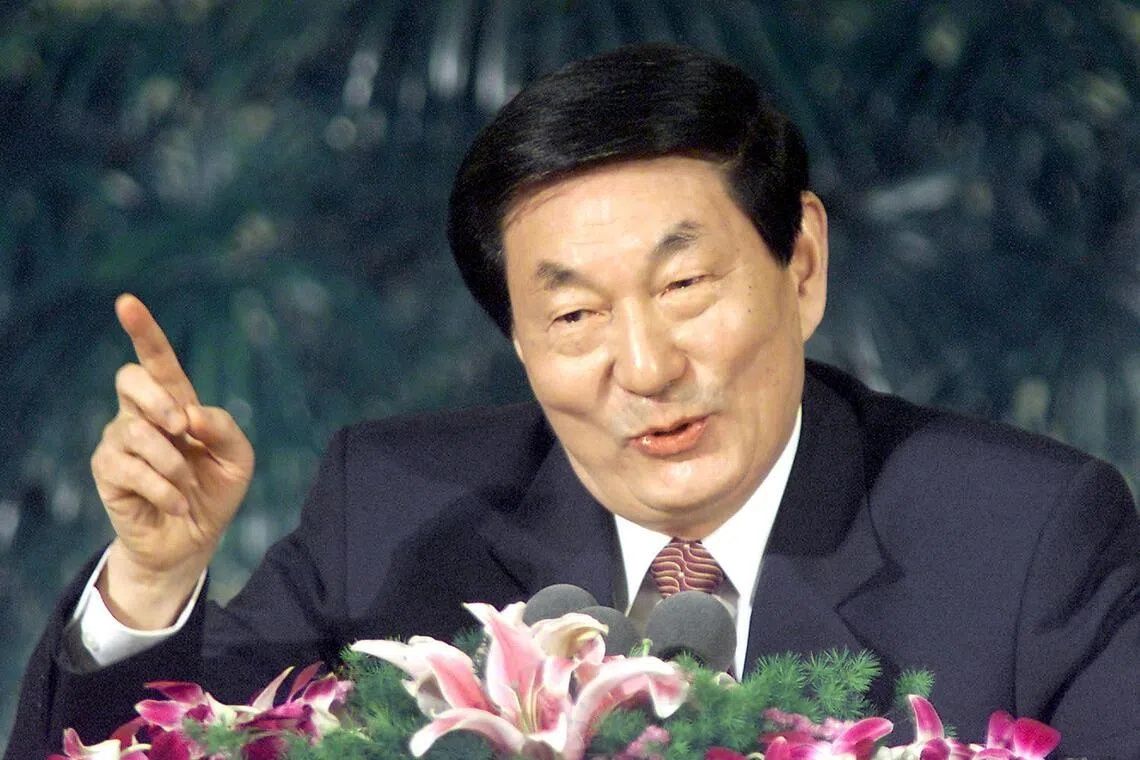
Singapore Prime Minister Lawrence Wong has extended formal condolences to Chinese Premier Li Qiang following the passing of Zhu Rongji, one of modern China's most influential economic architects. Zhu died in Beijing on Wednesday, August 12, just weeks before what would have been his 98th birthday, according to state news agency Xinhua. The death of the former premier marks the end of an era for those who remember China's transformative economic opening and its integration into the global trading system at the turn of the millennium.
In his formal letter dated August 13, PM Wong acknowledged Zhu's remarkable career spanning decades of public service, during which he became synonymous with China's market-oriented economic reforms. The Singapore leader specifically highlighted Zhu's instrumental role in steering China's accession to the World Trade Organization in 2001, a watershed moment that fundamentally altered the country's relationship with global commerce and set the stage for decades of rapid growth. This achievement remains relevant to Southeast Asian policymakers today, as China's WTO membership fundamentally reshaped regional trade patterns and investment flows that continue to influence economies across the Association of Southeast Asian Nations.
PM Wong's tribute underscored a significant personal dimension to Singapore-China relations by characterizing Zhu as an old friend of the island nation. Over his career, Zhu maintained warm diplomatic ties with Singapore's senior leadership, meeting on numerous occasions with former prime ministers Lee Kuan Yew and Goh Chok Tong. These connections, forged during the critical decades of the 1990s and 2000s, helped establish a foundation of trust and understanding between the two governments during a period when regional dynamics were shifting rapidly due to China's rise.
A particularly noteworthy aspect of Zhu's relationship with Singapore was his pioneering participation in the Singapore Lecture in 1999, becoming the first Chinese leader to address this prestigious annual forum organized by the ISEAS – Yusof Ishak Institute. His presence at this high-profile platform, where global statesmen and leading intellectuals share perspectives on international affairs, reflected China's growing confidence in engaging regional thought leaders on substantive policy matters. The timing of his appearance, coinciding with the eve of China's WTO entry, demonstrated his commitment to building understanding about China's economic trajectory among Southeast Asian elites.
During that Singapore Lecture address, Zhu articulated a vision that has proven remarkably prescient and has become a cornerstone of contemporary regional integration efforts. He contended that China's economic development and expansion would generate substantial benefits not only for the country itself but for Asia and the broader international community. More significantly, he advanced the concept of establishing a free trade agreement between China and the Association of Southeast Asian Nations, an initiative aimed at strengthening economic linkages across the region. This proposal, which seemed visionary at the time, eventually materialized and has become one of the defining features of contemporary Asian trade architecture.
PM Wong observed that Zhu's strategic foresight has been vindicated by subsequent developments. Today, China stands as a cornerstone economic partner for Singapore and virtually every country in Southeast Asia, fundamentally reshaping regional commerce, investment patterns, and strategic considerations. The ASEAN-China Free Trade Area, which Zhu championed during that 1999 lecture, eventually became operational and has since been upgraded, demonstrating the staying power of his vision for deepened economic integration.
Beyond his work at the national level, Zhu's contributions to Singapore-China relations extended into specific bilateral projects that have proven highly successful. PM Wong highlighted Zhu's consistent support for the China-Singapore Suzhou Industrial Park, a pioneering government-to-government collaborative venture that served as a flagship demonstration of bilateral economic cooperation. When Zhu served as mayor of Shanghai, he similarly encouraged substantive exchanges between officials from that major city and Singapore, fostering mutual understanding and collaborative learning between administrators grappling with rapid urbanization and economic transformation.
These multifaceted initiatives—from national-level policy frameworks to city-level administrative cooperation—collectively established the institutional architecture and personal relationships that underpin contemporary Singapore-China ties. The breadth of Zhu's engagement across multiple levels of government interaction reflected a sophisticated understanding of how sustained economic partnerships are built through patient institution-building and relationship cultivation. For Malaysian observers and policymakers, Zhu's approach to regional economic statecraft offers instructive lessons about the long-term nature of strategic partnerships and the importance of consistent engagement across multiple channels and administrative levels.
PM Wong's final assessment placed Zhu's legacy firmly within the context of both national and bilateral dimensions. He will be remembered, according to the Singapore leader, not merely as an architect of China's internal economic transformation but as someone who understood that China's prosperity and stability were inextricably linked to its constructive engagement with neighboring regions. In this sense, Zhu represents a particular generation of Chinese leadership that combined domestic reform ambitions with genuine interest in building mutually beneficial relationships with Southeast Asia. His passing marks the conclusion of a significant chapter in the region's recent economic history, one in which visionary leadership from Beijing helped reshape the entire trajectory of Asian development.

