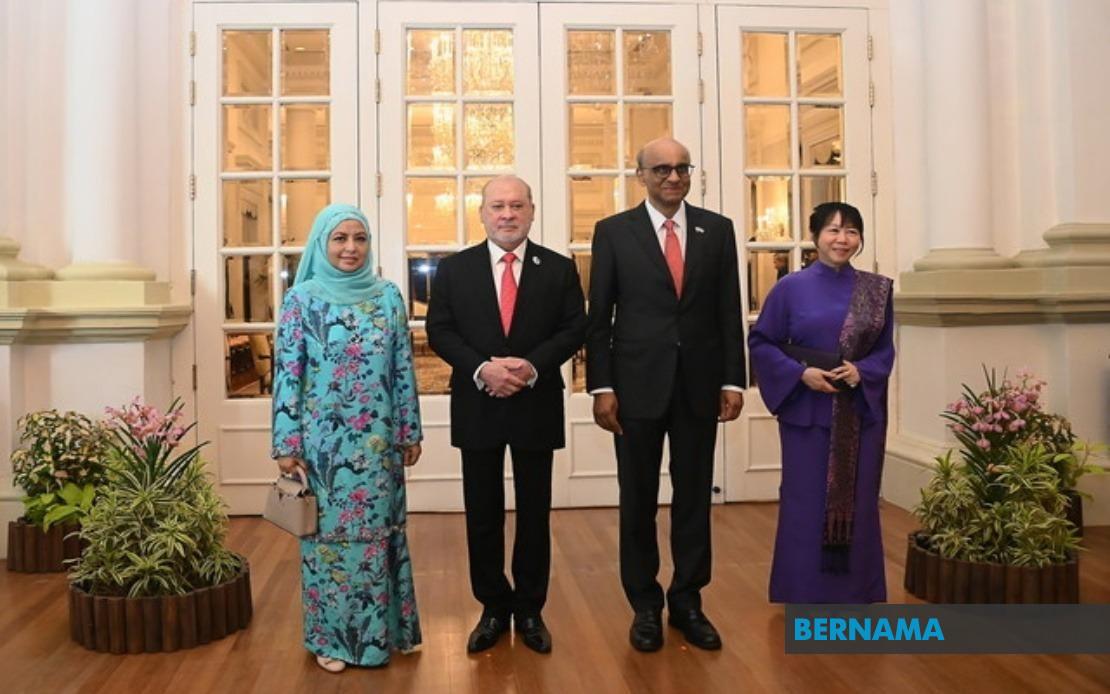
Singapore President Tharman Shanmugaratnam is arriving in Malaysia for a three-day State Visit at the invitation of His Majesty Sultan Ibrahim, King of Malaysia, bringing with him a vision of strengthened bilateral ties rooted not merely in economic calculation but in the deep historical and cultural bonds that have evolved between the two nations over centuries. Speaking ahead of his visit, Tharman articulated a relationship fundamentally anchored in mutual heritage, shared prosperity, and the accumulated trust that successive governments have carefully nurtured since Singapore's independence. His remarks come at a moment when both nations face mounting pressures from global fragmentation and intensifying great-power competition, dynamics that the Singapore President argues make neighbourhood solidarity increasingly valuable.
The relationship between Malaysia and Singapore, Tharman explained, rests on foundations that extend far beyond trade statistics and infrastructure projects. The two nations share interwoven cultural traditions, languages, and customs that have developed across centuries of proximity and intermigration. This heritage finds contemporary expression in collaborative cultural endeavours, such as the joint UNESCO inscription of the kebaya alongside Brunei, Indonesia, and Thailand—a recognition that encodes regional identity on the world stage. Beyond heritage inscription, both governments are jointly pursuing UNESCO recognition for Chingay, the vibrant street procession that embodies multicultural coexistence and serves as a living bridge between Singapore and Malaysian communities. These efforts transcend symbolic politics; they represent an intentional strategy to transmit cultural knowledge to younger generations in both nations, ensuring that the relationship remains emotionally resonant rather than purely administrative.
Crucially, Tharman acknowledged that the bilateral relationship has matured precisely because both nations have developed mechanisms to navigate inevitable disagreements without allowing them to corrode the broader partnership. The Singapore President observed that disagreement between close neighbours is natural and even healthy, provided it occurs within a framework of mutual respect and commitment to international law. This distinction matters enormously for regional observers: Tharman was signalling that disputes over sensitive issues—historical grievances, resource allocations, or geopolitical positioning—need not destroy the relationship if managed through established channels of dialogue and by leaders familiar with one another's positions and constraints. The trust accumulated over six decades, Tharman suggested, creates psychological and institutional space for difficult conversations that might otherwise escalate.
The practical expression of this deepening cooperation materialises in several interconnected projects that reshape the economic geography of the region. The Johor-Singapore Special Economic Zone represents, in Tharman's framing, a model for win-win cooperation in which two nations combine their respective competitive advantages to create value neither could generate alone. The zone positions itself not as a zero-sum competition for investment but as a mechanism for joint wealth creation that benefits enterprises, workers, and consumers in both jurisdictions. Similarly, the Rapid Transit System Link addresses a quotidian reality: hundreds of thousands of Malaysian and Singaporean citizens traverse the Johor-Singapore Causeway—the world's busiest land border crossing—daily for employment, commerce, and family visits. By easing this daily cross-border movement, the RTS Link acknowledges that the boundary between the two nations has become permeable in ways that economic integration, family networks, and labour mobility have made irreversible. Infrastructure development thus becomes a statement about the normalisation of regional movement and the recognition that prosperity requires seamless connectivity.
Tharman placed particular emphasis on energy transition and supply chain resilience as emerging domains for cooperation. As tropical nations facing common climate challenges, Singapore and Malaysia confront overlapping sustainability imperatives and energy transition targets. The Singapore President identified renewable energy and carbon credit markets as spheres where bilateral collaboration could generate mutual advantage while addressing shared climate vulnerabilities. This positioning is significant for Southeast Asian observers because it reframes bilateral cooperation away from legacy issues—historical disputes, water agreements, airspace disputes—toward forward-looking challenges that require technical expertise, capital deployment, and policy coordination. By emphasising climate cooperation, Tharman was effectively arguing that the future bilateral agenda transcends the past and addresses challenges that respect no border.
At the regional level, Tharman articulated Singapore and Malaysia's shared interest in deepening ASEAN integration while the bloc confronts fracturing global trading systems and intensifying great-power competition. He explicitly recognised Prime Minister Datuk Seri Anwar Ibrahim's stewardship of ASEAN's 2025 Chairmanship, during which Malaysia successfully advanced the ASEAN Digital Economy Framework Agreement, welcomed Timor-Leste as the bloc's 11th member, and upgraded the ASEAN Trade in Goods Agreement. Tharman's acknowledgement of these accomplishments serves multiple functions: it validates Malaysia's leadership within ASEAN, it signals Singapore's commitment to ASEAN centrality rather than external great-power alignments, and it positions both nations as custodians of a regional order that remains open, rules-based, and resistant to hegemonic competition. The Digital Economy Framework Agreement exemplifies this logic; ASEAN's digital economy could potentially double from a projected US$1 trillion in 2030 to US$2 trillion if high-quality implementation proceeds, creating a competitive bloc within global digital markets.
Looking toward Singapore's assumption of the ASEAN Chairmanship in 2027, Tharman suggested that Malaysian-Singaporean cooperation would prove essential for maintaining regional coherence amid geopolitical turbulence. The two nations, as ASEAN founding members, carry institutional memory and diplomatic experience that smaller or newer members lack. By working closely, they could model the approach—dialogue, restraint, respect for sovereignty, adherence to international law—that ASEAN requires to navigate competitions between major powers without fragmenting into competing camps. For Malaysian readers, this suggests that Singapore, rather than operating as an independent actor pursuing separate strategic interests, positions itself as committed to Southeast Asian collective endeavours. This framing addresses historical anxieties about Singapore's external orientation and its relationship to maritime security arrangements involving extra-regional powers.
Tharman devoted substantial attention to people-to-people engagement, contending that what earlier generations experienced naturally through proximity and family networks now requires deliberate facilitation. He called for expanded bilateral exchange programmes, joint internships, youth leadership forums, and collaborative community projects. This emphasis reflects a recognition that younger Singaporeans and Malaysians may lack the organic cross-border connections that characterised earlier decades, when permeable borders and family networks created natural constituencies for bilateral cooperation. Without intentional programming, Tharman suggested, the emotional and social capital that underpins governmental cooperation could erode. He was essentially arguing that institutional mechanisms must now substitute for the spontaneous human connections that once sustained the relationship, a subtle acknowledgement that globalisation, urbanisation, and changing patterns of mobility have attenuated the natural social bonds between border communities.
Tharman's phraseology throughout his remarks—particularly his invocation of allowing "hearts to shake hands"—reveals an emotional register beneath the diplomatic formality. He spoke warmly of personal memories of Malaysia, his appreciation of Malaysian cuisine, the hospitality of Malaysian people, and his family's experiences travelling through the country. This personalisation serves to humanise what might otherwise remain abstract governmental relations. By sharing affection for Malaysia's cultures and people, Tharman was implicitly arguing that the relationship deserves protection not merely because of economic interdependence or strategic interest but because genuine affinity and respect bind the two societies. This emotional dimension becomes particularly important in moments when disputes threaten to dominate headlines; a foundation of personal regard and cultural appreciation provides resilience that purely transactional arrangements cannot.
The timing of Tharman's State Visit, occurring amid broader discussions about regional integration and global uncertainties, positions the visit as more than ceremonial. It serves as a statement that despite competing pressures and occasional bilateral frictions, Singapore and Malaysia remain committed to deepening rather than narrowing their cooperation. For Malaysian observers, Tharman's emphasis on dialogue, mutual respect, and the non-transactional nature of the relationship responds to periodic concerns about Singapore's external orientation or its role in regional security architectures. For regional analysts, the visit demonstrates that ASEAN's founding members continue to prioritise bilateral cooperation even as they navigate great-power competitions. The relationship, as Tharman framed it, becomes a model for how smaller nations in a multipolar system might maintain agency by building deep partnerships with neighbours, deepening regional integration, and remaining aligned with rules-based international order rather than gravitating toward competing blocs.

