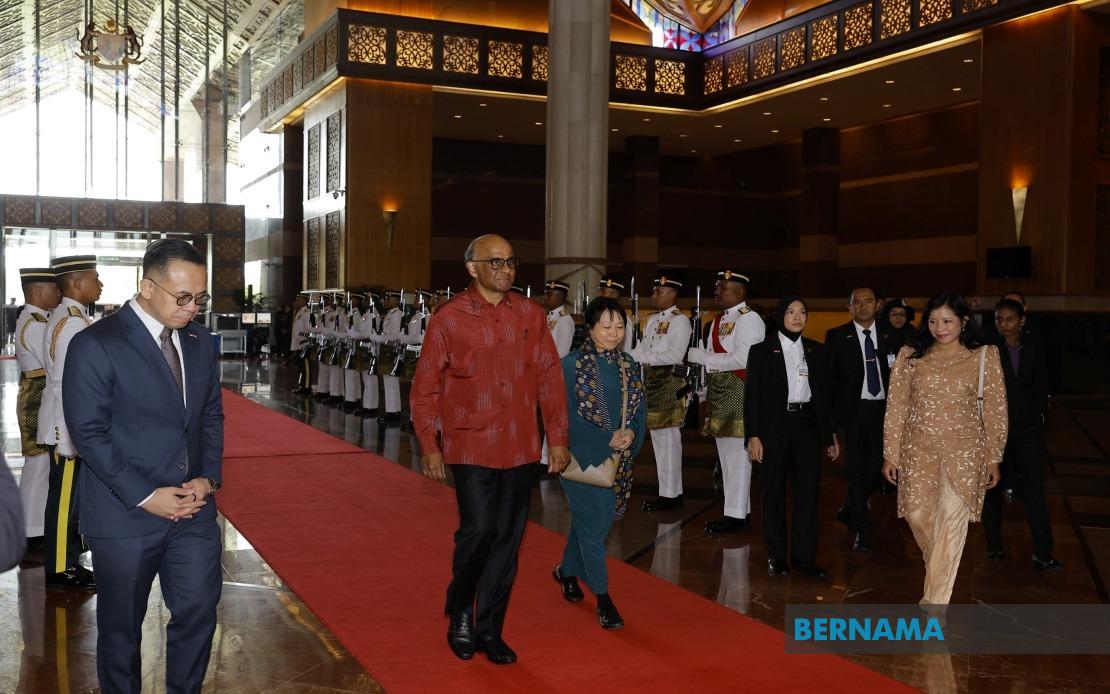
Singapore President Tharman Shanmugaratnam brought his three-day state visit to Malaysia to a close on Monday, departing from Kuala Lumpur International Airport's Terminal 1 at 2.20 pm on a commercial flight bound for Singapore, accompanied by his spouse Jane Ittogi and a delegation. The departure marked the formal conclusion of an engagement that underscored the diplomatic importance both governments place on their bilateral relationship, with Minister of Entrepreneur and Cooperatives Development Steven Sim present at the airport to extend farewell courtesies.
The President's departure was preceded by protocol ceremonies befitting his status. Upon arrival at the Bunga Raya Complex at KLIA approximately 45 minutes before departure, Tharman received a static Guard of Honour mounted by two officers and 26 personnel from the First Battalion of the Royal Ranger Regiment, commanded by Captain Muhammad Hanafi Ja'afar. These formalities reflected Malaysia's commitment to extending full state honours to its distinguished visitor, a symbolic gesture that carries particular weight in Southeast Asian diplomatic circles where adherence to protocol carries deep meaning.
Tharman's three-day sojourn represented his maiden state visit to Malaysia since he assumed office as Singapore's ninth President on September 14, 2023. The timing held considerable significance, as the visit functioned explicitly as a reciprocal gesture following Sultan Ibrahim's state visit to Singapore on May 6 and 7, 2024. This back-and-forth exchange of high-level visits by the respective heads of state demonstrates the enduring priority both nations assign to maintaining robust bilateral relations at the highest levels of government.
The visit commenced on Sunday following a formal invitation extended by His Majesty Sultan Ibrahim, King of Malaysia. The decision to extend such an invitation reflected Malaysia's interest in building momentum in its relationship with Singapore under the newly assumed presidency of Tharman, a development that carries implications for how both nations navigate regional challenges and opportunities in the coming years.
Monday's schedule encompassed the centrepiece engagements of the state visit. Tharman was accorded a full state welcoming ceremony upon his arrival in Kuala Lumpur, followed by a formal audience with Sultan Ibrahim conducted at Istana Negara, the official residence of Malaysia's constitutional monarchy. These ceremonial elements served not merely as diplomatic formality but as public affirmations of the bilateral relationship's centrality to both nations' regional strategies.
The visit also facilitated high-level political engagement at the executive level. Prime Minister Datuk Seri Anwar Ibrahim received Tharman in a courtesy call that included the presence of Foreign Minister Datuk Seri Mohamad Hasan, Investment, Trade and Industry Minister Datuk Seri Johari Abdul Ghani, and Steven Sim. The inclusion of these particular ministers signalled Malaysia's intent to address substantive matters spanning foreign policy, economic cooperation, and entrepreneurial development during the visit, suggesting that discussions extended beyond ceremonial pleasantries to encompass concrete bilateral interests.
On the visit's final full day, Tharman engaged with Malaysia's state-level leadership when the Sultan of Selangor, Sultan Sharafuddin Idris Shah, granted him an audience at Istana Alam Shah. This interaction expanded the visit's scope beyond federal engagement, demonstrating the comprehensive approach both nations adopted in showcasing the breadth of Malaysia's governance structure and reaffirming relationships across multiple levels of state administration.
The exchange of state visits between the two nations' heads of state carries particular significance in the Malaysian and Singapore context. The two countries share a complex history marked by cooperation and occasional tensions, making regular high-level diplomatic engagement crucial for maintaining understanding and preventing misunderstandings. The reciprocal nature of these visits, with Sultan Ibrahim's May journey to Singapore followed by Tharman's Malaysia visit just months later, suggests both nations view this cadence of engagement as essential for relationship management.
For Malaysia specifically, hosting a sitting Singapore President carries implications for how Kuala Lumpur positions itself within regional diplomacy. Singapore, despite its modest geographic footprint, wields considerable influence in Southeast Asia through its economic prowess, strategic location, and sophisticated diplomatic networks. The decision to accord Tharman full state visit honours amplified Malaysia's commitment to nurturing this critical bilateral relationship during a period when both countries navigate broader regional geopolitical shifts and economic interdependencies.
Tharman's profile as Singapore's ninth President adds another dimension to the visit's importance. Having assumed office relatively recently, his state visits abroad establish his administration's approach to bilateral relations and signal continuity in Singapore's foreign policy priorities. His engagement with Malaysia's political leadership offered opportunities to establish working relationships and clarify expectations for bilateral cooperation during his presidential tenure.
The formal conclusion of the state visit leaves both nations positioned to pursue collaborative initiatives across various domains. Whether these initiatives materialise in concrete agreements or understandings negotiated during the visit will become clearer in coming weeks as both governments make announcements regarding outcomes from the high-level meetings conducted during this period. The reciprocal exchange of visits by heads of state, now completed with Tharman's departure, resets the diplomatic calendar for both nations and opens space for lower-level officials to translate the political will demonstrated at the top into substantive bilateral cooperation.

