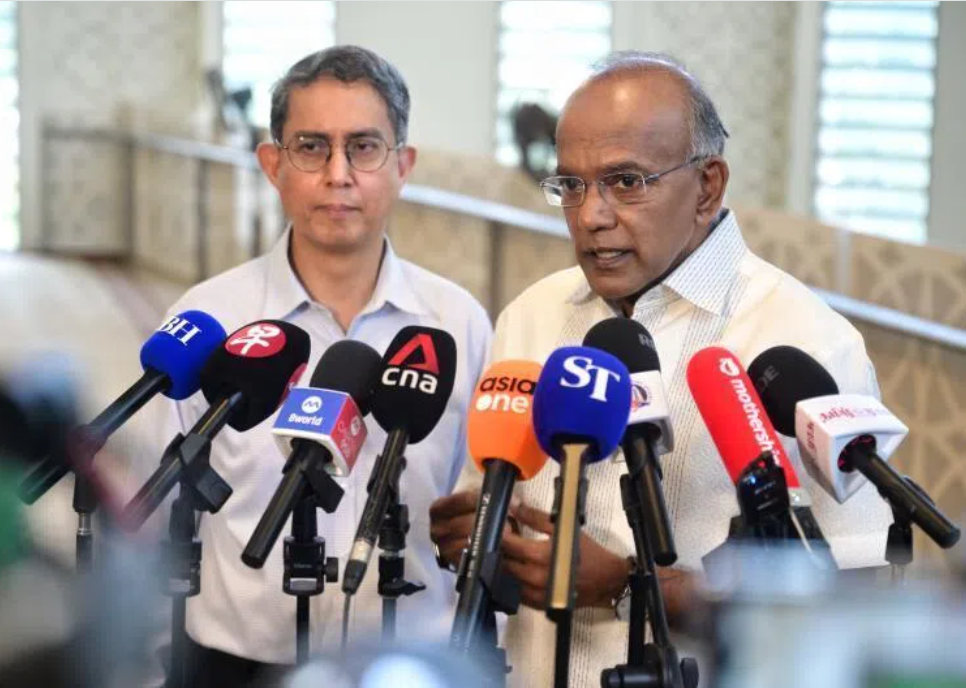
Singapore's Minister for Home Affairs K Shanmugam has publicly outlined the reasoning behind former Minister-in-charge of Muslim Affairs Faishal Ibrahim's resignation on July 20, emphasising that while Faishal received due process, his conduct fell short of expected standards. Speaking on July 22, Shanmugam characterised a series of online exchanges between Faishal and an unnamed member of the public as "objectively, inappropriate and questionable," setting out the government's position on a case that has drawn scrutiny over ministerial conduct and the boundaries between private behaviour and public responsibility.
The controversy centres on digital communications between Faishal and the woman, whose identity has been protected. According to Shanmugam's account, Faishal initially continued the interactions out of concern that abruptly ending contact might provoke a negative reaction from the woman. Yet despite this rationale, his responses were interpreted by the recipient as encouraging further engagement, which she acted upon. The online exchanges eventually extended to in-person meetings at the margins of public events, blurring the line between private interaction and conduct befitting a public officeholder. When Faishal subsequently attempted to cease the communication, the woman became upset, escalating the matter by forwarding selected messages and images to Prime Minister Lawrence Wong and alleging harassment.
Faishal's own account, presented in his resignation letter to PM Wong, denied any physical relationship had developed and stated he had not intended for the interactions to evolve into one. He also countered that the woman had harassed him, leading the government to refer the matter to police for investigation. This mutual accusation underscores the contested nature of the relationship and the difficulty in determining intent when digital communication can be subject to varying interpretations. However, Shanmugam's framing suggests that regardless of Faishal's subjective intentions, the objective pattern of his behaviour crossed professional lines.
A critical turning point in the affair came when the complainant escalated the matter by contacting PM Wong directly. Shanmugam emphasised that this action transformed what might otherwise have remained a private dispute into a semi-public controversy involving accusations against a government minister. Under Singapore's governance standards, a distinction is drawn between entirely private matters and those that enter the public domain through formal complaint. Once a serving minister becomes the subject of an allegation brought to the Prime Minister's Office, the government is obligated to examine the conduct in question, regardless of the circumstances that prompted the complaint.
Shanmugam cited longstanding principles of ministerial conduct established by Singapore's founding Prime Minister Lee Kuan Yew and reinforced during Senior Minister Lee Hsien Loong's tenure as Prime Minister. The standard articulated is straightforward: conduct that remains purely private and ceases following counselling can potentially remain confidential, but matters entering the public realm through complaint or disclosure must be scrutinised, with appropriate consequences following any determination of impropriety. This framework reflects a balance between protecting personal privacy and upholding public expectations of those in government.
The Home Affairs Minister stressed that Faishal was afforded a fair hearing throughout the process and was not simply dismissed summarily. Importantly, Faishal himself concluded that continuing as both MP and Minister was untenable given the circumstances, leading him to tender his resignation, which PM Wong accepted. This acknowledgment by Faishal that he should have established clear boundaries from the outset and that he bore responsibility for allowing the exchanges to continue appears to have been a decisive factor in his decision to step down voluntarily rather than face removal.
Faishal's political career, while relatively brief at the ministerial level, had been marked by steady advancement and, by Shanmugam's account, conscientious service. He first entered parliament in 2006 as part of the PAP's Marine Parade GRC team, subsequently winning re-election three times, including most recently in the uncontested 2025 General Election when his team returned to Marine Parade. Before entering politics, he was a real estate professor at the National University of Singapore. His rise through ministerial ranks began in 2012 with an appointment as parliamentary secretary for transport, followed by promotion to senior parliamentary secretary in 2017 with responsibilities spanning education and social and family development portfolios.
His elevation to Minister of State in 2020 and subsequent promotion to Senior Minister of State with an acting minister designation in PM Wong's May 2025 Cabinet reshuffle had positioned him as a rising figure in Singapore's government. Shanmugam's public tribute to Faishal, describing him as "someone who has always been focused on making a difference to the lives of others" and "a true gem," suggests an effort to separate the individual's broader character and service record from the specific conduct that prompted his departure. This approach reflects a tension common in political resignations: reconciling a person's overall contributions with a particular lapse in judgment.
The case carries implications for how Singapore's government addresses ministerial conduct in the digital age, where online communication can be preserved, forwarded, and weaponised in ways that traditional private conversations could not. The distinction between inappropriate flirtation and actionable harassment, and the role of subjective interpretation in assessing digital exchanges, remain grey areas. Shanmugam's decision to make a detailed public statement suggests the government wanted to establish that Faishal's departure reflected not arbitrary action but adherence to established principles of accountability.
For Malaysia and other Southeast Asian countries navigating similar governance challenges, the case illustrates how governments attempt to balance personal privacy with public accountability for those in elected office. The threshold at which a private matter becomes a matter of public concern, the standards applied to ministerial conduct, and the transparency with which such decisions are communicated all carry broader relevance. Singapore's approach—emphasising due process, fair hearing, and adherence to precedent-based standards—contrasts with jurisdictions where resignations or removals may occur more opaquely or appear politically motivated.

