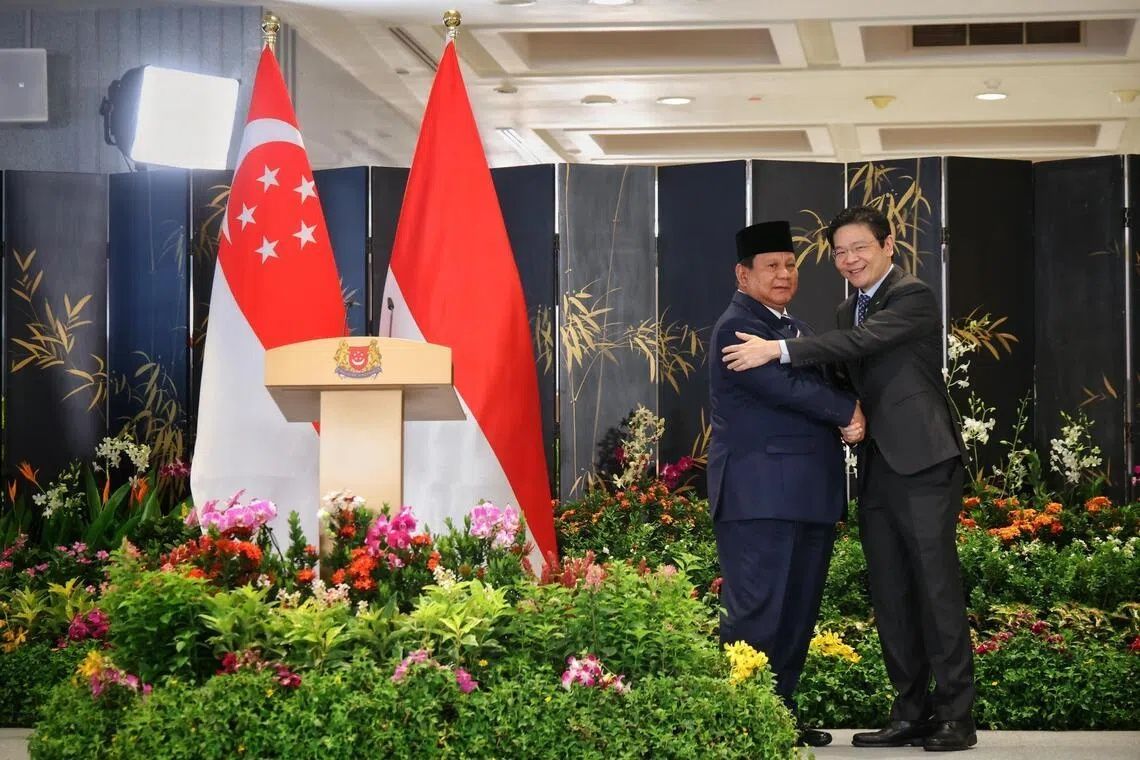
Prime Minister Lawrence Wong will arrive in Jakarta on Monday, July 6, for what marks the second Singapore-Indonesia Leaders' Retreat, a significant diplomatic engagement aimed at reinforcing the two neighbours' longstanding partnership. The retreat, to be hosted by President Prabowo Subianto, represents the highest-level bilateral platform through which both governments coordinate strategy across multiple sectors and discuss matters of regional importance.
As the most senior annual meeting between Singapore and Indonesia, the Leaders' Retreat convenes the heads of government alongside their most senior ministers to conduct a comprehensive review of the relationship and chart future direction. This year's gathering in Jakarta follows the inaugural retreat held in Singapore in June 2025, establishing what appears to be a new cadence for these top-level consultations. The previous such high-level gathering in Indonesia took place in April 2024 at Bogor Presidential Palace, when then Prime Minister Lee Hsien Loong met with then President Joko Widodo.
The agenda is expected to encompass both a progress check on existing bilateral initiatives undertaken since the last meeting and a forward-looking discussion on deepening cooperation. Singapore and Indonesia have been methodically expanding their partnership beyond conventional pillars of trade, investment, and defence into frontier areas that reflect evolving global economic priorities. These emerging domains include the green energy transition, cross-border electricity infrastructure, carbon capture and storage technologies, artificial intelligence applications, and digital infrastructure development—sectors that will likely dominate Southeast Asia's economic trajectory over the coming decade.
The timing of PM Wong's visit underscores the importance Singapore places on the Indonesian relationship. He will lead a substantial delegation comprising Deputy Prime Minister and Minister for Trade and Industry Gan Kim Yong, Coordinating Minister for Public Services and Minister for Defence Chan Chun Sing, Foreign Minister Vivian Balakrishnan, Minister for Social and Family Development Masagos Zulkifli, and Minister for Manpower and Minister-in-charge of Energy and Science and Technology Tan See Leng. This broad ministerial representation signals that discussions will span economic, security, social, and technological dimensions.
The bilateral investment flows underscore the material depth of this relationship. In 2025, Singapore maintained its position as Indonesia's largest foreign direct investor, channelling US$17.4 billion (S$22.4 billion) into the archipelago's economy. This sustained capital flow reflects not merely commercial confidence but also the institutional frameworks both governments have cultivated to facilitate cross-border economic activity. For Malaysian observers, this dynamic is particularly relevant, as Singapore's investment prowess in Indonesia demonstrates the competitive landscape within Southeast Asia for development capital.
The retreat framework itself reflects both countries' recognition that bilateral relations require sustained high-level attention and coordination. By institutionalising an annual gathering at the prime ministerial and presidential level, Singapore and Indonesia are signalling that their partnership transcends transactional diplomacy and encompasses strategic coordination on matters ranging from maritime security to economic integration to climate action. The format also allows both leaders to address potential friction points before they escalate and to align on responses to regional and global developments.
Regional geopolitical shifts have only amplified the importance of the Singapore-Indonesia relationship. Both nations occupy critical positions in the Indo-Pacific, with Singapore controlling one of the world's busiest maritime chokepoints and Indonesia commanding vast territory and resources. Their ability to cooperate effectively influences regional stability and economic flows that affect all Southeast Asian states. The retreat's discussion of regional and global developments will likely touch on concerns ranging from great power competition to maritime security to multilateral governance.
The focus on green economy collaboration and carbon capture technologies reflects both countries' awareness of climate imperatives and economic opportunity. Singapore, with its technological sophistication and capital, can partner with Indonesia's resources and vast development potential. Cross-border electricity trade, in particular, opens possibilities for Indonesia to leverage its renewable energy capacity while Singapore addresses its energy transition challenge. These emerging areas of cooperation may offer templates for how Southeast Asian nations can address shared challenges while creating mutual economic benefit.
Digital connectivity and artificial intelligence represent another frontier where the retreat discussions are likely to yield concrete initiatives. Southeast Asia's digital economy is expanding rapidly, and cooperation between Singapore and Indonesia on standards, infrastructure, and technological governance will influence the region's broader digital landscape. Singapore's regulatory sophistication and Indonesia's market scale create complementary advantages that both countries can leverage through coordinated strategy.
The retreat also serves as an opportunity to address implementation challenges on existing projects. Bilateral relations of this magnitude inevitably involve multiple ongoing initiatives, some progressing smoothly and others encountering bureaucratic or logistical obstacles. The retreat format allows leaders to unblock bottlenecks at the highest level and demonstrate political commitment to successful execution. This problem-solving dimension is often overlooked in discussions of diplomatic summits but proves crucial for translating high-level pledges into tangible outcomes.
For Malaysia and other Southeast Asian nations, the Singapore-Indonesia Leaders' Retreat exemplifies the strategic importance both governments assign to their bilateral relationship and the institutional mechanisms they employ to manage it effectively. The retreat's expansion into new sectors like green energy and artificial intelligence suggests that both countries view their partnership as foundational to navigating the economic and environmental challenges of the coming decades. The success or otherwise of cooperation initiatives announced at this retreat will reverberate across the region, influencing investment patterns, technology diffusion, and regional integration trajectories.
During PM Wong's absence, Singapore's Coordinating Minister for National Security and Minister for Home Affairs K. Shanmugam will assume the role of acting prime minister, ensuring continuity in governance. This succession arrangement reflects Singapore's institutional maturity and allows the prime minister to engage in extended diplomatic missions without disrupting domestic administration. The retreat is positioned to yield updates on bilateral progress and commitments to deepening cooperation across economic, security, and social dimensions, reinforcing the relationship that stands as one of Southeast Asia's most consequential bilateral partnerships.

