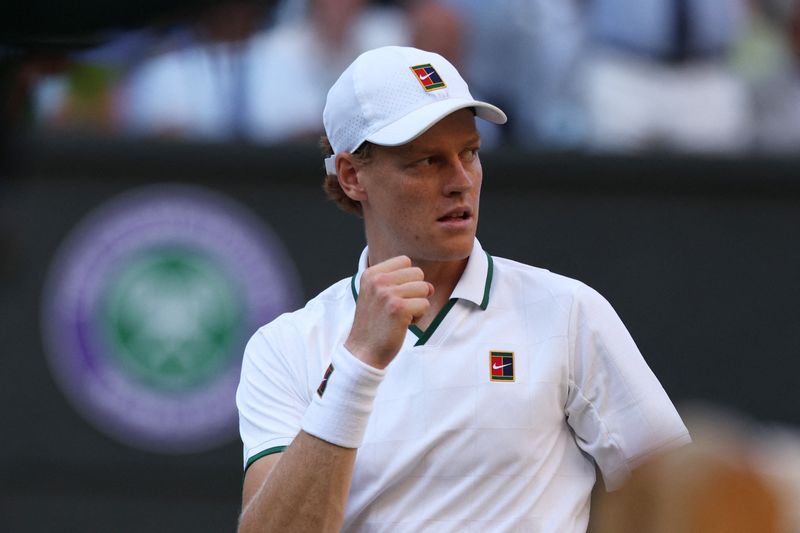
Jannik Sinner has successfully defended his Wimbledon singles crown, emerging victorious from a brutal encounter against Alexander Zverev at the All England Club on Sunday. The Italian champion, seeded first, prevailed 6-7(7) 7-6(2) 6-3 6-4 in a match that consumed three hours and 46 minutes and tested both players' physical and mental reserves. The victory marks Sinner's fifth Grand Slam title and places him among an exclusive group of ten men to have successfully retained the Wimbledon championship in the professional era. At 24 years old, Sinner has now claimed back-to-back Wimbledon crowns following his maiden grass-court triumph last year over Carlos Alcaraz, cementing his status as the sport's dominant force.
Zverev, the second seed and recently crowned French Open champion, arrived at the final as one of tennis's hottest players, carrying momentum from claiming his first major title at the 41st attempt. The German's breakthrough in Paris just weeks earlier had transformed his career narrative, yet on the grass of Centre Court, he encountered an opponent operating at the very peak of his powers. Despite his recent success, Zverev proved unable to extend his title collection, suffering what marks his fourth Grand Slam final defeat. Had the 29-year-old prevailed, he would have become the first German male competitor to capture the Wimbledon singles trophy since Michael Stich accomplished the feat in 1991. Instead, Sinner's dominance over his rival continued unabated, with the victory extending his head-to-head record against Zverev to ten consecutive wins, though the German mounted the strongest resistance yet.
The opening set encapsulated the intensity of the entire contest, a gruelling 65-minute affair where marginal differences separated the competitors. On a hot and breezy Centre Court, both men unleashed considerable firepower from the baseline, though opportunities remained scarce. Sinner squandered a critical chance at 4-3 when he uncharacteristically struck a forehand wide on the Zverev serve. Zverev's forehand, historically a vulnerability during high-pressure moments throughout his career, instead proved formidable throughout this opening period, with the German ceding just eight points on serve. The set ultimately resolved via tiebreak, where Zverev captured the advantage first before Sinner fought back, only for the German to secure the set by converting a forehand winner that notably ended Sinner's remarkable sequence of winning 14 consecutive sets against this opponent.
Frustration visibly etched itself across Sinner's features early in the second set as Zverev's service game appeared impenetrable. The German's delivery remained largely untouched through the conventional play, forcing another tiebreak scenario. In that pivotal second-set tiebreak, Sinner transformed his tactical approach, elevating his aggressive intensity to claim the set and level the overall match position. The momentum had begun its inevitable shift, though the contest remained perfectly poised as both competitors continued generating thunderous baseline exchanges punctuated by unreturnable serves.
The turning point arrived approximately two hours and 42 minutes into the contest, when Zverev earned his first break point opportunity at 3-3 in the third set. As Sinner crafted a delicate drop shot, Zverev sprinted toward the net, then attempted to reverse direction near the baseline. The German's feet slipped on the dusty grass, and he tumbled awkwardly to the surface. Though Zverev insisted he remained uninjured, the fall visibly disrupted his confidence and mobility. Sinner's subsequent hold followed immediately by a break for 4-3 essentially decided the contest's outcome, with Zverev moving noticeably more cautiously thereafter and eventually flinging his racket across the turf in obvious frustration.
Despite regaining some composure through the fourth set, Zverev could not prevent Sinner's relentless advance. The Italian broke serve once more to secure 4-3, then served out the match with two spectacular rallies that showcased the extraordinary quality both competitors had maintained throughout their three-hour-and-46-minute duel. Sinner's victory came during a period when he had appeared almost unbeatable on grass, including an impressive performance in the semi-final where he did not surrender a single service game.
The contrast with Sinner's performance at the French Open merely a fortnight earlier underscored the Italian's adaptability and mental fortitude. After a second-round collapse in Paris and narrowly escaping a first-round exit at Wimbledon against Miomir Kecmanovic, Sinner elevated his game substantially through the tournament, ultimately reaching peak form precisely when it mattered most. This capacity to recover from setbacks and perform under immense pressure has become a defining characteristic of his championship temperament.
In his courtside remarks immediately after clinching victory, Sinner articulated the profound emotion surrounding success at Wimbledon. The Italian spoke of the particular anxiety accompanying Sunday morning matches at the venue and expressed gratitude for his return to championship form. His acknowledgment of the two-player dynamic, emphasising mutual respect and the exceptional quality both competitors had demonstrated, reflected a maturity beyond his years. Sinner's perspective that he never takes opportunities for granted suggested a mindfulness about the uncertainty inherent in professional sport, particularly given that returning to claim back-to-back Wimbledon titles represents a rare achievement.
Zverev's post-match reflection revealed a player looking forward despite the defeat. The German emphasised the transformative nature of his trajectory over the preceding two months, noting that at 29 years old, he had finally reached a point where confidence in winning major championships felt justified. His breakthrough French Open triumph followed by reaching a Wimbledon final represented the most significant period of his career, even though the grass-court trophy proved elusive. The German's achievement of finally capturing a Grand Slam after 41 attempts, combined with an impressive maiden Wimbledon final appearance, established a foundation for potential future success at the sport's highest level.
For regional Southeast Asian audiences following tennis, Sinner's dominance presents a fascinating study in how younger players can systematically dismantle previously established hierarchies. The Italian's consistency in Grand Slam performance, combined with his ability to adapt across different surfaces with particular mastery on grass, offers instructive lessons about the evolution of professional tennis. Sinner's rise also reflects broader global patterns in sport, where meritocratic systems increasingly elevate players from nations traditionally considered secondary powers into positions of supreme dominance. The Italian's back-to-back Wimbledon triumphs suggest a period of sustained excellence that will likely challenge existing records for years to come.

