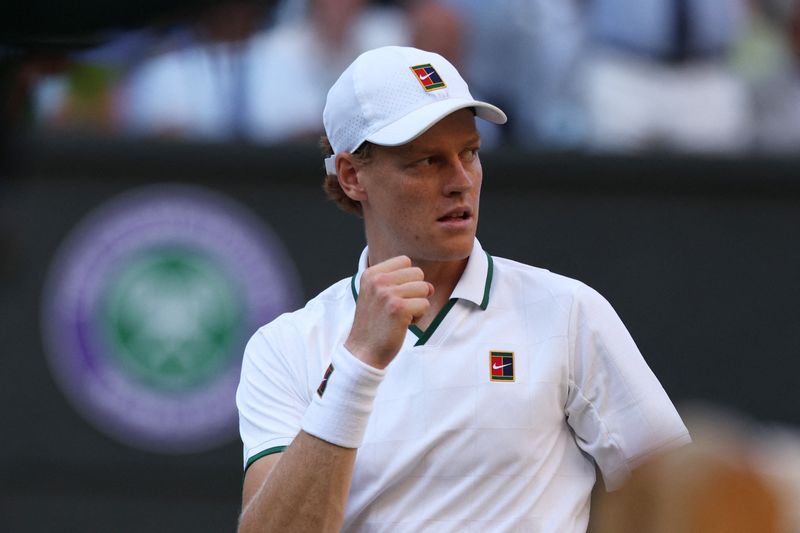
Jannik Sinner has cemented his status among tennis's elite by retaining the Wimbledon championship, triumphing over Alexander Zverev with a 6-7(7) 7-6(2) 6-3 6-4 victory in Sunday's final at London's Centre Court. The Italian's second consecutive All England Club crown represents his fifth major title and places him in exclusive historical company as only the tenth man in the professional era to successfully defend the grass-court championship. The win also extended Sinner's remarkable dominance over Zverev to ten consecutive victories, underscoring a widening gulf in form between the two competitors.
The contest itself proved to be an unexpectedly competitive affair, with both players engaged in a tense struggle that lasted nearly three hours before Sinner eventually overwhelmed his German opponent. The opening set encapsulated the match's intensity, with the competitors locked together through twelve gruelling games played in warm, blustery conditions. Zverev's aggressive groundstrokes proved particularly effective in the early exchanges, culminating in a powerful forehand winner that secured the tiebreak 7-5 following animated celebration from the second seed.
The second set saw a notable shift in momentum as Sinner's confidence grew visibly. Though Zverev initially maintained the quality of his ball-striking, frustration began creeping into the German's demeanour as Sinner took control of crucial moments. The second-set tiebreak proved decisive in this regard, with Sinner displaying significantly sharper execution at key junctures to restore parity in the match after nearly two hours of play. This capacity to raise his level during tight moments, rather than succumbing to pressure, has become a hallmark of Sinner's emergence as a dominant force in men's tennis.
The third set featured a pivotal turning point that proved psychologically damaging to Zverev's championship aspirations. After more than two-and-a-half hours of intense rallying, Zverev earned his first break point opportunity, but the opportunity dissolved in painful fashion when he was left wrong-footed by a delicate Sinner drop shot. The German's subsequent fall to the turf, accompanied by visible distress to his right knee, drew gasps from the crowd lining Centre Court. Though Zverev rose to continue, the incident appeared to fracture his concentration, and Sinner immediately capitalized in the following game to secure a break for a 5-3 advantage.
Zverev's anguish became further evident through his frustration, as he slammed his racket to the floor in response to the break. The German's mounting desperation contrasted sharply with Sinner's measured composure, a difference in temperament that often determines outcomes in heavyweight Grand Slam contests. Within the hour, Sinner had claimed the third set and established a commanding two-sets-to-one lead, the psychological advantage now firmly tilted in the Italian's direction after nearly three hours of attritional tennis.
The fourth and final set proved merely a formality, as Sinner's dominance became increasingly apparent. A second break of serve gave the 24-year-old an unassailable 4-3 advantage, and despite Zverev's continued resistance, the German's level had deteriorated sufficiently that Sinner navigated home without genuine difficulty. When the final point landed, Sinner collapsed to the grass in emotional release, the physical and mental toll of defending his crown evident in his reaction. The victory concluded an enthralling fortnight at the All England Club that has solidified Sinner's credentials as his generation's premier player.
Sinner's ascendancy carries particular resonance for tennis audiences across Southeast Asia, where the sport commands a dedicated following. The Italian's meteoric rise from talented prospect to Grand Slam champion represents the narrative arc that captivates regional viewers. His emergence alongside other young elite players like Carlos Alcaraz has infused the sport with fresh competitive energy, displacing the long-standing dominance of established figures. For Malaysian followers and regional tennis enthusiasts, Sinner's success demonstrates how talent and consistency at the highest levels can transcend tennis's traditional European strongholds.
From a broader competitive perspective, Sinner's fifth major championship has narrowed the gap with Alcaraz, who currently holds seven Grand Slam titles. The Italian's recent form suggests he may yet close that distance, particularly on grass and hard courts where his powerful baseline game flourishes. The direct head-to-head rivalry between these two players promises to define men's tennis for the coming decade, much as previous generational matchups have shaped the sport's competitive landscape. Sinner's defensive success at Wimbledon demonstrates a mental fortitude and tactical intelligence that suggests sustained excellence rather than temporary ascendancy.
Zverev's loss marked his fourth Grand Slam final defeat, a statistic that will weigh heavily on the German despite an otherwise accomplished career. The 27-year-old's inability to convert major championship opportunities into titles raises questions about whether he possesses the mental resilience to claim the breakthrough victory that has eluded him. His gracious postmatch remarks, including a light-hearted quip to Sinner that "I don't really like you anymore," reflected the philosophical bearing required of athletes who endure repeated near-misses at sport's highest levels. Zverev's acknowledgment of Sinner's superiority suggested resignation to the widening gulf between them.
Sinner's own words reflected the emotional weight of defending a Grand Slam title. His reference to the nerves experienced on Sunday morning, coupled with gratitude for the Centre Court atmosphere, conveyed a player acutely conscious of the privilege inherent in competing at tennis's most hallowed venue. The pineapple-topped Challenge Cup now permanently resides with him for a second consecutive year, a tangible symbol of achievement that transcends mere statistics. For a player of Sinner's generation and background, success at Wimbledon carries particular cultural significance, representing the pinnacle of tennis excellence in global consciousness.

