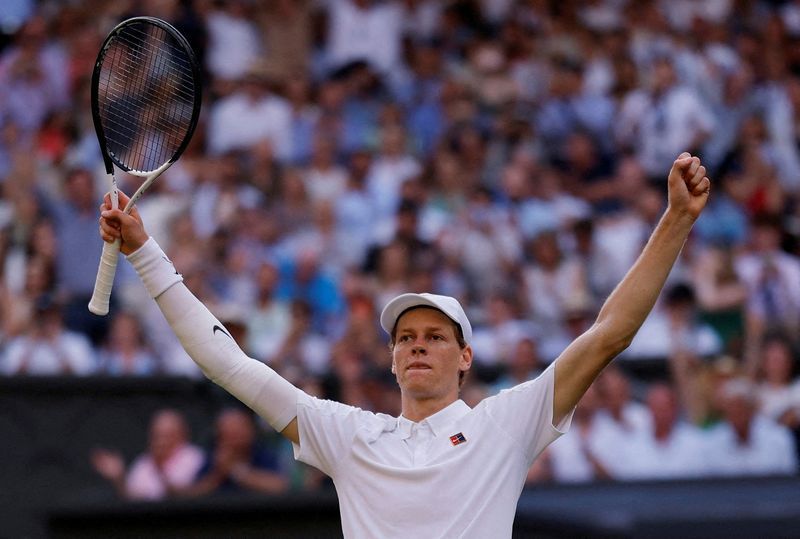
Jannik Sinner returns to Wimbledon as defending champion, but the Italian arrives stripped of the invincibility that defined his clay-court dominance, a vulnerability that has emboldened challengers circling the All England Club. The world number one must now demonstrate he can impose his formidable game on grass while simultaneously managing questions about his physical durability, questions that intensified after his shock second-round exit from Roland Garros ended a 30-match winning streak stretching back to February.
Sinner's collapse in Paris marked a jarring inflection point in what had been a ruthlessly dominant campaign. His demolition of the field on clay suggested he might become the first player since Rafael Nadal to win consecutive French Open titles, yet fatigue and physical issues intervened at precisely the wrong moment. The setback raises legitimate concerns about whether the 24-year-old can sustain peak performance across the season's most demanding stages, particularly when multiple Grand Slams are contested in rapid succession with minimal recovery windows.
Mats Wilander, the seven-time Grand Slam champion, nonetheless insists Sinner remains the tournament favourite despite his Paris stumble. Wilander attributes the collapse not to technical deficiency but to accumulated exhaustion, arguing that Sinner's grueling schedule in the two months before Roland Garros left him depleted and unable to recover sufficiently between matches and training sessions. The legendary Swede notes that Sinner now enjoys proper rest and should arrive refreshed, though he candidly observes that grass presents inherent unpredictability that clay does not.
No challenger looms larger over Sinner's title defence than Novak Djokovic, whose movement, return-of-serve precision, and mental fortitude on grass make him a formidable threat at 39 years old. The Serbian champion is hunting his eighth Wimbledon title, which would equal Roger Federer's record at the All England Club, but beyond trophies lies a deeper motivation: Djokovic remains one Grand Slam short of a 25th major championship, a standalone record that time is running out to achieve during his career's twilight years. Despite his own French Open disappointment, Djokovic appears energized by the circumstances, viewing Wimbledon as potentially his clearest path to major glory while Alcaraz is injured and Sinner's confidence appears shaken.
Andy Roddick, the three-time Wimbledon finalist, articulated this opportunity during his podcast, arguing that Djokovic's early Paris exit should not be misread as declining form but rather as liberation from a tournament where his skill-set is less decisive. Roddick suggested Djokovic can credibly convince himself that he represents the championship-calibre grasscourt player in the draw, particularly given his multiple Wimbledon titles and the gap created by Alcaraz's absence. The psychological dimension matters considerably; Djokovic's hunger and experience, combined with current circumstances, position him as a genuine threat to Sinner's crown.
Alexander Zverev has emerged as perhaps the tournament's most intriguing contender following his maiden Grand Slam triumph at Roland Garros. The German's French Open breakthrough, achieved at age 29, represents the culmination of years of promise and frustration, and he carries genuine momentum onto grass where he possesses a devastating serve that translates naturally to the faster surface. Boris Becker, the six-time major champion, declared that Zverev should be considered favourite at Wimbledon given Alcaraz's injury and uncertainty surrounding Sinner's condition, a striking assessment that reflects how dramatically circumstances have shifted.
Becker's reasoning hinges on Zverev's serving prowess; on grass, a dominant serve essentially deposits a player directly into the tournament's latter stages by winning free points and limiting break opportunities. Zverev must certainly adjust to grass's specific demands and nuances, yet he possesses the foundational weaponry required for success. His Roland Garros triumph proves he can perform at the highest level when pressure escalates, suggesting he could carry that confidence forward if the physical transition to grass proves manageable.
Carlos Alcaraz's absence fundamentally reshapes the tournament landscape, removing one of the few active players capable of dominating on grass through sheer all-court superiority. The Spaniard won Wimbledon in both 2023 and 2024, establishing himself as the natural heir to the faster courts that rewarded his aggressive baseline game and serve. Without Alcaraz, the field widens considerably, creating opportunities for secondary contenders rather than the typical scenario where two or three players command attention.
American players Ben Shelton, Taylor Fritz, and Frances Tiafoe possess the attacking weapons and grasscourt aggression to trouble top seeds, each bringing serve-and-volley elements or heavy baseline hitting that grass rewards. Flavio Cobolli, who reached the French Open final but falls short of major championship experience, leads the next tier of emerging challengers who may surprise. The breadth of the contender pool means Wimbledon could produce an unexpected champion or a stunning semifinal lineup if any of these players capture the necessary momentum.
Sinner's task extends beyond merely defending his title; he must re-establish the dominance that seemed destined to define his career after February. The grass courts present neither easier conditions nor a guaranteed reset despite conventional wisdom suggesting faster surfaces suit aggressive players more readily. Instead, Wimbledon represents a genuine test of character and resilience, requiring Sinner to compartmentalize the Paris disappointment and execute his game without the comfort of clay's forgiving characteristics. His rivals are watching intently for any lingering physical concerns or confidence erosion, circling like competitors sensing vulnerability in the defending champion.

