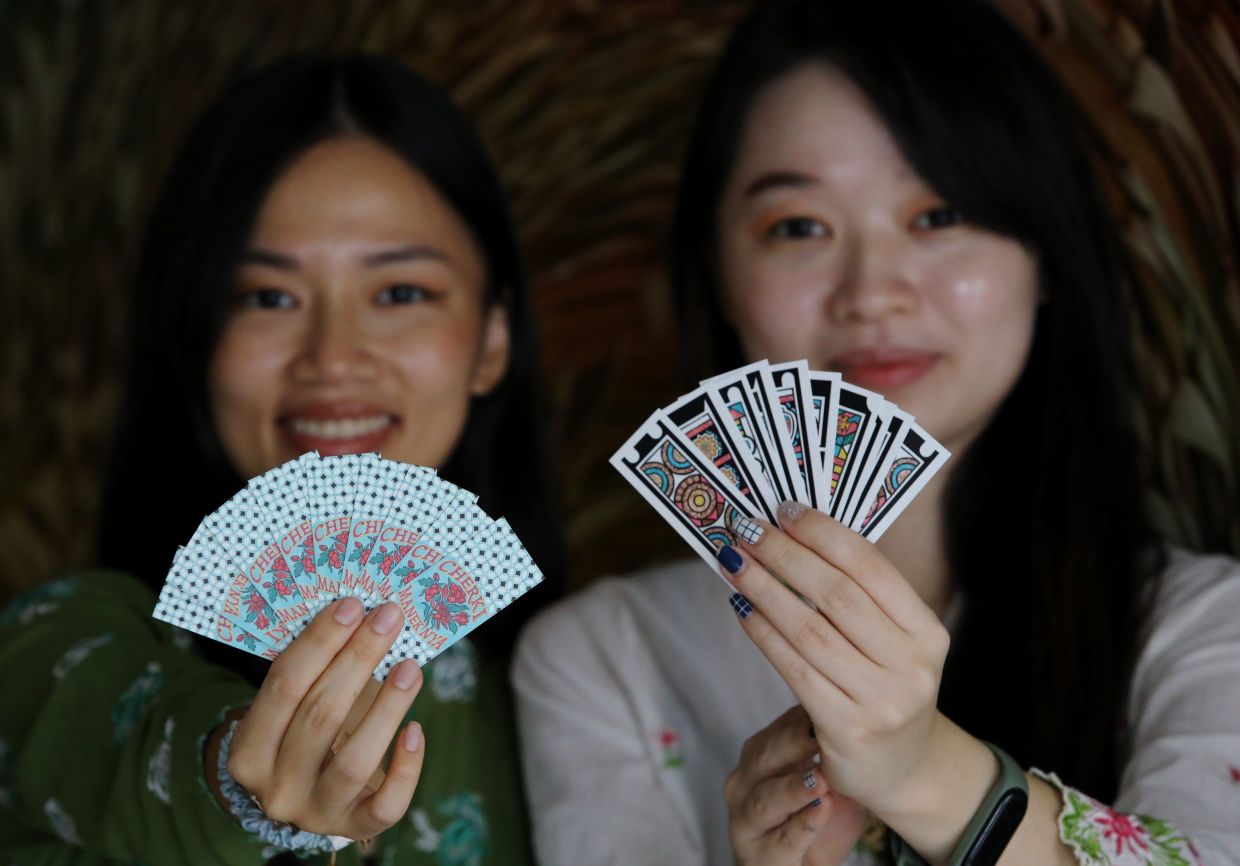
The Peranakan community's rich cultural tapestry has long been defined by its distinctive material heritage – the ornate beaded slippers, the elegant baju kebaya, the intricate hand-painted tiles that grace homes and shophouses. Yet beneath this visible patrimony lies an equally valuable but now-endangered tradition: the card game Cherki, a pastime that once brought families together across Baba Nyonya households throughout the region. Lee Swee Lin and Lee Swee May, two sisters aged 32 and 31 respectively, have embarked on a mission to ensure this ancestral game does not slip into irreversible obscurity. Their strategy is not to preserve it in amber, but to reimagine it for contemporary audiences whilst honouring its fundamental character.
Born in Melaka and now based in Kuala Lumpur, where they operate a business centred on traditional Peranakan beaded footwear and decorative items, the sisters found themselves naturally drawn to cultural preservation work. The catalyst came with personal loss. Their paternal grandmother, Deo Yeok Kim, who had been a living repository of Peranakan knowledge and practice, passed away recently. As the sisters reflected on her passing, they recognised how profoundly she had shaped their understanding of their heritage – not through formal instruction alone, but through the everyday witnessing of cultural practice. From the preparation of traditional dishes to the maintenance of linguistic nuance and the meticulous craft of beadwork, their grandmother embodied an entire worldview. This realisation prompted them to ask a crucial question: how might they transmit such knowledge to peers who increasingly lack similar intergenerational proximity?
Cherki itself carries considerable historical weight. Known alternatively as Ceki, Chi Kee, or Koa depending on linguistic and geographical context, the game represents one of several cultural imports that shaped the Peranakan experience. Historical records suggest that card games originated in China during the Tang Dynasty – references to a "leaf game" appear in ninth-century documentation – and subsequently travelled westward along established trading routes, reaching Europe by the fourteenth century. The Peranakans adopted this tradition, referring to the cards as daun ceki, where daun translates simply as "leaf". Traditionally played across Singapore, Malaysia, Indonesia and Thailand, Cherki employs two decks of sixty cards arranged into three suits – coins, strings and myriads – with numerical values from one to nine, supplemented by three special cards. In its original form, the cards featured austere black-and-white designs that prioritised function over aesthetic appeal.
The Lee sisters recognised an immediate challenge: their generational peers, and even their mother's generation, had largely forgotten how to play Cherki. This knowledge loss reflects a broader pattern affecting Peranakan cultural transmission. Research published in 2022 under the title "Comparative of Cultural Material Study Between Baba Nyonya Original Descendants and Baba Nyonya New Descendants in Malacca" documented how younger community members increasingly find themselves distant from their cultural moorings. The study highlighted that contemporary youth encounter overwhelming exposure to global pop culture, digital entertainment and modern leisure activities that compete for attention and time. These lifestyle shifts have been compounded by demographic changes including migration patterns away from ancestral centres such as Melaka and Penang, the prevalence of mixed marriages, and the simple reality that cultural activities are often deemed non-essential amid career pressures and competing priorities.
Lee Yuen Thien, deputy president of Persatuan Peranakan Baba Nyonya Malaysia (PPBNM) and himself only 36 years old, corroborates this observation from within community leadership structures. The association currently counts approximately three thousand formal members, though estimates suggest the total Peranakan population nationwide extends to between ten and fifteen thousand individuals. According to Lee, the fundamental issue revolves around reduced exposure and opportunity. Young Peranakans absorbed in professional advancement and modern commitments find insufficient time and motivation to prioritise cultural engagement. The situation has been exacerbated by reduced family-based transmission – the traditional mechanism through which cultural knowledge historically passed downward through generations. Without intentional intervention, these practices risk becoming museum artefacts rather than living traditions.
Tan, manager of the Baba & Nyonya Heritage Museum in Melaka, offers a complementary perspective that acknowledges both loss and possibility. Rather than advocating for cultural stasis, he argues that traditions must be permitted to evolve whilst simultaneously generating heightened awareness among younger generations. He contends that by cultivating consciousness of ancestry and heritage, communities can rekindle interest and establish foundations for cultural continuity. This philosophy directly informed the Lee sisters' approach to their Cherki revival project. Beginning their research and development work in 2024, they collaborated with a small design team utilising contemporary digital tools including Procreate and Adobe Illustrator. Their objective was deliberately dual-natured: introduce visual vibrancy and contemporary design language whilst preserving the essential structure and symbolic vocabulary of the original game.
The redesigned deck retains the foundational architecture of traditional Cherki but amplifies its visual appeal and accessibility. Rather than the original two repetitions of thirty patterns, the new version features four repetitions, providing additional gameplay flexibility. The three-suit structure and numerical values remain intact, though the special cards have been reimagined: where tradition featured white flower, red flower and old thousand, the new iteration presents butterfly, dragon and phoenix – symbols that carry profound resonance within Peranakan visual culture. Each numerical card incorporates distinct Peranakan iconography carefully selected for cultural authenticity. The kantan, a fragrant flower fundamental to Nyonya culinary tradition, appears alongside the chupu – those characteristic porcelain serving vessels that defined Peranakan dining customs. The kerongsang, that intricate jewelled brooch used to fasten the kebaya, shares space with the gelang, the bracelets worn by Nyonya women. These symbols are not merely decorative flourishes; they constitute a visual vocabulary connecting contemporary players to ancestral practices and material culture.
Swee May articulates the design philosophy underlying this recalibration with notable clarity. The sisters recognised that heritage items confined to historical presentations or museum contexts risk becoming irrelevant to lived experience. Their intention was therefore to create a game that contemporaries would actually desire to retrieve and play with friends, rather than something consigned to the dusty pages of academic history. This required colour, modern illustration techniques and visual appeal sufficient to overcome initial resistance or indifference. Yet this modernisation could never come at the expense of authentic connection. The traditional Peranakan patterns and symbols remained non-negotiable. The fundamental insight was that younger players need not sacrifice cultural grounding to experience enjoyment; the two objectives were not contradictory but complementary. By making Cherki visually compelling, mechanically transparent and socially engaging, the sisters have created a potential gateway through which their peers might access the heritage their grandparents once inhabited.
The implications of this initiative extend beyond a single card game. The Lees' project exemplifies a broader strategic response to cultural erosion – one that recognises both the reality of demographic and lifestyle changes and the possibility of adaptation without abandonment. Their business experience with beadwork provided practical understanding of how traditional techniques can be transmitted whilst aesthetically meeting contemporary expectations. Similarly, their childhood spent in their grandmother's Melaka home gave them authenticity and legitimacy that external enthusiasts might lack. What distinguishes their approach from either fundamentalist preservation or wholesale assimilation is its acceptance that culture naturally evolves. The question is not whether traditions will change, but whether that change occurs through deliberate community agency or through passive erosion.
For Malaysia's Peranakan community specifically, the Cherki revival addresses a pressing vulnerability. Unlike some heritage elements that have achieved commercial visibility – Nyonya cuisine now appears in restaurants nationwide, kebaya design has experienced periodic fashion rehabilitation – the card game lacked institutional or market champions. It occupied a precarious middle ground: too obscure for casual commercial exploitation, too specialised for mainstream cultural institutions to prioritise, yet too valuable to abandon. The sisters' timing is advantageous. Growing consciousness of cultural preservation, increasing valuation of intangible heritage within Southeast Asia, and younger-generation curiosity about ancestral identity create conditions potentially receptive to such initiatives. However, success will require more than a single beautiful product. Workshops, social media engagement, integration into cultural centres and educational contexts, and perhaps most importantly, actual gameplay experiences will determine whether the redesigned Cherki becomes a lived tradition or remains an interesting novelty.
The broader significance lies in demonstrating how cultural transmission might proceed in contemporary conditions. Rather than lamenting that younger Peranakans lack their grandparents' knowledge, the Lee sisters have asked what new forms of engagement might bridge that gap. Their solution retains enough structural continuity that players learning the new version would experience the same fundamental game their ancestors enjoyed, yet presents it through a visual and design language that speaks to current sensibilities. This approach – respecting tradition whilst embracing evolution – offers a model potentially applicable beyond Cherki to other endangered Peranakan practices. As migration, modernisation and globalisation continue reshaping Southeast Asian communities, initiatives grounded in authentic cultural knowledge yet responsive to contemporary contexts may prove essential for keeping such heritages alive not merely as historical memory but as active, generational practice.

