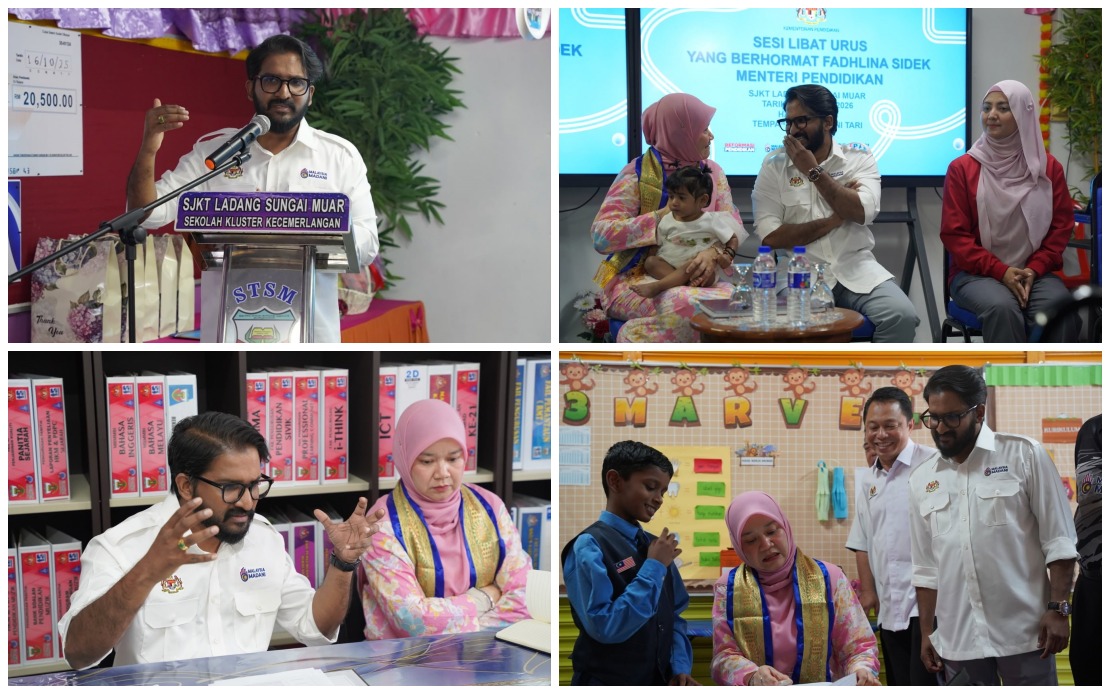
The relocation of Sekolah Jenis Kebangsaan Tamil (SJKT) Ladang Sungai Muar in Segamat has reached a critical milestone, moving into the land ownership acquisition stage as authorities work to provide the institution with improved facilities and a safer learning environment. The development, confirmed during a school engagement session attended by Education Minister Fadhlina Sidek, represents tangible progress on a project that has been flagged as a priority by local representatives and education officials concerned about the current campus's operational constraints.
Segamat Member of Parliament R. Yuneswaran outlined the procedural advancement at the meeting held in Segamat, noting that the land transaction process is being facilitated through collaboration with the Segamat Land and Mines Office. The involvement of these land administration agencies suggests that negotiations over property acquisition are underway, though the timeline for completing this phase remains undisclosed. This stage typically involves securing suitable land parcels, verifying ownership documentation, and navigating the bureaucratic requirements necessary for government institutions to occupy new premises.
The Education Minister's participation in the engagement session carries symbolic weight beyond ceremonial attendance. Her presence signals that the education portfolio views this relocation as aligned with broader ministerial objectives regarding infrastructure modernization and student welfare. Such high-level engagement often accelerates decision-making processes within government agencies, as it elevates the project's priority within institutional hierarchies. For a school serving the Tamil-speaking community in Johor, ministerial validation helps ensure that resource allocation and timely execution remain focal points across relevant departments.
Yuneswaran has consistently advocated for the relocation since his election as Segamat MP in 2022, framing the issue around three interconnected concerns: student safety risks associated with the current site, the school's geographical isolation from the broader Segamat community, and deficiencies in basic educational infrastructure. These factors collectively impact both the quality of teaching and learning experiences and the school's ability to recruit and retain qualified educators. Tamil-medium schools across Malaysia often face resource constraints compared to their national-medium counterparts, making targeted improvements particularly consequential for affected student populations.
The current location of SJKT Ladang Sungai Muar appears to present operational difficulties that extend beyond aesthetic or comfort considerations. Schools positioned at considerable distances from residential areas face challenges in student recruitment, parental involvement in school activities, and accessibility for teachers commuting from populated centers. Additionally, if infrastructure deficiencies include inadequate facilities for specialized subjects or extracurricular activities, these gaps directly constrain the educational offerings available to enrolled students. A relocation to a more strategically situated campus could facilitate better community integration and improved resource utilization.
The MADANI Government's stated commitment to prioritizing education provision underpins this project's advancement. Under this political framework, education has been positioned as a foundational element of national development, with particular emphasis on ensuring equitable access across different community segments. For vernacular schools serving minority language communities, demonstrating tangible improvements through relocations and infrastructure upgrades reinforces government messaging about inclusive governance and educational equity. The project thus carries political significance beyond the immediate benefits accruing to SJKT Ladang Sungai Muar's students and staff.
From a regional perspective, Tamil-medium primary education in Malaysia serves an important cultural and linguistic preservation function while providing quality education to Tamil-speaking children. In Johor, where significant Tamil-speaking populations maintain educational institutions, government responsiveness to infrastructure challenges strengthens confidence in the education system's capacity to serve minority communities effectively. Conversely, prolonged neglect of such facilities can contribute to declining enrollment and eventual institutional decline, outcomes that governments generally seek to prevent.
The land acquisition phase presents its own logistical complexities. Identifying suitable parcels within or near Segamat that meet educational facility specifications, negotiating fair market valuations, and processing title transfers through appropriate land authorities requires coordination across multiple governmental tiers. The Segamat Land and Mines Office's involvement indicates that statutory land administration procedures are being followed, which ensures legal clarity regarding property transfer but may also extend timelines beyond initial expectations. Communities monitoring such projects often experience delays at this phase due to documentation issues or competing land claims.
Yuneswaran's commitment to ongoing monitoring and follow-up suggests he recognizes that relocation projects frequently encounter implementation delays or funding challenges. By positioning himself as an active oversight participant, the MP signals both to constituents and to relevant agencies that this matter retains political salience. Such sustained parliamentary attention often proves instrumental in maintaining bureaucratic momentum when projects risk deprioritization due to competing administrative demands or budget constraints. For schools awaiting improvements, parliamentary advocacy provides a valuable mechanism for accelerating progress through governmental systems.
The broader implications of this relocation extend to how Malaysian education policy addresses infrastructure disparities across different school categories. While national schools typically benefit from more consistent capital allocation, vernacular institutions sometimes experience relative neglect in facility development. Visible progress on projects like the SJKT Ladang Sungai Muar relocation demonstrates that targeted political engagement can secure improvements for underserved institutions. This precedent may encourage other communities to pursue similar advocacy efforts, potentially reshaping resource distribution patterns within the education sector.
Moving forward, stakeholders will focus on completing the land acquisition process and transitioning toward facility design and construction phases. The timeline for these subsequent stages will significantly determine whether current students benefit from the improved campus, or whether relocation occurs only after they have progressed through the system. Transparency regarding projected completion dates would help manage expectations and maintain community confidence in the project's viability. As with numerous Malaysian infrastructure initiatives, sustained political will and adequate budgetary allocation will prove essential to ensuring that the relocation advances from planning into physical reality.

