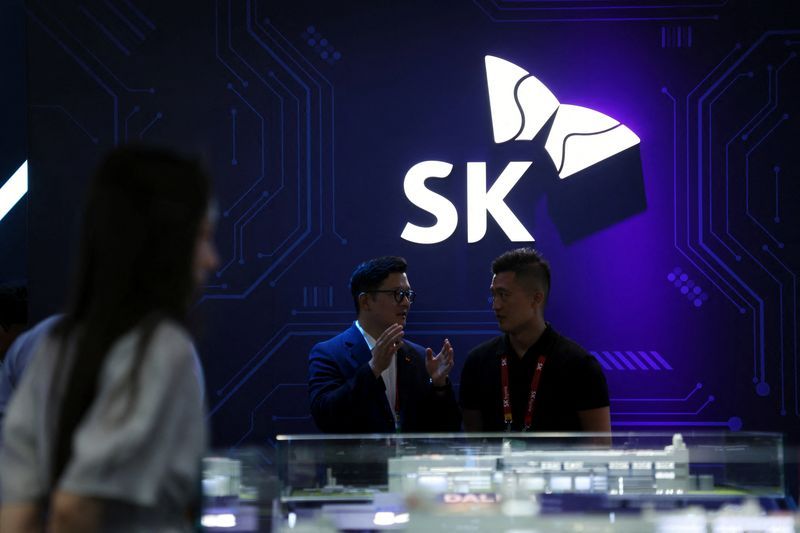
South Korea's SK Hynix, the world's second-largest manufacturer of memory semiconductors, announced plans on Wednesday to raise as much as 45.45 trillion won, equivalent to $29.43 billion, through an American Depositary Receipts listing. The move represents a significant capital-raising exercise aimed at accelerating the company's capacity for producing memory chips that have become indispensable to artificial intelligence applications globally. The amount remains subject to adjustment during the bookbuilding phase, reflecting market conditions at the time of the offering.
The semiconductor manufacturer intends to list 17.79 million new shares backing the ADR offering on the Nasdaq market, with trading scheduled to commence on July 10. Under the structure of this offering, ten ADRs will be equivalent to a single common share, a mechanism designed to make the securities accessible to international investors while maintaining share structure integrity. The listing represents a deliberate strategy to deepen SK Hynix's presence in North American capital markets and broaden its global institutional investor base.
Proceeds from the capital raise will be channelled toward three major infrastructure initiatives that underscore the company's commitment to capturing growth in the artificial intelligence sector. The company plans to construct a new chip fabrication facility in Yongin, establish an advanced packaging manufacturing centre in Cheongju, and acquire essential chipmaking equipment including an Extreme Ultraviolet Scanner, which represents the cutting-edge lithography technology required for producing the most advanced semiconductor nodes. These investments reflect the substantial capital requirements of modern semiconductor manufacturing and the competitive pressures facing the industry.
The offering is being managed by a consortium of leading global investment banks: BofA Securities, Citigroup Global Markets, Goldman Sachs, and JP Morgan Securities. This selection of banking partners underscores the scale and complexity of the transaction, as well as investor confidence in SK Hynix's strategic direction. The involvement of such prominent financial institutions typically signals strong market receptivity and suggests that institutional demand for the offering is anticipated to be robust.
Should the offering achieve the upper end of its indicated pricing range, SK Hynix would accomplish a historic milestone, surpassing Alibaba's 2014 New York debut, which garnered $21.8 billion and held the record for the largest ADR offering in history. This distinction would underscore the magnitude of capital that technology companies can mobilize in contemporary markets, particularly those positioned at the intersection of global semiconductor demand and artificial intelligence proliferation.
SK Hynix occupies a commanding position within the semiconductor supply chain for artificial intelligence infrastructure. The company is a dominant supplier of high-bandwidth memory chips that power advanced AI systems operated by industry titans including Nvidia and Alphabet's Google. These memory components have emerged as critical bottlenecks in AI system deployment, as the explosive demand for processing artificial intelligence workloads has strained global capacity for specialized memory solutions. SK Hynix's production capabilities have positioned the firm as a primary beneficiary of the worldwide artificial intelligence investment surge that has characterized technology spending over the past eighteen months.
The company's ascendance within the Korean tech ecosystem has been remarkably rapid. On Monday, SK Hynix surpassed Samsung Electronics to claim the title of South Korea's most valuable listed company, a transition that speaks to investor perception of growth trajectories within the memory semiconductor sector. This shift reflects expectations that artificial intelligence-related demand will sustain elevated margins and growth rates for memory chip producers, potentially for an extended period. For Malaysian investors and businesses, this development carries implications across multiple dimensions, from semiconductor supply chain resilience to regional technology sector competitiveness.
The timing of SK Hynix's capital raise coincides with intensifying global competition in semiconductor manufacturing and a shift toward geographic diversification of chip production. Major economies, including the United States and South Korea itself, are investing heavily in domestic capacity expansion to reduce dependence on Taiwan as a concentration point for advanced chip manufacturing. SK Hynix's expansion plans must be understood within this geopolitical and strategic context, where securing reliable sources of advanced memory chips has become a national priority for multiple governments.
For Southeast Asia, including Malaysia, SK Hynix's expansion carries both competitive and collaborative dimensions. Malaysia hosts semiconductor assembly and testing operations for numerous global chipmakers, but the region has limited presence in advanced memory chip fabrication. The capital intensity of memory chip manufacturing means that facilities are typically concentrated in a handful of countries with substantial technological capacity and capital availability. SK Hynix's investment trajectory illustrates the formidable barriers to entry in this sector and the concentration of advanced semiconductor capability in Northeast Asia.
The artificial intelligence revolution has fundamentally altered capital allocation priorities within the technology sector. Companies securing advantages in AI-adjacent components and manufacturing capabilities are attracting investor enthusiasm and commanding premium valuations. SK Hynix's decision to pursue a major capital raise reflects management's confidence that elevated demand for memory chips supporting AI applications will persist, justifying substantial infrastructure investment. The success or challenges encountered in executing this capital raise will provide important signals regarding institutional investor appetite for semiconductor industry capital expenditure cycles.
Regional technology industries should observe SK Hynix's expansion strategy as an indicator of where semiconductor value creation is concentrated and where investment is flowing. While Malaysia participates in semiconductor manufacturing, the most capital-intensive and highest-margin activities remain concentrated in a narrow set of locations. For local policymakers and technology companies, SK Hynix's ADR listing represents a reminder of the advantages accruing to firms positioned at the leading edge of technology transitions, a positioning that requires sustained investment in engineering talent, manufacturing infrastructure, and research capacity.