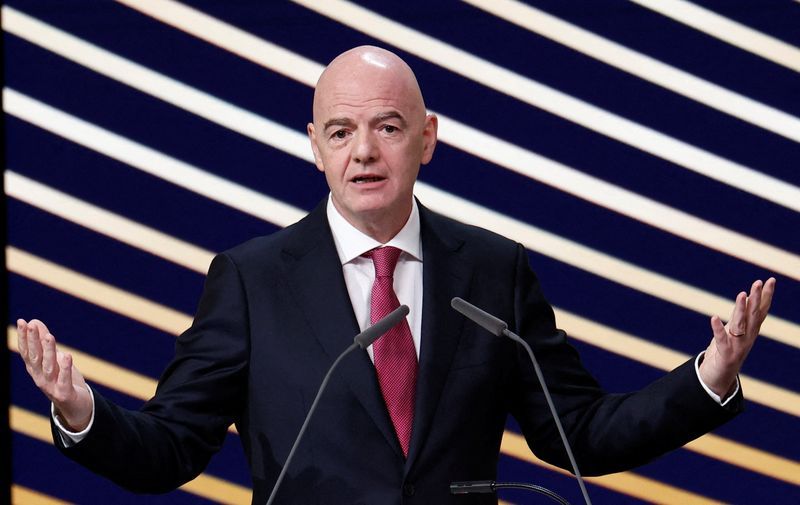
Gianni Infantino's bid to secure a fourth term as FIFA president has shifted its centre of gravity away from football's established superpowers toward the constellation of developing nations that form the backbone of FIFA's membership. The Swiss administrator faces unprecedented political turbulence following the rejection of his private equity proposal for the World Cup by two major continental confederations, forcing him to recalibrate his support base in an organisation where voting power is distributed equally across all 211 member associations, regardless of wealth or sporting prominence.
The scale of Infantino's political predicament became evident when Wales became the first national football federation to formally withdraw its endorsement, a symbolic blow to his European flank. Simultaneously, UEFA confirmed it had initiated legal proceedings against the FIFA chief over the controversial private equity initiative, which would have granted minority stakes to investors. These twin developments have created a confluence of pressure that could theoretically culminate in an Extraordinary Congress called to remove him from office—a mechanism that requires written support from just 42 FIFA members to trigger, well within the reach of organised opposition.
Yet translating that technical possibility into political reality presents substantial obstacles. UEFA's 55 member nations, despite their unified opposition to Infantino's World Cup proposal, could theoretically force an Extraordinary Congress unilaterally. However, securing the simple majority required to actually vote him out demands coalition-building that extends far beyond the wealthy nations of Europe. This is where the geopolitical arithmetic fundamentally favours Infantino, despite his recent setbacks among elite football confederations.
The structural advantage lies in FIFA's distribution of resources to developing member associations. Between 2023 and 2026, FIFA has made available up to $3 million per member nation for soccer development initiatives—a substantial increase of $1 million compared to the previous quadrennial cycle. For emerging football nations operating with minimal state support and limited commercial revenue, this funding represents the difference between serious investment in infrastructure and stagnation. A nation like Bhutan, which has never qualified for a World Cup and operates in one of Asia's most geographically challenged regions, depends almost entirely on FIFA's financial support to maintain competitive international participation.
Vanuatu exemplifies both the dependency and the political loyalty that such patronage generates. The Pacific island nation, with a population of approximately 340,000, received a FIFA development grant of $4.15 million that enabled the construction of a 6,500-seat stadium in Port Vila, completed in 2022. This investment fundamentally transformed the island's football infrastructure and international standing. Simultaneously, Vanuatu's football association president Lambert Maltock secured elevation to FIFA's Executive Council as one of eight vice-presidents—a position of genuine influence on the world body's governing structures. This combination of financial support and political recognition creates powerful incentives for continued backing of an incumbent president.
The testimony of Vanuatu's professional footballer Brian Kaltak, currently with Perth Glory in Australia, underscores the tangible impact of Infantino's development agenda on emerging nations. Kaltak credited the FIFA president not only with elevating his country's representation within football's global governance structures but also with catalysing broader investment in soccer programmes across developing nations. For players from small island states or remote regions, these FIFA-funded initiatives represent genuine pathways to professional careers and international exposure that would otherwise remain inaccessible.
This pattern of targeted investment replicates across Africa, Asia, the Caribbean, and the Pacific, where FIFA development grants finance the construction of training facilities, gym equipment, and structured coaching programmes that national associations cannot otherwise afford. Ghana and Kenya in Africa, Jamaica in the Caribbean, and Samoa in the Pacific have all received substantial infrastructure support under Infantino's tenure. These investments create constituencies of beneficiaries whose football federations have material incentives to maintain political stability within FIFA.
Critics contend that this funding model represents a deliberate strategy of consolidating political influence through financial dependency. By concentrating discretionary development resources under the presidency's direction, Infantino has constructed a system in which smaller nations receive tangible benefits contingent on their continued participation in FIFA's governance structures. The accusation, in essence, is that FIFA's development largesse functions as a currency of political control, converting financial flows into voting compliance.
The mechanics of removing Infantino would require orchestrating opposition among enough FIFA members to achieve a majority, but this requires mobilising nations across disparate continents with divergent interests and competing regional priorities. UEFA and CONCACAF, despite their unified opposition to the World Cup private equity proposal, do not command sufficient votes independently. Compelling the developing world to abandon an incumbent president requires constructing alternative narratives about football governance that rival the immediate material benefits offered by continued support.
Infantino's confirmation that he intends to contest the April Congress election, which would normally determine his fate, becomes less relevant if opponents successfully convene an Extraordinary Congress beforehand. The three-month window between triggering such a congress and its mandatory convocation would allow rival candidates to emerge and mobilise their own support networks. However, the structural mathematics remain daunting for anti-Infantino forces, particularly without a compelling alternative candidate who can offer developing nations equivalent development funding and governance representation.
The geographical distribution of FIFA's membership means that any successful challenge to Infantino must address not merely the football power structures of Europe and North America, but the aspirations and material interests of 150 nations scattered across multiple continents. Emerging football nations do not perceive themselves as subordinate participants whose voices should defer to European traditions or established competitive hierarchies. Rather, FIFA's democratic voting structure—one nation, one vote—elevates their collective bargaining power to a level unprecedented in traditional international sports governance.
Infantino's political vulnerability remains genuine, particularly given the coordinated regional opposition and legal threats emanating from UEFA. Yet his survival ultimately depends on a calculation that smaller nations will prioritise concrete financial benefits and genuine inclusion in global football governance over the political preferences of established European and American confederations. As the FIFA political drama unfolds toward potential extraordinary votes, the outcome will be determined less by the preferences of traditional football powers than by whether developing nations perceive greater advantage in stability or change.

