Johor's 16th state election entered its critical nomination phase on June 27 with candidates filing their papers across 56 centres statewide under largely supportive conditions. The Election Commission managed the filing process from 9am to 10am at all locations, with officials completing final preparations before the formal commencement. The orderly atmosphere across the various nomination posting centres reflected careful planning and coordination, setting a professional tone for the campaign period ahead.
Weather conditions proved favourable for the nomination day's proceedings, a factor that facilitated candidate registration and allowed party representatives to move efficiently between centres. The Malaysian Meteorological Department forecast predominantly dry conditions throughout Johor's morning hours, with thunderstorms potentially developing only in scattered areas during the afternoon—a timing that allowed the morning nomination window to proceed uninterrupted. Such weather cooperativeness removed a logistical variable that could have complicated the already complex exercise of managing candidate filings across an extensive geographic area.
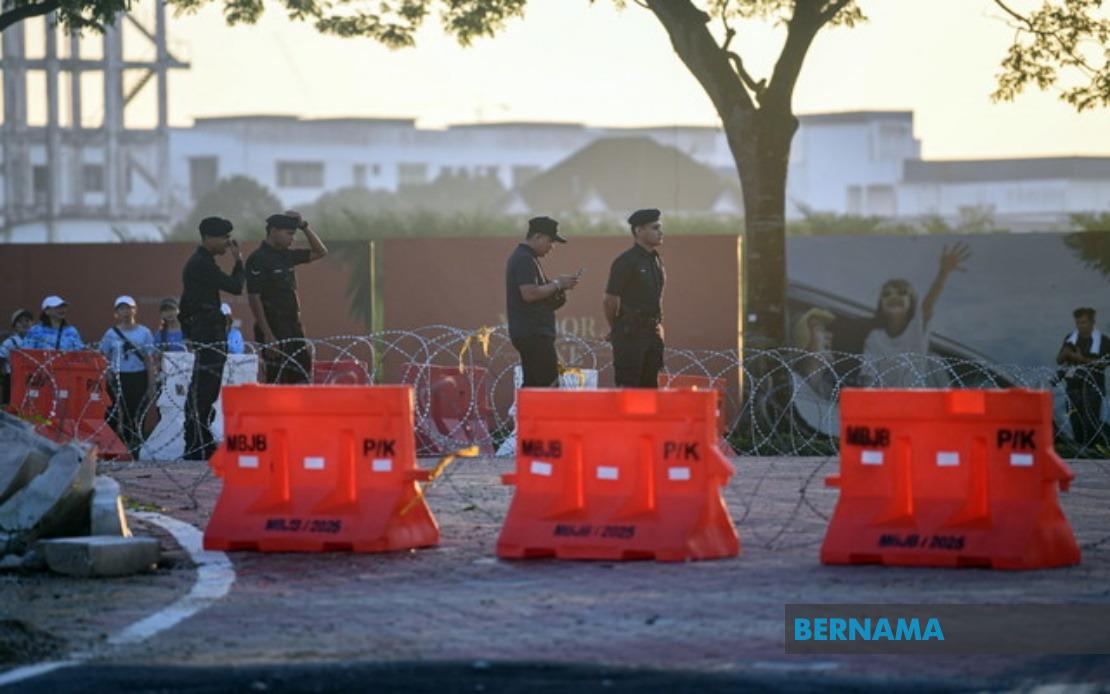
Security arrangements at all 56 nomination centres remained tight throughout the registration period, with uniformed personnel maintaining vigilant positions to preserve order and prevent disruptions. Their presence underscored the Election Commission's commitment to protecting the integrity of the nomination process, a foundational element for democratic credibility. The visible security presence also served a regulatory function, ensuring that supporters gathered at centres maintained appropriate decorum while expressing party affiliation.
Party enthusiasm manifested early, with supportive crowds converging at various centres from 7.30am onwards, demonstrating the considerable grassroots engagement surrounding this election cycle. Such early mobilisation reflects both the competitive intensity of Johor politics and the significance parties assign to demonstrating public backing for their candidates. The willingness of supporters to arrive hours before official proceedings suggests high stakes in a state that has historically influenced broader regional political dynamics.
Johor's electorate comprises 2,727,926 registered voters distributed across three categories: 2,703,175 ordinary voters, 12,041 military personnel and their families, and 12,710 police personnel and their families. This composition represents substantial representation from security force families, a demographic bloc whose electoral preferences have historically attracted party attention in Malaysia. The inclusion of these cohorts ensures comprehensive voter participation while acknowledging the political weight of constituencies with direct security force membership.
The state assembly dissolution on June 1 triggered the formal election cycle, with the Election Commission establishing July 7 for early voting and July 11 as the main polling day. This timeline provides a compressed but organised campaign window compressed into roughly two weeks, testing parties' capacity to mount effective grassroots campaigns within a truncated period. Early voting provisions ensure that military and police personnel, whose duties may prevent standard polling attendance, can exercise their franchise at designated stations.
With 56 seats across the Johor State Legislative Assembly at stake, this election carries considerable implications for state governance and resource allocation affecting the peninsula's southernmost major population centre. The scale of the assembly means that coalition arithmetic will likely determine government formation, putting premium on candidate selection quality and ground-level campaign effectiveness. Each seat represents thousands of constituents whose concerns around economic development, infrastructure, and service provision will shape voting patterns.
The nomination day's successful execution establishes logistical confidence heading into the two-week campaign phase. Smooth processing of nomination papers typically correlates with efficient election administration overall, suggesting that voters can expect well-organised polling procedures on July 11. The Election Commission's demonstrated capacity to manage simultaneous activities across 56 locations reflects institutional maturation and operational expertise refined through previous electoral cycles.
For Malaysian observers and regional analysts, Johor's election outcome carries implications extending beyond state boundaries. As Malaysia's economically significant southern state and a traditional bellwether for national political sentiment, Johor's voter preferences often presage broader shifts in peninsular politics. The distribution of the 56 seats among competing coalitions could signal whether opposition parties continue consolidating gains from recent national electoral cycles or whether governing coalitions have arrested momentum loss.
The campaign period ahead will test party messaging around cost-of-living pressures, investment attraction, and governance quality—issues resonating across Malaysia's electorate. Candidates will need to articulate visions addressing Johor-specific concerns while positioning themselves within broader national political narratives. The compressed timeframe means that whoever secures the most assembly seats will need to move rapidly toward government formation, making post-election coalition negotiations potentially acute.
With nomination formalities now complete and candidate lists finalised, political parties enter the public campaigning phase armed with their selected representatives. The July 11 polling day will determine whether current governance arrangements persist or whether voter preferences necessitate political restructuring. For a state of Johor's demographic and economic significance, the election outcome will influence not merely state policy directions but potentially broader coalition dynamics affecting Malaysia's national political trajectory through 2025 and beyond.

