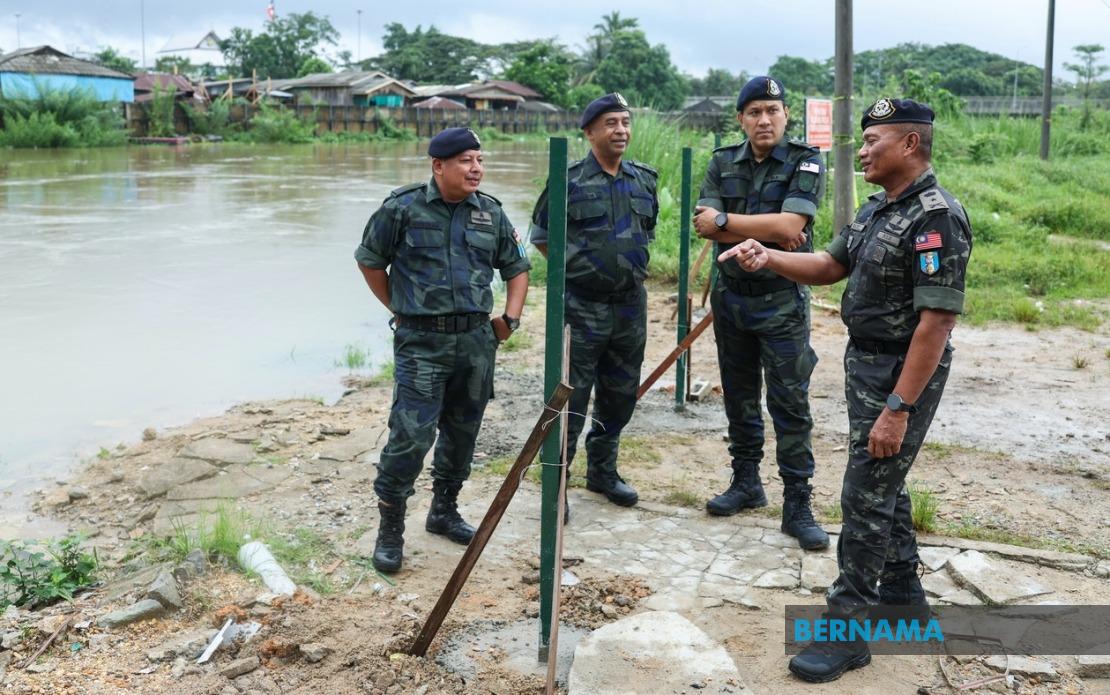
The General Operations Force has exposed a troubling evolution in human trafficking methodology along Malaysia's borders, with smuggling syndicates deliberately fragmenting migrant movements into smaller batches to circumvent security detection. The discovery emerged during Operasi Taring Wawasan Kelantan in Pasir Mas, where the GOF's 8th Battalion, working alongside the Criminal Investigation Division, apprehended 13 Myanmar nationals including five women across multiple raids in the Kampung Banggol Kemian area. The coordinated enforcement action underscores how trafficking networks continue to innovate their approach despite increased vigilance from Malaysian security agencies.
According to Southeast Brigade GOF commander SAC Ahmad Radzi Hussain, the operation commenced in the early morning hours around 3.30 am after intelligence prompted a team to monitor suspicious activity near Pasir Mas. Officers spotted a Proton Exora exhibiting unusual behaviour in the locality, and when the driver detected their presence, he abandoned the vehicle and fled into adjacent forest terrain, successfully evading immediate capture. The subsequent vehicle search yielded four Myanmar nationals seated in the rear compartment, all unable to present legitimate travel documentation. This initial discovery proved to be merely the beginning of a larger smuggling operation.
Within an hour of securing the four detainees from the vehicle, enforcement personnel conducting extensive forest searches located nine additional Myanmar nationals dispersed throughout the surrounding woodland. These individuals had reportedly just completed their crossing through an illegal entry point, consistent with the fragmented movement pattern now characterised as the syndicate's operational adjustment. The entire group, aged between 20 and 37 years, had been transported across the Golok River frontier from Thailand by two unidentified facilitators operating the smuggling network. Rather than moving as one cohesive unit, which would create an obvious target for security forces, the migrants were deliberately discharged at staggered intervals and locations to minimise their visibility during transit.
The deliberate spacing and staged placement of migrants reflects a calculated response by trafficking organisations to Malaysia's border security infrastructure. By fragmenting groups, smugglers reduce the conspicuousness of their movements and lower the probability that any single security checkpoint or patrol would encounter a large concentration of undocumented individuals. This tactical recalibration demonstrates the adaptive nature of transnational smuggling networks, which continuously adjust methodologies based on enforcement patterns and security presence. For Malaysian authorities, this evolution presents new investigative challenges, as smaller dispersed movements are inherently more difficult to detect and monitor than consolidated group movements.
The arrested individuals were destined for employment opportunities in the Kuala Lumpur metropolitan region, representing the broader pull factors that continue to attract irregular migrants to Malaysia despite significant enforcement efforts. The prospect of economic opportunity, even in informal or irregular employment sectors, maintains powerful incentive structures for vulnerable populations from Myanmar and other regional source countries. These migration flows intersect with labour market demands in Malaysian cities, where certain industries historically rely on informal migrant workforces, creating ongoing tension between labour supply dynamics and immigration enforcement.
Beyond the human trafficking dimensions, authorities recovered a Proton Exora valued at approximately RM30,000, which had served as the primary transport mechanism. The seizure of vehicles represents a significant financial penalty for smuggling operations, though the loss of a single conveyance is unlikely to substantially deter networks operating with apparent financial resources and established routes. The vehicle's relatively modest value, however, underscores that sophisticated trafficking requires minimal capital investment beyond logistical coordination and border facilitators.
All 13 detainees have been transferred to the Criminal Investigation Division of the Pasir Mas district police headquarters for continued processing and investigation pursuant to Section 6(1)(c) of the Immigration Act 1959/63. This legal framework provides the statutory basis for charging individuals found within Malaysian territory without valid immigration status. The investigation phase will determine whether any individuals warrant additional prosecution under human trafficking statutes, which carry substantially more severe penalties than simple immigration violations.
This operation illustrates the persistent challenge confronting Southeast Asian governments attempting to manage irregular migration within the context of porous land borders and organised transnational networks. Thailand's northeastern border areas, particularly along the Golok River demarcation, continue serving as primary transit zones for migrants originating from Myanmar seeking passage into Malaysia. The seasonal patterns of such movements, coupled with economic desperation within Myanmar, suggest that enforcement actions targeting individual smuggling operations address symptoms rather than underlying structural factors driving migration flows.
For Malaysia, such incidents highlight the ongoing necessity for sustained border enforcement while simultaneously raising questions about complementary policy approaches addressing root migration drivers. The sophistication evident in the syndicate's tactical adjustments—moving rapidly from large-group to small-group methodologies—indicates these networks possess adequate intelligence regarding security operations and adaptation capacity. Effective counter-smuggling strategies must therefore incorporate intelligence gathering on organisational structures and facilitator networks operating across borders, alongside conventional checkpoint enforcement. The Kelantan operation represents incremental progress in disrupting individual smuggling operations, yet the broader trafficking infrastructure enabling such movements remains substantially intact within the region.

