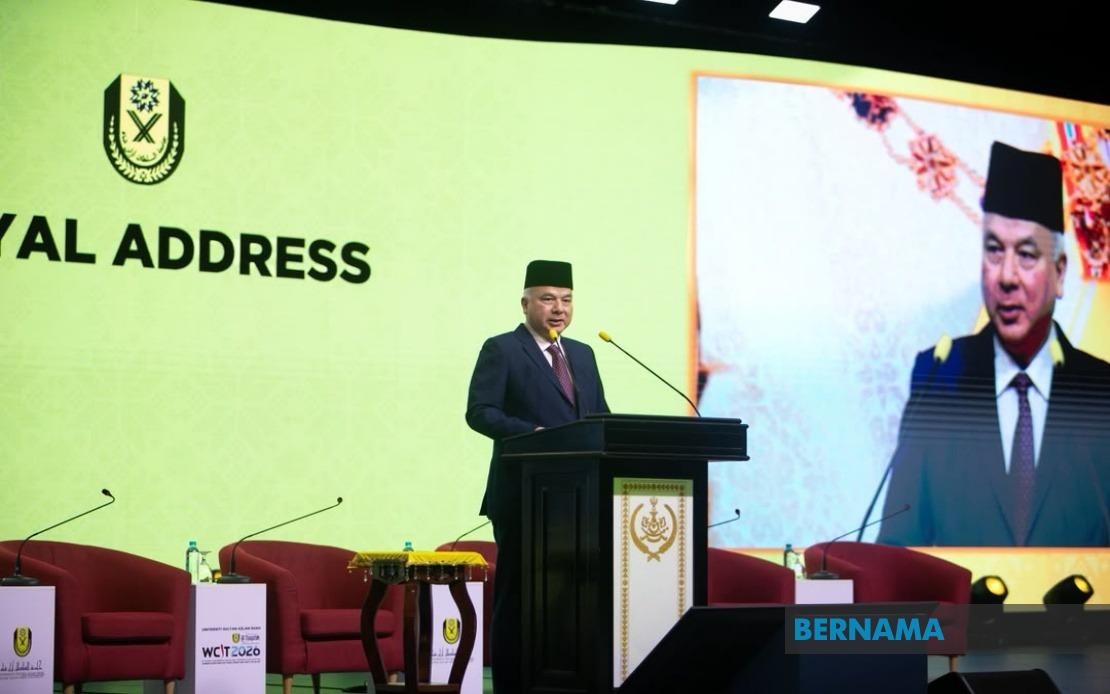
Sultan Nazrin Shah, the Sultan of Perak, has articulated a vision of national security that extends far beyond conventional military defence or cyber capabilities, arguing instead that genuine stability flows from the bonds holding a society together. Addressing the 8th World Conference on Islamic Thought and Civilisation in Ipoh on July 21, His Royal Highness positioned social cohesion as the ultimate safeguard—one that no amount of fortifications or technological countermeasures can replicate or replace. This framing challenges policymakers across the Muslim world and Southeast Asia to reconsider what true security actually means in an era of fragmented identities and competing narratives.
The Sultan's intervention carries particular weight in Malaysia's current political climate, where religious and ethnic sensitivities frequently intersect with factional power struggles. His Royal Highness explicitly warned against the weaponisation of faith, pointing to a troubling pattern whereby religious doctrine becomes distorted to serve narrow partisan interests rather than fostering broader unity. This distinction—between faith as a unifying force and faith as a tool for division—strikes at the heart of contemporary Malaysian politics, where appeals to Islamic identity sometimes mask essentially material or sectional ambitions. By emphasising that true national integrity demands vigilance against such manipulation, Sultan Nazrin implicitly called on political and religious leaders to examine their own rhetoric and conduct.
Central to Sultan Nazrin's argument is the proposition that a nation cannot achieve lasting security if its citizens lack a genuine sense of belonging within the national project. A state may fortify its borders, arrest dissidents, and monitor digital networks, yet if large segments of the population feel excluded from economic opportunity, political voice, or cultural recognition, the foundations remain unstable. This observation resonates throughout Southeast Asia, where rapid urbanisation, digital connectivity, and economic inequality have fractured traditional social structures. Malaysia in particular faces the challenge of ensuring that citizens across its diverse ethnic and religious landscape perceive the system as fundamentally fair and inclusive.
The Sultan drew a sharp distinction between two types of unity: that imposed through coercion, which he characterised as brittle and prone to fracture, and that built on shared belonging, which he described as resilient and durable. This framework suggests that short-term security measures—increased surveillance, harsher penalties, more restrictive laws—may actually undermine long-term stability by deepening grievances and widening fault lines. Instead, His Royal Highness advocated for institutional reforms ensuring every community sees itself reflected in legislation, economic policy, education systems, and leadership structures. For Malaysia, this implies ongoing examination of whether policies in areas such as affirmative action, business licensing, and university admission truly serve inclusive growth or merely entrench privilege.
Sultan Nazrin placed particular emphasis on the role of education in building social cohesion and preparing citizens for future challenges. He stressed that investment in human capital must go beyond simply constructing more schools and universities; it must embrace a comprehensive approach integrating sciences, mathematics, humanities, and arts in balanced measure. This integrated vision contrasts with narrower approaches that treat technical and vocational training as inferior to academic pathways, or that prioritise STEM fields at the expense of moral and philosophical development. For a nation increasingly aware of its need to compete in global knowledge economies whilst maintaining social stability, this holistic educational philosophy offers practical guidance.
Looking ahead to the artificial intelligence era, Sultan Nazrin identified a fundamental misalignment between education systems optimised for the industrial age and the capacities demanded by the digital future. Traditional pedagogies emphasising rote memorisation and standardised testing, he argued, ill-serve a generation confronting a world where information is instantly retrievable and abundant. Instead, young people require the distinctly human capabilities that machines cannot easily replicate: critical thinking, ethical reasoning, creativity, and adaptive problem-solving. The Sultan noted that Islamic educational traditions, properly understood, have always sought to cultivate precisely these capacities through their emphasis on both revealed knowledge and rational inquiry, offering a template for contemporary educational reform.
The presence of high-level government figures at the conference—including Deputy Prime Minister Fadillah Yusof and Perak Menteri Besar Saarani Mohamad—suggests that Sultan Nazrin's message about social cohesion resonates within governing circles, though whether it will translate into substantive policy shifts remains uncertain. The challenge for Malaysian policymakers lies in translating rhetorical commitment to inclusion and shared belonging into concrete measures addressing economic inequality, political representation, and cultural respect. This requires not merely protecting religious sentiment from exploitation but actively building institutions and practices that genuinely incorporate marginalised voices into decision-making.
Sultan Nazrin's remarks also carry implications for Malaysia's standing within the broader Islamic world and within Southeast Asia's regional architecture. By arguing that Islamic education and values naturally incline toward inclusive reasoning and critical inquiry, he countered narratives that position Islam as inherently opposed to pluralism or rational thought. This framing strengthens Malaysia's ability to position itself as a model of Islamic modernity, demonstrating that religious commitment and social diversity can coexist productively. For neighbouring countries grappling with similar questions about identity, modernity, and social order, Malaysia's experience—both its successes and its ongoing struggles—offers relevant lessons.
The Sultan's emphasis on national integrity as inseparable from security suggests that programmes focused solely on border control, counterterrorism, or cybersecurity, without addressing underlying grievances and structural inequalities, will prove insufficient. A nation secure from external attack but riven by corruption, injustice, and exclusion has merely deferred its reckoning, not achieved genuine security. This long-view perspective challenges the tendency in security discourse to prioritise spectacular threats and immediate crises over the patient work of institution-building and social inclusion. For Malaysia and the wider region, embracing this perspective could reshape how governments allocate resources and measure success.
Moving forward, the test of Sultan Nazrin's vision will be whether Malaysian institutions—educational, legal, economic, and political—begin to evolve in ways that genuinely reflect his call for inclusive belonging and shared stakes in national success. Education reform offers a particularly promising entry point, given the Sultan's specific recommendations regarding curriculum, pedagogical approach, and the valuing of diverse career pathways. Equally important is the willingness of political and religious leaders to resist the temptation to exploit religious identity for short-term partisan advantage, recognising instead that true national strength flows from citizens who genuinely believe their nation is theirs.

