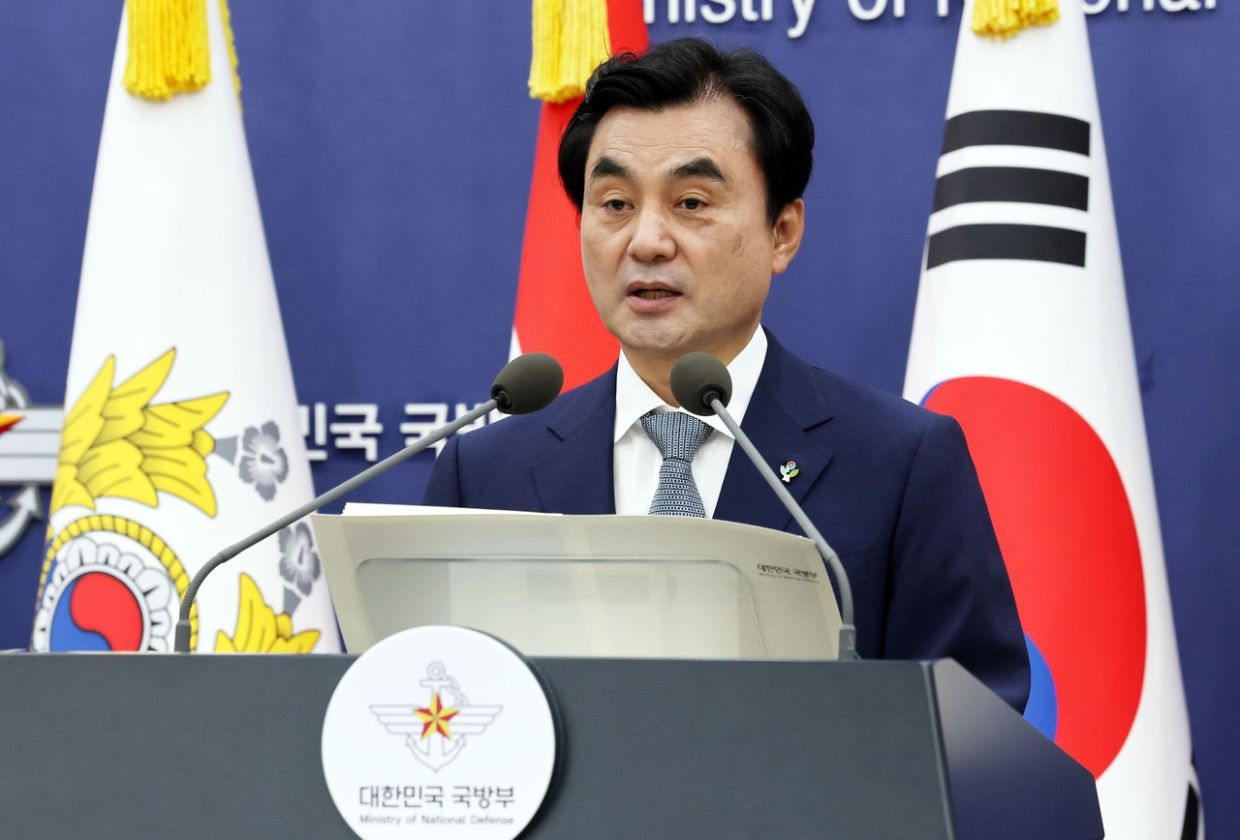
South Korea is embarking on a comprehensive transformation of its uncrewed warfare strategy, committing to procure more than 20,000 low-cost drones and accelerate deployment of its homegrown long-range loitering munition system, known as K-Lucas. Defence Minister Ahn Gyu-back announced the sweeping initiative on Friday, positioning the country to adapt to modern battlefield realities shaped by affordable drone technology and lessons learned from conflicts in Ukraine and the Middle East.
The strategic pivot reflects a fundamental recognition that budget-conscious drone deployment is fundamentally altering how contemporary warfare unfolds. Rather than relying exclusively on expensive, advanced systems, Seoul is embracing a layered defence approach that combines low-cost expendable drones with directed-energy weapons and interceptor systems. This shift acknowledges that adversaries increasingly favour swarm tactics and mass drone deployments over traditional platforms, forcing militaries to recalibrate their procurement and operational doctrines accordingly.
North Korea's expanding uncrewed aerial capabilities serve as the primary catalyst for this strategic recalibration. Pyongyang has progressively developed diverse drone platforms capable of reconnaissance, surveillance, and potentially offensive operations, creating vulnerabilities not only for South Korean military installations but also for critical civilian infrastructure. By scaling up its own drone inventory significantly, Seoul aims to level an asymmetric playing field where adversaries could overwhelm defences through sheer volume rather than technological sophistication.
The acquisition programme targets multiple drone categories through 2030. Short-range reconnaissance platforms will provide frontline intelligence, whilst small loitering munitions—sometimes termed suicide drones—offer precision strike capabilities at a fraction of the cost of conventional weapons systems. The ministry has deliberately emphasized the "low-cost" and "expendable" characteristics of these platforms, signalling a philosophical departure from previous procurement patterns that prioritized advanced, long-serving systems requiring sophisticated maintenance and training infrastructure.
K-Lucas represents South Korea's indigenous answer to loitering munition development, with officials asserting the weapon can execute strategic strikes during future conflicts. By domestically developing this capability rather than importing foreign systems, Seoul maintains operational independence whilst supporting its defence industrial base. The accelerated fielding timeline underscores the urgency officials perceive in addressing contemporary threats, suggesting deployment could begin within the near-to-medium term.
From 2025 onwards, South Korea plans to position counterdrone systems and small unmanned aircraft defence apparatus throughout frontline areas adjacent to the Korean Demilitarised Zone. These defensive measures will work in conjunction with directed-energy systems—including laser and high-power microwave platforms—currently under development. The dual strategy of overwhelming potential attackers through numerical drone superiority whilst deploying cutting-edge air defence creates a multifaceted deterrent posture that would complicate any large-scale unmanned assault.
Ministry officials acknowledge that traditional defence procurement cycles cannot match the velocity of drone and counterdrone technological advancement. Deputy Defence Minister Kim Hong-cheol emphasized that streamlined acquisition pathways are essential, proposing legislation enabling commercial drone systems to undergo military testing and rapid certification rather than lengthy development timelines. This represents a pragmatic recognition that off-the-shelf solutions proven in civilian markets can often meet military requirements without waiting years for bespoke platforms.
The Defence Ministry is simultaneously committing to develop next-generation capabilities centred on artificial intelligence-powered drone swarms. These autonomous systems, operating with minimal human intervention, could coordinate complex multi-platform operations across contested airspace. Such swarm technology would dramatically complicate adversary air defence challenges, as traditional point-defence systems struggle against distributed, coordinated attacks. This investment signals South Korea's determination to maintain technological edge despite embracing cost-effective procurement for lower-tier systems.
An ambitious human capital initiative accompanies the material expansion, with the military targeting training of 500,000 drone operators by enabling all service members to deploy unmanned systems as "second personal weapons." This democratization of drone operation transforms uncrewed systems from specialized military tools into ubiquitous tactical assets, fundamentally altering force employment concepts and tactical flexibility. Such universal training would require significant institutional reorganization, doctrine development, and resource allocation across military branches.
Organizational restructuring accompanies the strategic pivot. The Drone Operations Command will transition into the National Defence Drone Headquarters, losing direct operational authority whilst retaining policy, procurement, and industrial coordination responsibilities. Individual military branches—Army, Navy, Air Force, and Marine Corps—will assume operational planning and execution, enabling service-specific drone concepts tailored to maritime, air, and ground warfare domains. This decentralization aims to foster innovation whilst maintaining centralized capability development and industrial partnership oversight.
The reorganization concludes months of controversy surrounding the command's alleged involvement in unauthorised drone incursions over North Korean territory in October 2024, incidents tied to former President Yoon Suk Yeol's abortive martial law declaration. Personnel reportedly destroyed evidence by deleting flight logs and disposing of operational equipment, raising governance and accountability concerns. Despite dissolution speculation, the Defence Ministry retained the organization, recognizing drones, robotics, and artificial intelligence as increasingly pivotal to modern military effectiveness—a decision that prioritizes strategic capability over institutional accountability measures.
Separately, President Lee Jae Myung will chair deliberations on fostering advanced defence and space technology companies, addressing systemic challenges to South Korea's industrial competitiveness amid evolving security dynamics. Such high-level attention to defence innovation underscores governmental commitment to sustaining technological leadership whilst managing geopolitical pressures and budgetary constraints. For Southeast Asian security observers, South Korea's drone strategy provides instructive lessons about adapting to unmanned warfare proliferation—challenges increasingly relevant throughout the region as technological diffusion continues and strategic competition intensifies.

