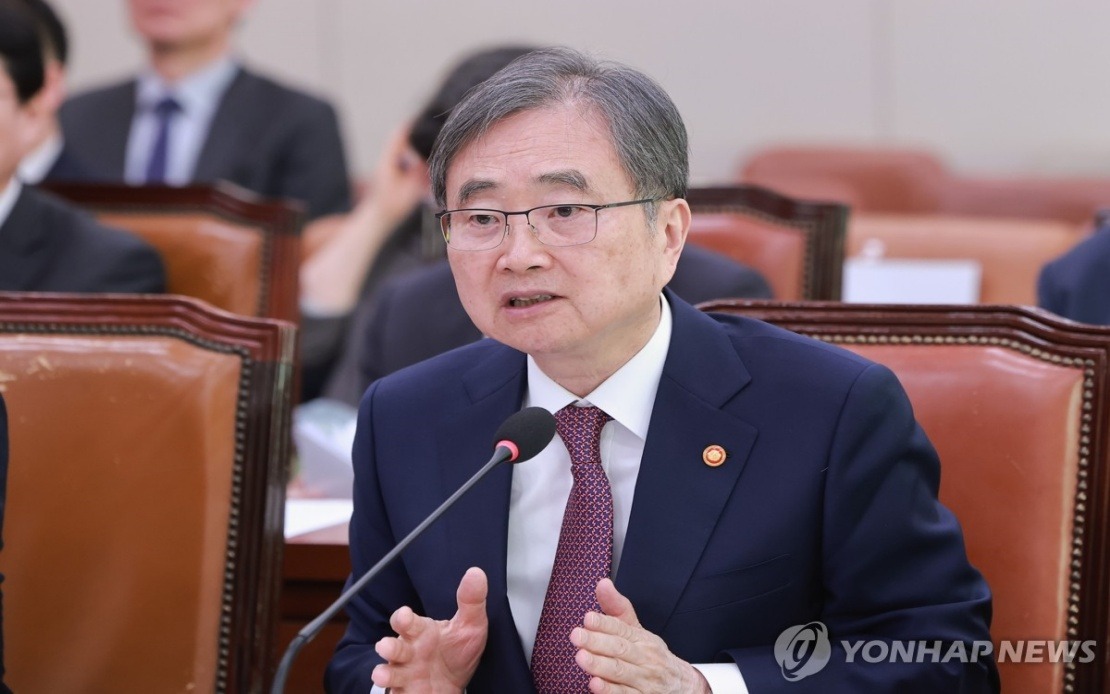
South Korea's diplomatic establishment faced an unusual diplomatic embarrassment this week when Foreign Minister Cho Hyun revealed that his government learned about significant cuts to joint military exercises with the United States through President Donald Trump's social media announcement rather than through official channels. The disclosure underscores the unpredictability that characterises the current US administration's approach to alliance management and raises questions about the coordination mechanisms between Washington and one of its most strategically important partners in East Asia.
Cho disclosed to lawmakers on the parliamentary committee for foreign affairs and unification that neither Seoul nor Washington had provided advance notice before Trump posted his announcement on August 16 regarding a substantial reduction in joint South Korea-US military activities. The revelation is particularly striking given that military exercises represent a cornerstone of the defence alliance between the two nations and typically involve extensive advance planning and coordination. The fact that a decision of this magnitude emerged first through social media rather than diplomatic cables suggests a breakdown in standard protocols or a deliberate departure from conventional channels.
Defending the government's response, Cho emphasised that South Korea's Defence Minister Ahn Gyu-back had immediately begun intensive consultations with American counterparts following Trump's post. Cho's characterisation of these discussions as consultations rather than responses to a unilateral notification was likely intended to preserve Seoul's standing and suggest some degree of agency in the process. However, the distinction rings hollow for observers accustomed to the deliberate pacing and formal notification procedures that typically govern alliance military operations. The narrative of consultation after the fact differs substantially from the collaborative decision-making that official statements usually describe.
The practical implications of the reduction became apparent when South Korea's Joint Chiefs of Staff announced that the Ulchi Freedom Shield exercise, a major annual drill, would be shortened from its originally scheduled August 17-27 timeframe to conclude on August 21. This modification represents not merely a cosmetic adjustment but a meaningful reduction in operational scope and duration. Ulchi Freedom Shield is no routine exercise; it encompasses field manoeuvres, computer-simulated command post operations, and civil defence drills designed to maintain readiness against potential North Korean aggression. Compressing these activities into a shorter window necessarily diminishes the training value and stress-testing of command structures and inter-allied coordination mechanisms.
Trump's initial directive to the Pentagon, announced on August 16, framed the reduction as a cost-saving measure, reflecting his longstanding criticism of what he characterises as disproportionate defence spending by South Korea relative to its economic capacity. This framing, however familiar to observers of Trump's previous tenure, carries particular weight in the Korean context where the alliance serves not primarily as an expensive mutual insurance policy but as a direct counterbalance to North Korean military capabilities. The economic argument, however compelling in other contexts, oversimplifies the security calculus on the peninsula.
The involvement of US Forces Korea Commander Xavier Brunson in subsequent consultations suggests that Washington was attempting to manage fallout and establish a more orderly process following the social media announcement. Brunson's visit to South Korea's defence ministry building on Tuesday represented a rapid attempt to restore some semblance of institutional coordination after the initial shock of the public announcement. Such damage-control visits, however necessary, cannot fully restore the consultative framework that should have preceded any policy change of this significance.
For Malaysia and other Southeast Asian nations observing US alliance management in the region, the incident carries troubling implications. It demonstrates that even countries bound by decades of formal alliance arrangements and stationed with tens of thousands of American military personnel cannot assume predictable, institutionalised consultation processes. If South Korea, with its existential dependence on US security commitments, can be surprised by major policy shifts announced through social media, the message for less strategically proximate nations is sobering. The incident raises questions about the reliability of American commitments and the durability of alliance structures when subjected to the whims of individual leadership decisions made through informal channels.
The broader context involves Trump's well-documented scepticism about the costs of maintaining overseas military commitments. His instruction to scale back operations significantly represents not an isolated incident but part of a consistent pattern of questioning the financial burden of alliance relationships. In the Korean context, these arguments encounter the reality that the alliance exists primarily to deter conflict rather than to project power outward. The calculus differs fundamentally from the defence of distant territories; instead, it concerns preventing catastrophic conflict on the peninsula that would claim hundreds of thousands of lives and destabilise the entire region.
South Korea's measured response, despite the evident frustration reflected in Cho's parliamentary testimony, reflects Seoul's constrained position. The country cannot afford to escalate tensions with its dominant security guarantor, regardless of communication breakdowns or procedural irregularities. This asymmetry in the relationship, where one party can announce major policy changes unilaterally while the other must accept them gracefully, underscores the fundamental vulnerabilities of smaller nations dependent on great power protection. For Malaysia's own strategic calculations, the lesson is clear: alliance relationships provide no guaranteed insulation from sudden shifts in policy direction.
Moving forward, the Ulchi Freedom Shield exercise will proceed in truncated form, allowing both armies to maintain at least some level of coordinated readiness despite the compressed timeline. However, the diplomatic damage extends beyond the immediate operational concerns. Trust in institutional processes, once undermined, takes time to rebuild. The incident demonstrates that even the most essential alliance relationships operate within constraints of great power politics where communication protocols can be bypassed and decisions imposed rather than negotiated. For regional observers assessing the stability of security architecture across East Asia and Southeast Asia, this episode offers an uncomfortable reminder about the inherent unpredictability of dependencies built on great power commitments.

