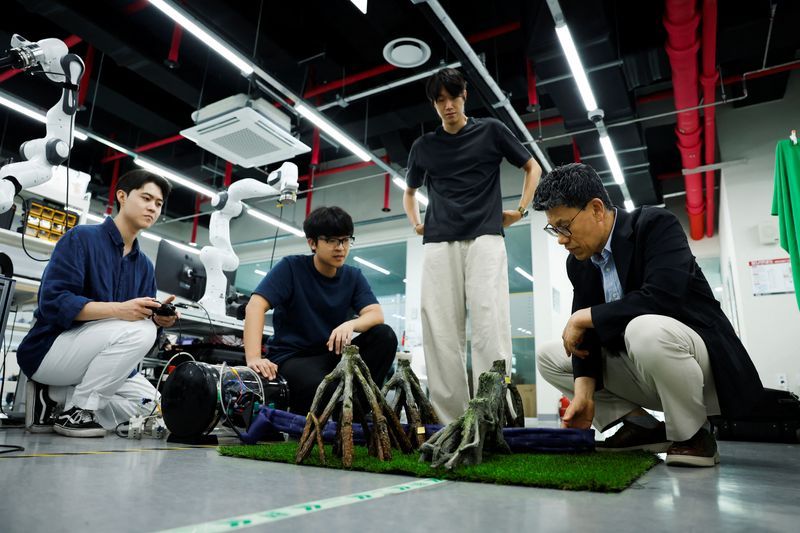
A collaborative team of researchers from South Korea's KAIST university and Stanford University has developed a novel robotic system that enables individuals to don protective or everyday clothing entirely hands-free, marking a significant advancement in wearable robotics technology. The breakthrough, unveiled in Daejeon, represents a practical solution to a challenge long posed by accessibility and occupational safety experts: how to streamline the process of wearing complex garments without manual dexterity or assistance from others.
The innovation centers on pneumatic "vines"—soft, flexible tubes powered by compressed air—that are embedded directly into the fabric of clothing. When activated and pressurised, these vines function similarly to ivy climbing a trellis, gracefully guiding material along the body's contours. The system works by progressively turning the garment inside out as it moves upward, creating a natural flow that adapts to individual body shapes and maintains contact throughout the dressing process. Remarkably, the entire procedure takes approximately ten seconds from initiation to complete coverage.
The genesis of this technology reveals the human-centred thinking underlying the innovation. Kim Nam Gyun, the lead postdoctoral researcher at KAIST who spearheaded the project, recounts how a mundane experience sparked the concept. While cycling during an unexpected rainstorm, he contemplated the inconvenience of manually donning a raincoat mid-journey and wondered whether automated dressing could solve such everyday problems. This casual observation evolved into a rigorous engineering challenge that ultimately produced a prototype with far broader applications than weatherproof outerwear.
A critical advantage of this robotic system lies in its operational simplicity and flexibility. Unlike many automated technologies that demand precise positioning or complex computational control, the vine robot functions stably regardless of whether the wearer remains stationary or continues moving. This capability transforms the potential use cases significantly—individuals can don suits whilst performing other activities, eliminating downtime and increasing practical utility. The engineering principle behind this adaptability draws inspiration directly from nature; the vines advance by growing at their tips rather than displacing their entire mass, enabling stable progression along curved, irregular surfaces.
Ryu Jee-Hwan, a professor of civil and environmental engineering at KAIST, emphasises the mechanical sophistication embedded within this seemingly simple concept. The vine-based approach allows the system to traverse narrow spaces, conform to varied environmental geometries, and maintain grip on surfaces regardless of friction properties—whether slippery, adhesive, or inclined. This robustness across diverse conditions addresses a fundamental challenge in robotics: creating systems that operate reliably beyond controlled laboratory settings. The technology essentially combines biomimetic design with pneumatic engineering to achieve outcomes that would otherwise require elaborate sensors and decision-making algorithms.
Beyond accessibility applications for elderly individuals and people with mobility limitations, the technology opens significant possibilities within specialised professional environments. Semiconductor manufacturing cleanrooms, where workers must don extensive protective gear whilst maintaining sterile conditions and productivity, represent one immediate domain. Emergency responders—firefighters, hazardous materials teams, and disaster response personnel—represent another crucial sector where rapid, hands-free deployment of protective equipment could enhance safety and operational efficiency. In both contexts, reducing the time and physical effort required for suit-up directly translates to resource savings and improved worker outcomes.
The development of this technology also underscores an often-overlooked dimension of contemporary innovation: the continued relevance of mechanical engineering excellence. As artificial intelligence and software systems dominate technology discourse and investment capital, Ryu points out that sophisticated mechanical solutions can deliver profound practical value. The vine robot exemplifies how classical engineering principles, when combined with modern materials science and creative problem-solving, can produce breakthrough applications. This perspective holds particular resonance in Southeast Asia, where manufacturing excellence and engineering capabilities remain core regional strengths.
For Malaysian industries and workers, this technology carries tangible implications. Malaysia's significant presence in semiconductor manufacturing means that efficiency improvements in cleanroom operations directly impact national economic interests. Additionally, given the region's demographics and the increasing proportion of elderly citizens across Southeast Asia, accessibility innovations address a growing societal need. The technology also demonstrates how international research collaboration—connecting Asian and American expertise—can generate solutions with global applicability. Malaysian researchers and institutions might explore similar biomimetic approaches to localised challenges in manufacturing, healthcare, and occupational safety.
The research team's findings have been formally published in IEEE Robotics and Automation Letters, a peer-reviewed journal recognised for rigorous technical standards. This scholarly publication ensures that the underlying mechanisms, testing protocols, and performance data undergo expert scrutiny before wider adoption. The peer-review process validates both the novelty and reliability of the innovation, providing confidence to potential commercial partners and end users considering implementation. As development progresses toward commercial prototypes, the documented technical foundation will facilitate scaling and customisation for specific industry requirements.
Looking forward, the vine robot technology represents an early example of how robotics innovation can address practical human needs through elegant mechanical solutions. Further refinement may yield variations tailored to different garment types, environmental conditions, and user populations. The underlying pneumatic vine principle could potentially extend to other applications requiring adaptive, compliant movement along variable surfaces. For Malaysia and Southeast Asia, this technology signals both the importance of maintaining robust engineering research capabilities and the value of participating in global innovation networks that generate solutions addressing regional challenges and opportunities.

