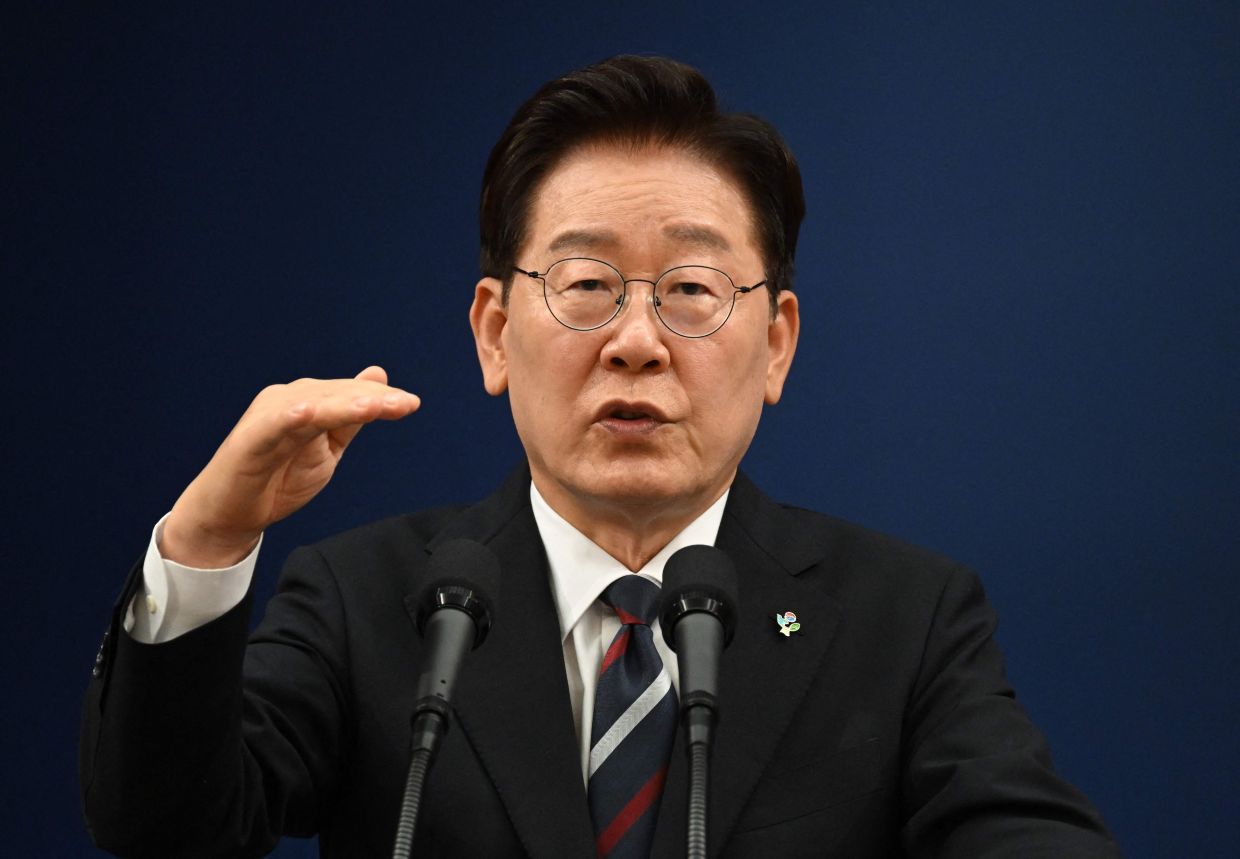
South Korea's newly inaugurated President Lee Jae Myung faces a sharp erosion of public confidence, with his approval rating slipping to 46.7 per cent by late June—marking the first occasion it has fallen below the symbolic 50 per cent threshold since he took office on June 4, 2025. The decline comes amid five consecutive weeks of deteriorating support, according to polling data from Realmeter released on June 22. More significantly, negative evaluations have surpassed positive assessments for the first time during his presidency, with disapproval reaching 49.7 per cent, whilst 3.6 per cent remained undecided. The margin between approval and disapproval remains within the survey's error tolerance, yet the psychological impact of crossing into negative territory is substantial for any newly elected leader attempting to establish governing legitimacy.
The trajectory of Lee's approval ratings reveals an alarming acceleration in public disaffection. Starting at 60.5 per cent during the second week of May, his standing deteriorated through June, dropping to 51.5 per cent by mid-month before the latest collapse. The intervening weeks showed ratings of 59.3 per cent, 59.1 per cent, and 55.2 per cent, illustrating a consistent downward gradient that suggests underlying systemic dissatisfaction rather than isolated incident-driven volatility. For context on South Korea's political history, Lee's trajectory differs markedly from recent predecessors. Former President Yoon Suk Yeol experienced approval-disapproval crossover in June 2022, roughly six weeks into his tenure—making Lee's five-month duration longer. By comparison, Park Geun-hye's ratings inverted approximately 16 months into her presidency in June 2014, whilst Moon Jae-in saw the same transition 19 months into his term in December 2018. This comparative analysis suggests Lee is experiencing a more rapid deterioration than typical for South Korean leaders.
Two primary factors drove the dramatic collapse according to Realmeter's analysis: the ballot shortage fiasco during June 3 local elections and intensifying factional disputes within his ruling Democratic Party of Korea as it prepares for an August 17 convention to elect a new party chair. The election management debacle particularly damaged public confidence, as voters interpreted the administrative failure as symptomatic of incompetent governance. The pollster observed that demands for accountability intensified following disclosure of the electoral irregularities, creating a political crisis that extended beyond the immediate election context into broader assessments of presidential competence. Simultaneously, the party's internal leadership struggle undermined the administration's capacity to project unified direction, with different factions publicly contesting the party's future direction whilst simultaneously expected to defend government policies.
Additionally, market-related concerns have eroded support among specific voter demographics that historically provide electoral support to centrist and progressive candidates. Widening asset price disparities—particularly concerning affordability and inequality—particularly weakened support in Greater Seoul metropolitan areas, traditionally viewed as politically volatile and sensitive to economic messaging. The pollster noted that despite some offsetting positive developments, including Lee's perceived successful European diplomatic mission and the Kospi index's breakthrough above the 9,000-point threshold, these achievements failed to counterbalance accumulated grievances regarding economic fairness and administrative competence.
Regional analysis reveals starkly differentiated erosion patterns across South Korea's geography. Lee's approval rating experienced its most dramatic collapse in the conservative strongholds of Daegu and North Gyeongsang Province, plummeting 9.9 percentage points to merely 34.6 per cent—a particularly troubling development since these regions represent traditional conservative voting blocs. In Greater Seoul, his support declined 7.6 percentage points to 44.8 per cent in Incheon and Gyeonggi Province and fell to 39.8 per cent in Seoul itself, also a 7.6 percentage point decrease. These metropolitan declines are particularly consequential given Seoul's substantial electoral weight and the region's historical significance as a bellwether for national political sentiment.
Demographic fracturing presents additional complications for Lee's political coalition. Support among moderate voters—typically representing the swing demographic most critical for presidential viability—declined 4.9 percentage points to 47.5 per cent, suggesting erosion within his intended political centre. Approval among liberals fell 3.2 percentage points to 80.4 per cent, demonstrating some persistence within the Democratic Party's traditional base despite internal conflicts. Notably, conservative disapproval proved more resilient, declining only 0.7 percentage points to 19.8 per cent, suggesting Lee never commanded substantial conservative backing and these voters' minimal withdrawal produced minimal statistical impact. The ideological arithmetic reveals Lee's presidency rests upon progressively weakening support from centre and left-leaning voters whilst never gaining conservative validation.
The presidential office responded to the polling collapse with carefully calibrated humility. Cheong Wa Dae issued a statement acknowledging the results and pledging heightened responsiveness to public concerns, framing the approval rating fluctuations as legitimate public assessment of both economic conditions and overall governance conduct. The statement's tone—emphasising acceptance and introspection—suggested the administration recognises the severity of public dissatisfaction whilst attempting to signal capability for course correction. Notably, the response avoided defensive posturing or dismissal of polling data, potentially attempting to preserve presidential credibility through apparent candour.
Parallel polling regarding party support dynamics reveals additional complexity within South Korea's political ecosystem. A separate Realmeter survey conducted among 1,001 voters on June 18-19 found the conservative People Power Party maintaining a narrow advantage over the Democratic Party for a second consecutive week, though the gap had narrowed substantially. Democratic Party support rose 2.1 percentage points to 40.1 per cent, whilst the People Power Party's backing slipped 2 percentage points to 42.3 per cent. These figures suggest potential parliamentary dynamics may tighten as midterm governing approaches, particularly concerning if Lee's presidential approval continues deteriorating.
The People Power Party confronts mounting challenges relating to the electoral administration crisis and internal leadership divisions. Realmeter analysis indicated the party experienced downward pressure from overlapping controversies surrounding ballot shortages, including contentious debates regarding full election reruns and abolition of early voting procedures. These technical electoral debates, typically arcane administrative matters, escaped specialist discourse to become mass political controversies, suggesting public frustration transcended procedural concerns to reflect fundamental anxieties regarding democratic institutional integrity. The conservative party's internal conflicts, particularly regarding calls for leadership resignation, fractured voter cohesion and accelerated exodus of younger voters—a particularly alarming trend given generational demographic projections.
Younger voter flight from conservative ranks appears particularly severe. Among voters in their 20s, People Power Party approval collapsed 10.5 percentage points to 48.6 per cent, whilst 30-something voters' support declined 5.1 percentage points to 47.4 per cent. This demographic haemorrhage threatens conservative electoral viability given Korea's aging population structure, where retention of younger voters constitutes long-term political necessity. The Democratic Party, conversely, experienced a modest rebound attributed partly to apparent crisis management following bipartisan agreement to launch National Assembly investigation into election administration failures. The pollster observed that despite persisting factional tensions, Democratic Party emphasis on organisational unity behind government success strengthened base support, suggesting that collaborative crisis response messaging could partially offset deeper dissatisfaction with Lee's personal leadership.
The Realmeter survey methodology involved 2,517 voters aged 18 and above, utilising automated response systems and conducted June 15-19, representing a reasonably robust sample capturing sentiment during the most acute political turbulence. The findings, whilst concerning for Lee's administration, reflect South Korea's volatile political environment where presidential approval ratings commonly fluctuate substantially during first-year governing. However, the specific trajectory—rapid deterioration, regional fracturing, demographic fracturing, and negative crossover—suggests Lee faces genuine structural challenges extending beyond cyclical political adjustment. The combination of electoral competence questions, party infighting, and economic fairness concerns creates particularly toxic political atmosphere unlikely to resolve through rhetorical repositioning alone, requiring instead substantive policy responses addressing public grievances regarding governance capacity and economic equity.