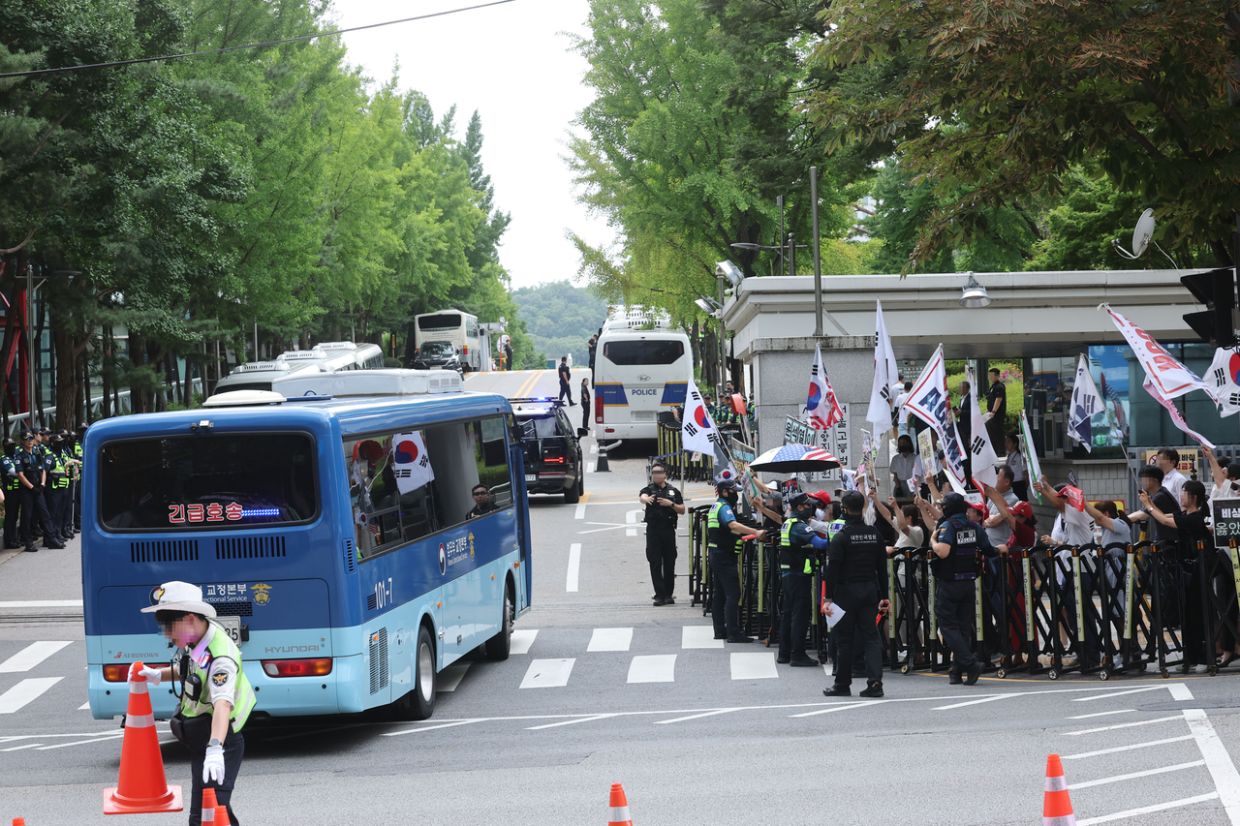
Former South Korean President Yoon Suk Yeol has been handed a two-year prison sentence by the Seoul Central District Court following his conviction for accepting free political polling services during his presidential campaign. The court determined that Yoon illegally received 14 surveys valued at 27.92 million won (approximately US$18,600) from political broker Myung Tae-kyun, constituting a clear breach of the Political Funds Act, which strictly regulates how candidates and political figures can accept contributions and services.
The conviction carries significant implications for South Korean electoral law enforcement and the broader question of campaign finance accountability. Judge Lee Jin-gwan emphasized in his ruling that opinion polls carry substantial weight in shaping voter behaviour and that their perceived credibility underpins the integrity of democratic processes. When political actors receive polling services outside the framework established by campaign finance legislation, and polling agencies supply research in exchange for political favours, the judge noted, the arrangement directly threatens to distort public opinion formation and compromises the fairness of elections themselves.
Prosecutors had initially charged Yoon with conspiracy, alleging that he and his former wife, ex-first lady Kim Keon Hee, had coordinated to receive 58 free surveys worth more than 270 million won across a nine-month period from June 2021 through March 2022. While the court did not convict on the full scope of the prosecution's allegations, it established through evidence that Kim had authorized Myung to control the timing, substance, methodology, and public release of polling information. The court found that Yoon was aware of this arrangement and implicitly approved it, establishing what amounted to a prolonged and unspoken understanding among all three parties regarding the delivery of polling services.
Central to the conviction was the court's finding that Yoon had promised Myung that former lawmaker Kim Young-sun would receive the People Power Party's presidential nomination in return for the surveys. The evidence indicated that after securing his own party's backing, Yoon subsequently leveraged his influence through Chang Je-won, his then chief of staff, to assist in securing Kim Young-sun's nomination within the party machinery. This quid pro quo arrangement—political favours exchanged for campaign services—formed a critical component of the court's reasoning, though the judge noted that proving such an explicit exchange was not strictly necessary to establish a violation of the Political Funds Act's provisions.
Myung Tae-kyun, the political broker who facilitated the arrangement, received an 18-month prison sentence and was taken into custody immediately following the verdict. His conviction underscores the court's determination to hold all parties accountable in campaign finance violations, extending liability beyond the politicians who benefit from such arrangements to the intermediaries who broker them. This aspect of the ruling signals a stricter enforcement posture regarding the shadow networks that often facilitate unofficial campaign support in South Korean politics.
The ruling creates an interesting procedural contrast with a parallel case involving Yoon's former wife. Kim Keon Hee faced separate charges related to the same polling services, but was acquitted in both her trial and subsequent appellate decisions on the related Political Funds Act charge. The courts in Kim's case determined that prosecutors had failed to establish that she received financial benefit equivalent to the survey costs or that the polling services were specifically conditional on securing Kim Young-sun's nomination. Judge Lee indicated that despite the overlapping circumstances, the legal findings in the two cases could not be treated as identical due to differences in how the prosecution framed the allegations and what evidence was presented regarding each defendant's involvement.
This divergence in outcomes between Yoon and Kim Keon Hee raises important questions about prosecutorial strategy and the application of campaign finance standards. The Supreme Court is scheduled to issue its definitive ruling in Kim's case on Thursday, which could potentially clarify the legal thresholds for conviction under the Political Funds Act or may maintain the lower courts' more lenient interpretation. Such inconsistency in judicial findings regarding what appears to be substantially similar conduct has prompted ongoing debate within South Korea about whether campaign finance laws are applied equitably or whether factors beyond the strict legal evidence influence outcomes.
The conviction represents a landmark moment in South Korean legal history, marking the first time a sitting or former president has been incarcerated following a criminal conviction and sentencing for campaign finance violations. The precedent carries weight not only for South Korea's immediate political landscape but also for regional governance standards. Other democracies in East and Southeast Asia, including those grappling with campaign finance oversight, will likely monitor how South Korea's appeals process unfolds and how such convictions affect broader electoral integrity efforts.
For Malaysian observers and those in other Southeast Asian nations, the Yoon case illustrates both the potential and limitations of legal mechanisms designed to constrain political corruption and enforce campaign finance discipline. South Korea's court system demonstrated willingness to pursue and convict a former head of state, suggesting institutional independence and commitment to rule of law. However, the parallel acquittal of Kim Keon Hee in related proceedings also reveals how fact-specific such cases become and how different judicial findings can emerge from seemingly similar circumstances, underscoring the inherent unpredictability of campaign finance litigation.
The broader context of this conviction includes heightened scrutiny of Yoon's presidency following his controversial declaration of martial law in December 2024, which triggered an immediate impeachment process. His conviction on campaign finance grounds now compounds his legal jeopardy, as he simultaneously faces multiple investigations and potential charges related to the martial law episode. These converging legal challenges have dramatically altered Yoon's post-presidential trajectory from that of most of his predecessors and created a politically volatile situation within South Korea that continues to unfold.

