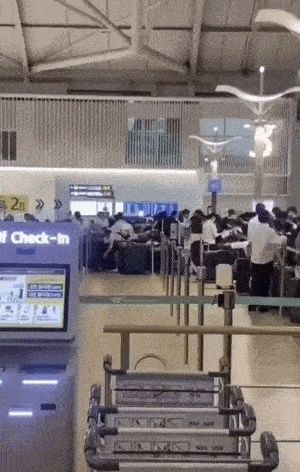
South Korea's busiest airport has moved to fortify its security infrastructure following a spate of disruptive incidents where suspected Chinese bulk traders overwhelmed departure hall queues, leaving airport workers hurt and forcing authorities to rethink crowd management protocols. Incheon Airport announced it would install reinforced barriers at airline check-in zones after a dramatic July 2 incident—captured on video and subsequently shared widely online—revealed dozens of travellers forcing their way past conventional queue dividers on the third floor of Terminal 1's departure section. The chaotic surge, where passengers shoved luggage carts across the serpentine belt barriers that typically funnel arrivals into orderly lines, sparked a wider review of airport safety measures and raised questions about how major Asian transport hubs can manage passenger flows during peak trading seasons.
The individuals involved in these incidents are believed to be daigou, a term referring to small-scale merchants who operate a well-established business model across Northeast Asia. These traders purchase heavily discounted duty-free merchandise at South Korean retailers, then transport large quantities back to China and other regional markets where they resell the goods at a profit. The practice has become sufficiently prevalent that airport staff have developed informal protocols to identify and manage these passengers, yet the incidents in July—five documented cases within a single month according to Yonhap News Agency—demonstrated that existing measures were inadequate to prevent dangerous congestion.
What distinguishes the daigou model from typical tourism or personal shopping is the volume and intent involved. These are not casual holiday travellers purchasing gifts or personal items; they are commercial operators moving inventory in bulk, often with specially coordinated luggage arrangements designed to maximise cargo capacity. The July 2 video starkly illustrated the problem: instead of respecting the zigzag barrier system designed to create visual separation and psychological spacing between queue segments, passengers treated the check-in area as an obstacle course, abandoning the designated path entirely to make a beeline for the counters. The urgency behind their actions reflects the competitive nature of their work—earlier arrivals at check-in can mean earlier departures and faster turnarounds for the next buying trip.
The human cost of these incidents has not been trivial. Multiple airline employees sustained injuries while attempting to redirect passengers back into proper queue formation, raising workplace safety concerns that extended well beyond the inconvenience factor. Airport authorities recognised that the integrity of their queuing system had been fundamentally compromised, and that cosmetic adjustments or verbal warnings alone would not restore order. The decision to install plastic partitions between existing retractable barriers represents a physical redesign intended to eliminate the sight lines and gaps that allow passengers to circumvent the system. By reducing the visual permeability of queue dividers and creating more substantial physical obstacles, airport management hopes to make queue-jumping both more difficult and more socially stigmatised.
The airport also attributed part of the congestion problem to decisions by airlines operating from Incheon to deploy larger aircraft on major trunk routes serving Chinese cities. The addition of roughly one hundred seats per flight on certain China-bound services has created scheduling pressures and heightened competition among passengers to secure early boarding and overhead bin space. Daigou traders, whose business model depends on rapid turnaround times and large cargo allowances, would naturally feel more acute pressure to position themselves advantageously within these expanded passenger manifests. This dynamic underscores how changes in fleet deployment and capacity planning can create unexpected downstream effects on terminal operations and passenger behaviour.
Interestingly, airport authorities noted that enforcement tightening within China itself has provided temporary relief from the phenomenon. Stricter regulatory measures implemented by Chinese authorities to monitor and restrict the daigou trade have reduced the number of traders departing South Korea during certain periods, effectively lowering demand pressure on check-in facilities. However, this reprieve appears cyclical rather than permanent, contingent on the stringency of enforcement policies across the border. Officials have acknowledged that similar surges could resume if regulatory pressure in China eases, necessitating sustained vigilance rather than assuming the problem has been solved.
For Malaysian readers and Southeast Asian observers, the Incheon Airport situation offers instructive parallels worth considering. Cross-border e-commerce, grey-market trading, and bulk purchasing have become increasingly sophisticated throughout the region, with hubs like Singapore's Changi Airport, Bangkok's Suvarnabhumi, and Kuala Lumpur International Airport all experiencing similar phenomena involving regional traders moving goods for online resale or informal distribution networks. The daigou model, while associated with Chinese traders, represents a broader trend of individuals leveraging international price differentials and duty-free regulations to create arbitrage opportunities. As airports across Southeast Asia expand capacity to accommodate regional growth, they may face comparable pressures on ground operations and queue management systems.
The incident also illustrates the tension between facilitating legitimate commerce and maintaining orderly, safe airport operations. Daigou traders are not engaged in smuggling or illegal activity in the strict sense; they are operating within legal frameworks, albeit sometimes at the edges of regulatory intent. Yet their behaviour, driven by economic logic and competitive incentives, creates externalities—safety risks, staff injuries, delays for other passengers—that airports must manage through infrastructure investment and policy design. This reflects a broader challenge facing busy regional hubs: how to preserve passenger flow efficiency while preventing the tragedy of the commons dynamics that emerge when individual commercial interest conflicts with collective transit needs.
Looking ahead, Incheon Airport's response strategy combines physical infrastructure upgrades with intensified human oversight. Beyond the planned plastic partitions, airline employees have increased their presence in departure halls to monitor crowd behaviour and intervene early when queue discipline begins to deteriorate. This dual approach—making queue-jumping physically harder while simultaneously increasing the social cost through visible enforcement—mirrors strategies employed at other high-volume Asian airports. The sustainability of this approach will depend on whether the infrastructure modifications prove cost-effective relative to the operational benefits gained, and whether staff resources allocated to enforcement monitoring can be maintained without degrading service quality for the broader passenger base.

