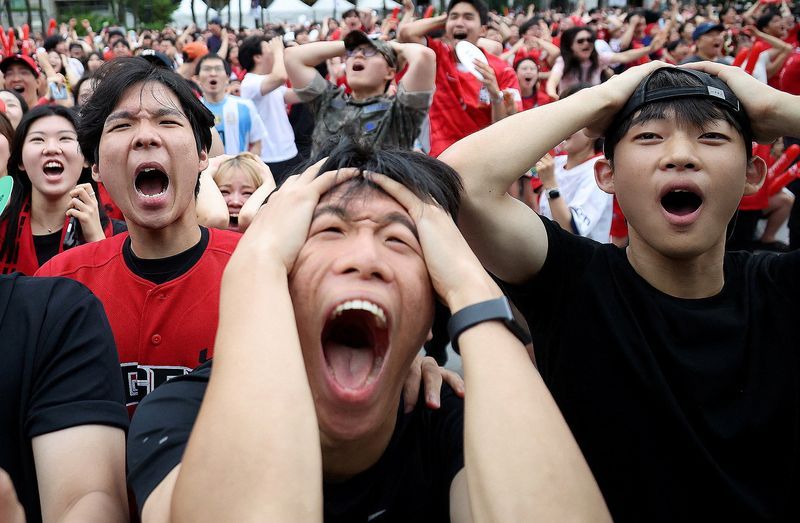
South Korea's political leadership has erupted in frustration following the national football team's shocking early elimination from the World Cup, with President Lee Jae Myung using unusually blunt language to express his bewilderment at a performance that has left the nation reeling. Speaking on social media platform X on Sunday, Lee declared himself "utterly baffled" by an outcome few had predicted, given that South Korea occupied what appeared to be a favourable group position heading into the competition. The presidential statement, rare for its vehemence, signals how deeply the sporting disappointment has cut through South Korean society and political circles.
The team's failure to progress stemmed from consecutive defeats to Mexico and South Africa, results that consigned South Korea to third place in Group A—a standing insufficient to secure passage to the tournament's knockout phase even as one of the eight best-performing third-place teams. The elimination represents a significant setback for a nation with considerable football pedigree in Asia and one accustomed to navigating group stages with relative comfort. Lee's immediate pivot from disappointment to institutional criticism reflects a broader narrative now gaining traction within South Korea: that structural failures within the national team's management apparatus bear primary responsibility for the debacle.
At the heart of the president's grievance lies the appointment and retention of coach Hong Myung-bo, a decision that has attracted controversy since Hong's reappointment to the position in 2024. Lee's public censure centres on broader allegations of favouritism and what he characterises as an opaque recruitment process lacking transparency and accountability. The presidential remarks invoke systemic concerns about South Korean institutions generally—the tension between personal connections and merit-based advancement, and the vulnerability of high-profile positions to patronage networks rather than rigorous competitive selection. Lee articulated this grievance in explicitly political terms, suggesting that when "us versus them" thinking supersedes competence, the consequences become predictable and damaging.
The scale of public discontent extends well beyond political commentary. A formal petition calling for Hong's dismissal, submitted through South Korea's national assembly website, rapidly accumulated the signatures necessary to trigger an official preliminary review. More viscerally, social media posts documenting shops displaying signs explicitly banning Hong from their premises have circulated widely, illustrating the depth of public anger directed at the coach. This grassroots hostility suggests the World Cup exit has crystallised wider frustrations about meritocratic failures within South Korean sports administration.
Lee's framing of the incident as symptomatic of broader institutional dysfunction carries significant weight given his political position. He characterised the root problem not merely as poor tactical or technical decisions on the field, but as fundamental governance failures within sports administration. His specific critique centres on how appointment authority operates without adequate oversight mechanisms, allowing individuals responsible for hiring decisions to escape meaningful accountability even when their choices produce catastrophic results. This analysis aligns the World Cup failure with wider debates about transparency and checks-and-balances within South Korean public institutions.
The presidential intervention has triggered a formal governmental response. Lee has explicitly requested that the Ministry of Culture, Sports and Tourism conduct a comprehensive investigation into the circumstances surrounding the World Cup exit, identify causal factors, and develop preventative measures to avoid similar failures. This action represents a significant escalation from general public criticism to formal state scrutiny, signalling that the football team's performance has become a matter of perceived institutional importance warranting government-level investigation. Such investigations typically examine not only on-field performance metrics but operational decision-making, resource allocation, and strategic planning within the national football programme.
The situation carries implications beyond sporting outcomes, touching on questions of public trust in institutional leadership more broadly. For Malaysian and Southeast Asian observers, the South Korean case illustrates how even nations with strong sporting traditions and robust institutional frameworks remain vulnerable to governance failures in specialised domains like football administration. The episode also demonstrates the political salience of sporting outcomes in East Asian societies, where national team performance carries resonances extending far beyond the pitch into questions of national competence and organisational effectiveness.
Hong's denials regarding allegations of favouritism have thus far failed to temper criticism, suggesting the controversy has transcended straightforward debates about coaching ability or tactical acumen. The appointment controversy predates the World Cup elimination; Korean media had previously scrutinised the hiring process as lacking transparency and potentially influenced by personal relationships rather than competitive merit. However, the team's subsequent failure to advance has transformed these procedural concerns into substantive indictments of the decision itself.
The investigation Lee has demanded will likely examine decision-making processes within Korean football's governing structures, examining whether established protocols for coach selection were followed and whether competing candidates received fair consideration. This procedural focus reflects a broader institutional learning objective: determining whether the World Cup failure stemmed from an isolated poor decision by Hong or whether systemic weaknesses in governance created conditions enabling such errors to occur repeatedly. For South Korean sports administration, the reputational stakes are considerable, as international audiences observe how the country responds to this crisis.
Looking forward, the investigation outcome will shape perceptions about whether South Korea's sports governance can self-correct and impose accountability on senior figures responsible for significant public disappointment. The intensity of public backlash suggests that merely replacing Hong without addressing underlying appointment and oversight mechanisms would likely prove insufficient to restore public confidence. Lee's intervention, while politically advantageous during a period of public frustration, commits his administration to pursuing substantive reforms that demonstrate institutional renewal.

