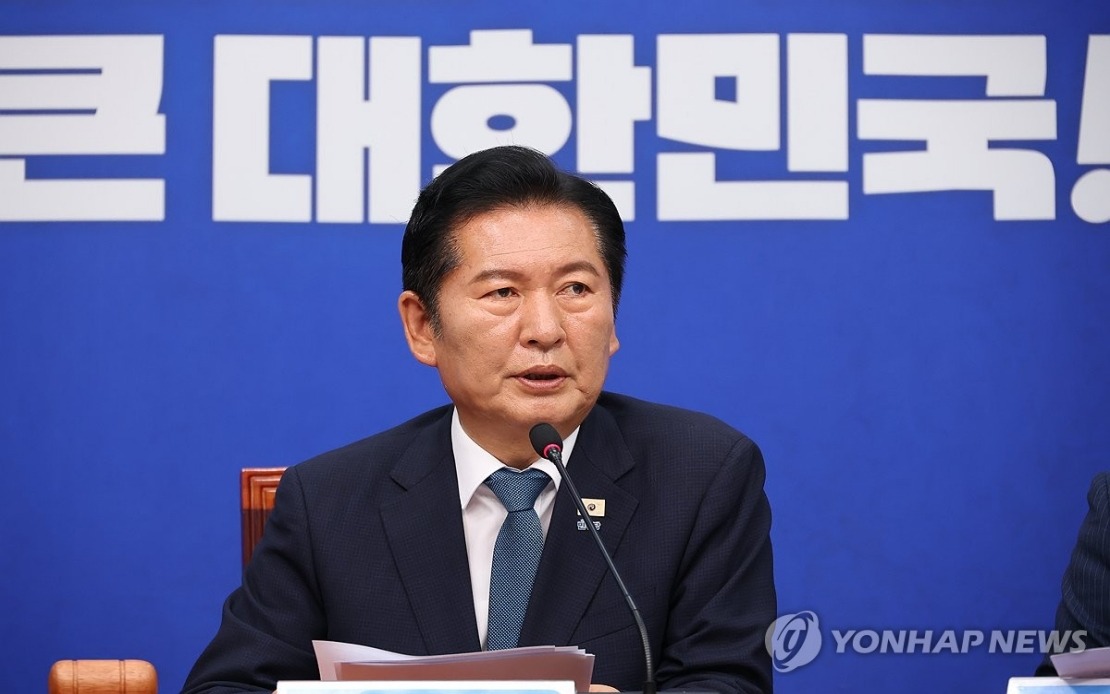
South Korean lawmaker Jung Chung-rae has stepped down as chairman of the ruling Democratic Party, a strategic move that signals his bid to seek re-election at the party's national convention scheduled for August 17. His resignation, announced during a meeting of the party's supreme council at the National Assembly on Wednesday, represents a calculated political manoeuvre within the Democratic Party's increasingly fractious leadership structure.
In his statement, Jung reflected introspectively on his tenure, acknowledging the personal toll of his position. He described enduring countless sleepless nights while reassessing both his personal conduct and political trajectory, suggesting a period of genuine deliberation rather than impulsive action. This framing sought to position his departure as a principled decision rooted in careful self-examination, a rhetorical device commonly employed by Korean politicians navigating sensitive transitions.
Throughout his remarks, Jung emphasised his unwavering commitment to supporting President Lee Jae Myung's administration and fostering cohesion between the ruling party, government structures, and the presidential office. He portrayed himself as a dedicated steward of party unity, someone who had consistently championed collaborative governance despite facing considerable internal and external opposition. This messaging appears designed to insulate him from criticism while simultaneously reminding party members of his loyalty to the sitting president.
Yet Jung's departure occurs against a backdrop of significant friction within the Democratic Party ranks. Certain pro-Lee faction members have publicly criticised his leadership approach, arguing that Jung has prioritised the interests of his hardline supporters over genuine partnership with the president on substantive policy matters. This criticism cuts to the heart of ongoing tensions between different power blocs within South Korea's ruling party, revealing the fault lines that characterise contemporary Korean politics.
The vacancy created by Jung's resignation has transformed the upcoming party convention into a genuinely competitive three-way contest. Beyond Jung himself, the race now includes Prime Minister Kim Min-seok, who enjoys strong backing from President Lee, and Song Young-gil, a former party leader with his own substantial political credentials. This constellation of candidates represents divergent visions for the party's direction and its relationship with the presidential office.
Song Young-gil has reportedly indicated to President Lee his intention to participate in the leadership race while simultaneously exploring the possibility of consolidating his candidacy with Prime Minister Kim. According to Democratic Party lawmaker Park Jie-won, who discussed the matter during an interview with radio broadcaster CBS, Song has contemplated strategic alignment with Kim as a means of strengthening their combined position. Such calculations highlight the intricate alliance-building that characterises Korean political contests, where coalitions frequently form and dissolve around specific candidates and policy platforms.
The mechanics of the transition underscore the party's procedural regularity. Democratic Party floor leader Han Byung-do will assume the role of acting party leader, maintaining organisational continuity until the August 17 convention determines the party's new direction. This interim arrangement ensures that the party machine remains functional during the interregnum, preventing the kind of leadership vacuum that might otherwise weaken the Democratic Party's standing or legislative effectiveness during a period of internal competition.
For Malaysian observers, this South Korean political development offers instructive parallels regarding intra-party dynamics and succession management within dominant ruling parties. Like Malaysia's own experiences with power transitions in established governing coalitions, South Korea's Democratic Party faces the challenge of balancing factional interests while maintaining public confidence in institutional governance. The questions animating the Korean contest—how to balance presidential authority with party autonomy, how to accommodate divergent interests within a governing coalition, and how to ensure orderly transitions—resonate across Southeast Asia.
The timing of this leadership struggle also carries implications for South Korean governance more broadly. With the August convention occurring amid ongoing policy debates and international relations challenges, the Democratic Party's internal competition could influence the government's ability to execute its legislative agenda. The outcome of the convention will determine whether the party moves toward greater alignment with presidential preferences or maintains a degree of independence within the ruling coalition.
Jung's resignation and subsequent re-election bid represent a gambit familiar to Korean politics: standing down to reset one's candidacy and present oneself as renewed to party members. Whether this strategy succeeds depends substantially on how effectively Jung can distinguish himself from his rivals while maintaining his established support base. The months leading to August will witness intensive campaigning within the party structure, reflecting the stakes involved in controlling the Democratic Party apparatus.
Ultimately, the Democratic Party's leadership transition illustrates the vibrant but often contentious nature of South Korean democratic competition. Rather than representing institutional weakness, these internal contests demonstrate the party system's capacity to accommodate multiple power centres and facilitate genuine contestation for leadership positions. The August convention will provide clarity on which faction and which vision ultimately prevails within Korea's ruling party.