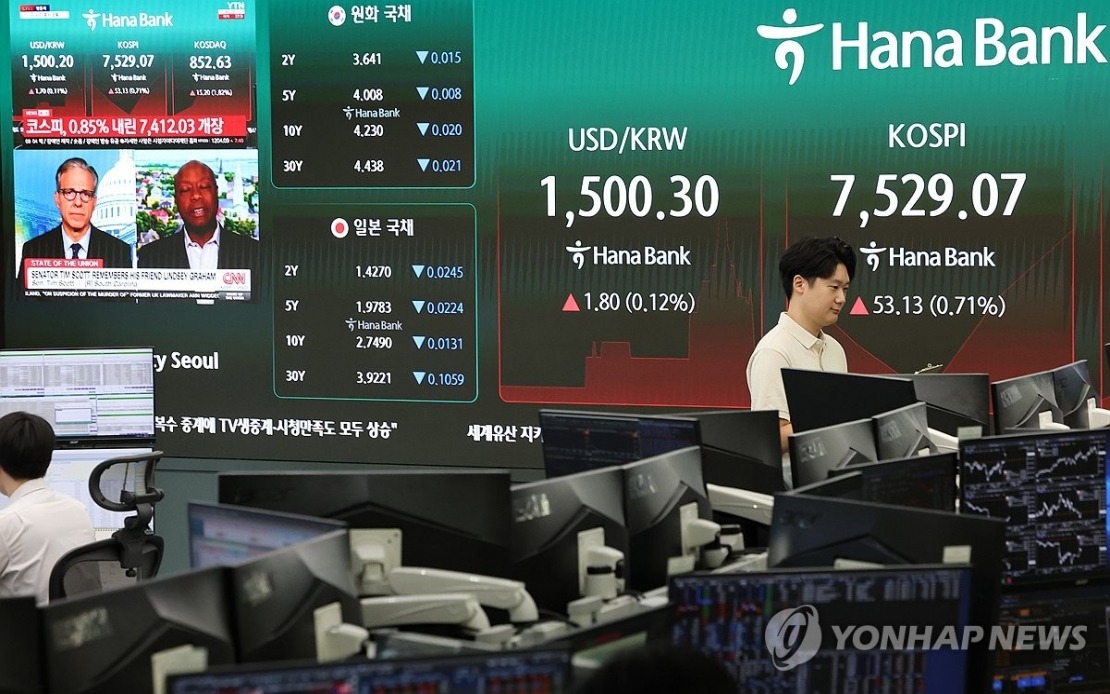
The Korea Exchange triggered a marketwide trading halt on Monday afternoon as investor sentiment deteriorated rapidly following renewed military confrontations between the United States and Iran. The automatic circuit breaker mechanism, designed to prevent panic selling during extreme market movements, was activated after the KOSPI benchmark index declined more than 8 percent from the previous trading session's closing level. Trading across KOSPI-listed shares ceased for twenty minutes beginning at approximately 1:28 p.m. local time, giving market participants an opportunity to reassess positions and restore orderly trading conditions.
Geopolitical developments in the Middle East have become an increasingly consequential driver of regional and global financial markets throughout 2024. The latest escalation in US-Iran hostilities, particularly surrounding control of the strategically vital Strait of Hormuz, sent shivers through equity markets across Asia and beyond. For South Korean investors and corporations, such disruptions carry particular significance given the nation's substantial dependence on energy imports and its substantial trading relationships throughout the Middle East region. The sharp market reaction underscores how quickly investor confidence can evaporate when geopolitical risks intensify without clear resolution pathways.
This represents the seventh instance in 2024 that the Korea Exchange has needed to activate its circuit breaker mechanism, a statistic that reflects the heightened volatility characterising global markets this year. The increasing frequency of these automatic trading halts suggests that investors remain exceptionally skittish about multiple risk factors simultaneously—from macroeconomic uncertainties to supply chain disruptions tied to regional conflicts. For Malaysian and Southeast Asian observers, South Korea's market turbulence offers important lessons about how vulnerabilities in one region's financial ecosystem can propagate quickly through interconnected trading networks.
The circuit breaker system represents a crucial safeguard that exchanges worldwide implemented following the 1987 Black Monday crash, when markets suffered devastating losses within hours. By pausing trading when indices move sharply downward, the mechanism creates space for cooler heads to prevail and prevents algorithmic selling from accelerating into full-blown panic. South Korea's decision to implement such protections reflects international best practices adopted across major financial centres. However, the seventh activation this year suggests that underlying market anxiety extends well beyond temporary shocks, pointing instead to deeper concerns about economic trajectories and geopolitical stability.
Investor caution surrounding Middle East tensions reflects legitimate concerns about energy security and shipping routes. Approximately one-third of all globally traded petroleum passes through the Strait of Hormuz annually, making any disruption to maritime traffic potentially consequential for oil prices and downstream economic activity. South Korea, which imports virtually all its crude oil requirements, faces direct exposure to such supply disruptions. The anticipatory market response visible on Monday morning likely reflected calculations about potential supply constraints, insurance premiums, and operational uncertainties that could plague global trade.
Beyond the immediate shock of heightened US-Iran tensions, the KOSPI's weakness also hints at broader economic headwinds confronting South Korea. Manufacturing export orders have faced persistent softness, particularly in semiconductor and electronics sectors where the nation maintains dominant global positions. Combined with demographic pressures and rising geopolitical tensions on the Korean Peninsula itself, South Korean equities face multiple overlapping challenges that justify investor defensiveness. The circuit breaker activation therefore serves as a visible indicator of these accumulating stresses rather than a singular response to Middle East developments.
For regional observers including Malaysian investors and policymakers, South Korea's market volatility carries instructive implications about financial system resilience and interconnectedness. Malaysian corporations with exposure to Korean supply chains or South Korean investments in Malaysia could face secondary effects as Korean companies potentially curtail expansion plans or redirect capital in response to market uncertainty. Additionally, Malaysian financial institutions holding South Korean securities face potential valuation pressures that mirror the broader Asian equity market sentiment.
The timing of this circuit breaker activation, arriving at midday Seoul time, demonstrates how geopolitical news cycles can disrupt trading during peak activity windows when the largest volumes typically occur. Had tensions escalated during overseas trading sessions, the impact might have rippled through multiple regional exchanges sequentially. The twenty-minute trading halt provided crucial breathing room, though it remains unclear whether such mechanical pauses genuinely restore calm or merely postpone inevitable selling pressure.
Looking forward, South Korea's financial authorities face ongoing questions about whether circuit breakers sufficiently protect market integrity or whether additional safeguards merit consideration. Some policymakers advocate for enhanced cooling-off provisions during geopolitical crises, while others argue that markets function most efficiently when price discovery proceeds unobstructed. The Korea Exchange's operational performance throughout 2024 will likely inform subsequent discussions about optimal crisis management protocols. Such debates resonate throughout Southeast Asia, where regulators must balance market efficiency against investor protection objectives.

